
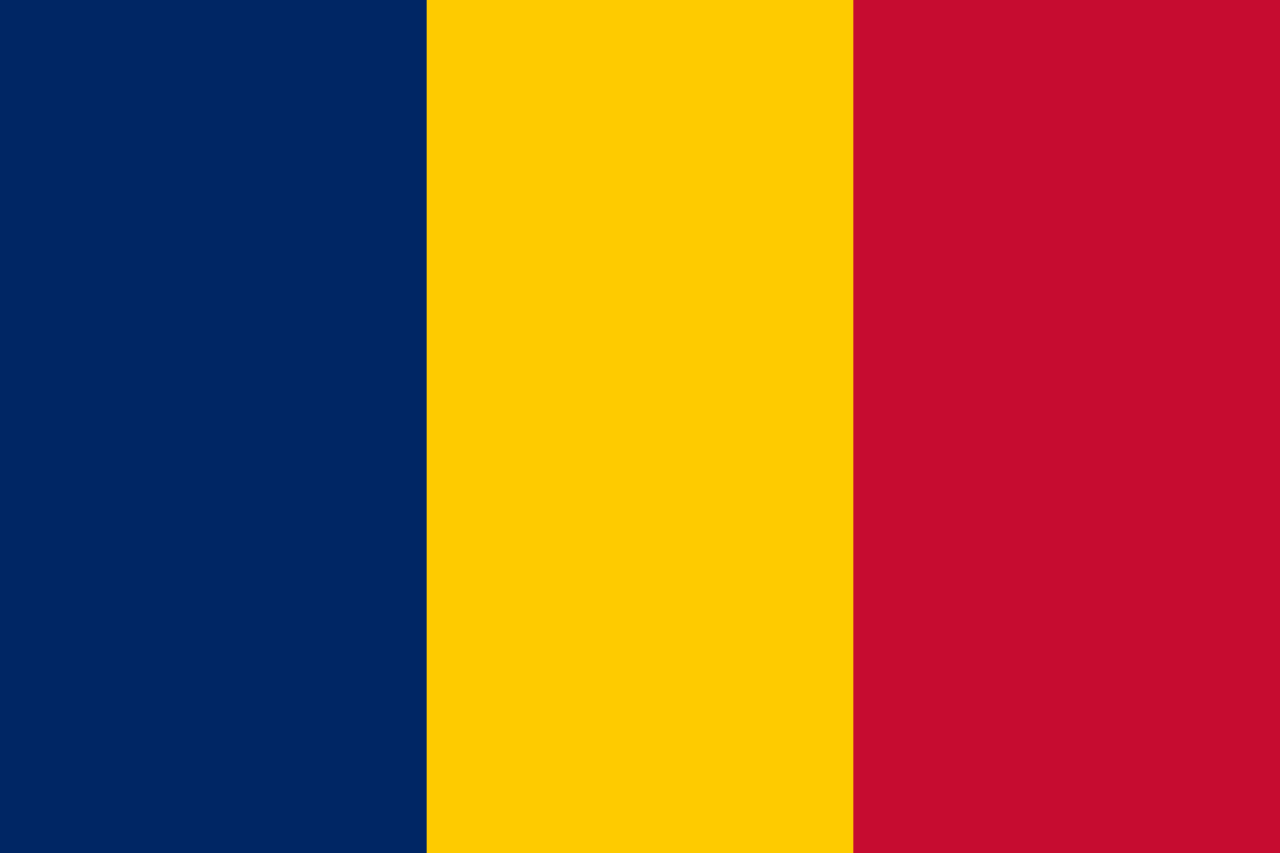
Tucked into the dead center of the African continent, Chad is a landlocked giant that swings from the shimmering dunes of the Sahara in the north to green savanna and seasonal swamps in the south. It is named after a lake that is vanishing, ruled from a capital twice burned and rebuilt, and home to ancient rock art that predates the pyramids. Here are ten facts that reveal why Chad is one of the most surprising and underappreciated countries on Earth.
1. It Is the "Dead Heart of Africa"
Chad is one of the largest countries in Africa, the fifth-biggest on the continent and the world's 20th-largest nation, covering roughly 1.28 million square kilometers. It is entirely landlocked, with the nearest seaport more than 1,500 kilometers away on the coast of Cameroon. Because it sits so deep in the continental interior, geographers sometimes call it the "Dead Heart of Africa." This remoteness has shaped everything about the country, from its trade routes to its history. Goods, ideas, and armies have for millennia traveled overland across vast distances, and even today getting cargo in and out of Chad remains an expensive logistical challenge that influences its entire economy. You can learn more in our country guide.
2. A Country Named After a Disappearing Lake
Chad takes its name from Lake Chad, once one of the largest lakes in Africa and a lifeline for tens of millions of people across four nations. The word "chad" comes from a local term meaning "large expanse of water," which is deeply ironic today. Since the 1960s, the lake has shrunk by an estimated 90 percent due to drought, climate change, and heavy irrigation. What was once an inland sea spanning around 25,000 square kilometers has fragmented into a fraction of its former size. The lake's decline is one of the world's most dramatic environmental stories, threatening fishing, farming, and herding communities that have depended on its waters for generations.
3. N'Djamena, the Capital That Rose From the River
Chad's capital, N'Djamena, sits on the banks of the Chari River near the Cameroonian border. Founded by the French in 1900 as Fort-Lamy, it was renamed N'Djamena in 1973, a name drawn from a nearby village meaning "place of rest." The city is the country's commercial and administrative heart, a sprawling, dusty metropolis of over a million people where camels and modern vehicles share the roads. N'Djamena has weathered enormous hardship, including being heavily damaged during civil conflicts in the late twentieth century. Today it serves as Chad's gateway to the world, hosting government ministries, markets brimming with grain and livestock, and a vibrant blend of cultures from across the Sahel.
4. Home to More Than 200 Ethnic Groups
With a population of roughly 21.6 million, Chad is a mosaic of more than 200 distinct ethnic groups, making it one of the most culturally diverse countries in Africa. The north and east are dominated by Muslim, often nomadic or semi-nomadic peoples such as the Arabs, Toubou, and Zaghawa, while the south is home to settled, largely Christian and animist farming communities like the Sara. This north-south divide is more than cultural; it has fueled political tensions throughout Chad's modern history. Yet it also gives the country an extraordinary tapestry of traditions, music, and dress that few other nations can match.
5. Two Official Languages and Over 100 More
Chad recognizes two official languages: French, a legacy of colonial rule, and Arabic, reflecting the strong Islamic influence across the north and the Sahel. Beyond these, more than 100 indigenous languages are spoken throughout the country. One of the most fascinating is Chadian Arabic, a distinct dialect that functions as a common tongue in markets and on the streets, allowing people from wildly different backgrounds to communicate. This linguistic richness mirrors Chad's ethnic diversity and means that many Chadians grow up speaking several languages fluently, switching effortlessly depending on whether they are at school, in the mosque, or trading at a busy market stall.
6. Ancient Rock Art Older Than the Pyramids
In the remote Ennedi Plateau and the Tibesti Mountains of northern Chad lie thousands of prehistoric rock paintings and engravings, some dating back more than 7,000 years. These images depict cattle, antelope, hunters, and even crocodiles and hippos, proof that the now-arid Sahara was once a green, water-rich landscape. The Ennedi Massif, a UNESCO World Heritage Site, is a labyrinth of sandstone arches, canyons, and towers sculpted by wind and water over millions of years. Among its wonders is the Aloba Arch, one of the tallest natural arches on the planet. This open-air gallery offers an astonishing window into a vanished world and the people who once thrived there.
7. The Sahara Meets the Sahel Meets the Tropics
Few countries pack as much ecological variety into their borders as Chad. The north is true Sahara Desert, including the Tibesti Mountains, home to Emi Koussi, an extinct volcano that is the highest peak in the Sahara at around 3,415 meters. Moving south, the landscape shifts into the semi-arid Sahel, then into wetter savanna and tropical zones near the rivers. This gradient creates dramatically different ways of life, from desert nomads herding camels to southern farmers cultivating cotton and sorghum. The contrast between the lifeless dunes of the north and the green, river-fed south is one of the most striking transitions found anywhere on the African continent.
8. Oil Transformed Its Economy
For most of its history, Chad relied on agriculture and cattle, with cotton as its main export. That changed dramatically in 2003, when a massive pipeline opened to carry Chadian crude oil more than 1,000 kilometers to the coast of Cameroon for export. Oil quickly became the backbone of government revenue and the country's dominant export. Despite this resource wealth, Chad remains one of the world's poorest nations, and much of the population still depends on subsistence farming and herding. The gap between oil riches and everyday hardship is one of the central challenges facing the country as it tries to build a more stable and diversified future.
9. A Wildlife Comeback Story in Zakouma
Zakouma National Park in the southeast is one of Africa's great conservation success stories. In the 2000s, rampant poaching nearly wiped out its elephants, with the population crashing from thousands to a few hundred. Through intensive anti-poaching efforts, elephant numbers have since stabilized and begun to recover. The park also shelters lions, giraffes, buffalo, and vast flocks of birds, including spectacular concentrations during the dry season. Further north, the Ennedi region is a refuge for a tiny relict population of desert crocodiles, survivors from the era when the Sahara was green. These protected areas show that even in a country with limited resources, remarkable nature endures.
10. Camel Racing and a Passion for Football
Sport and tradition blend in fascinating ways across Chad. In the desert north, camel racing and horsemanship remain prized skills tied to nomadic heritage, while wrestling is a celebrated traditional sport in the south, drawing large, enthusiastic crowds. Like much of Africa, football is wildly popular, played on dusty pitches in every town and followed passionately during international tournaments. Chad's vibrant culture also shines through its music, with rhythms and instruments such as the balafon and various drums accompanying ceremonies and celebrations. To round out your knowledge of the nation's symbols, take a look at our piece on the Chadian flag.
Frequently Asked Questions
What is the capital of Chad?
The capital of Chad is N'Djamena, located on the Chari River near the border with Cameroon. Founded in 1900 as Fort-Lamy and renamed in 1973, it is the country's largest city and serves as its political, commercial, and cultural center, with a population of over a million people.
What is Chad famous for?
Chad is best known for Lake Chad, the shrinking lake that gave the country its name, and for its stunning desert landscapes, including the Ennedi Plateau and the Tibesti Mountains. It is also famous for its ancient Saharan rock art, its enormous ethnic diversity, and Zakouma National Park's wildlife recovery.
Was the Sahara in Chad ever green?
Yes. Thousands of years ago, the now-arid regions of northern Chad were lush and full of water. Prehistoric rock paintings in the Ennedi and Tibesti areas show cattle, hippos, and crocodiles, and tiny populations of desert crocodiles still survive today as living relics of that wetter, greener past.
Conclusion
Chad defies easy summary. It is a land of vanishing lakes and ancient art, of towering desert volcanoes and recovering elephant herds, of more than 200 peoples speaking over 100 languages. Often overlooked and rarely visited, this vast country at the heart of Africa holds some of the continent's most extraordinary stories. The ten facts here are only a starting point, an invitation to keep exploring one of the world's most fascinating and least-known nations.