
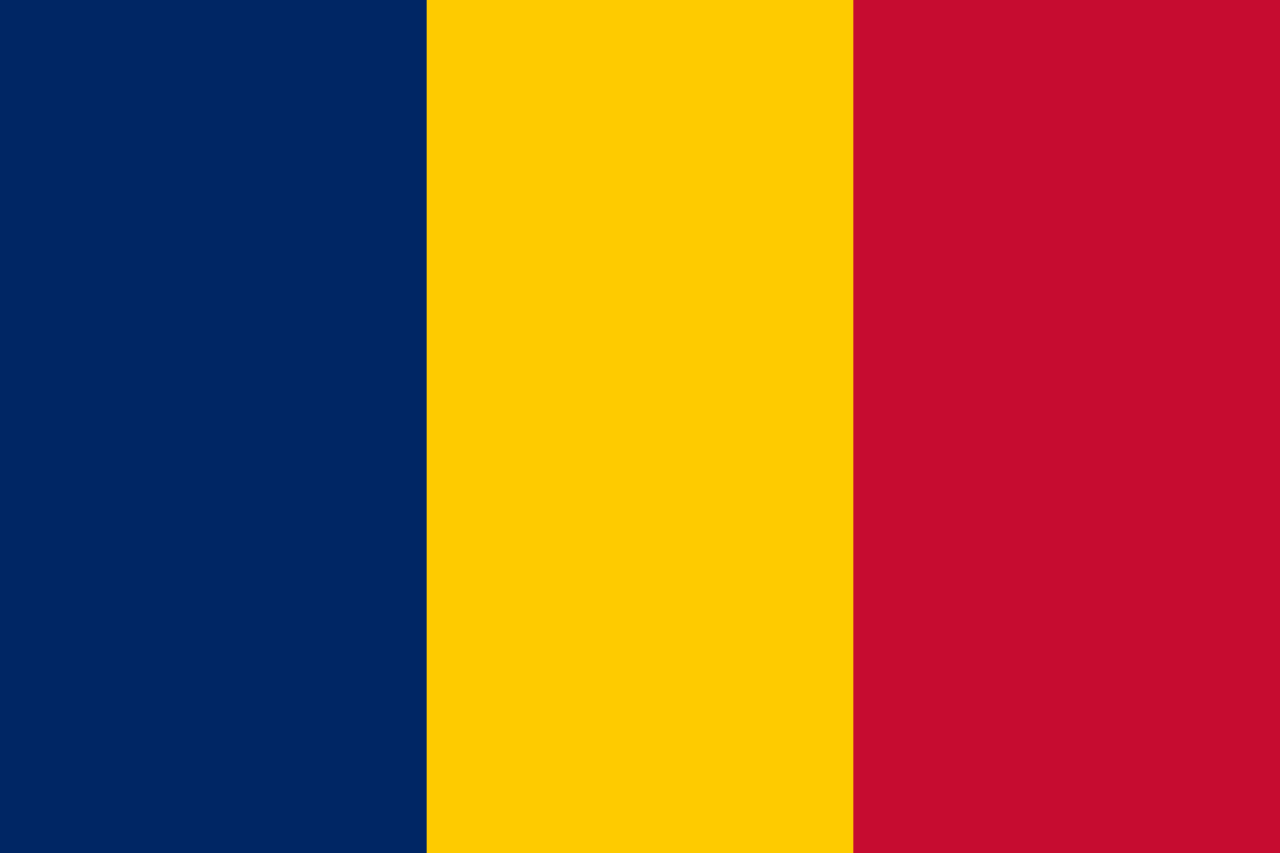
Three bands of color stand side by side on the flag of Chad: a deep blue, a warm golden yellow, and a vivid red. At first glance it looks simple, but this vertical tricolor carries the weight of a young nation's hopes and a continent's struggle for self-determination. Flown over the deserts of the north and the savannas of the south alike, Chad's banner is a study in how a handful of colors can hold an entire identity.
A Tricolor Born at Independence
Chad adopted its national flag in 1959, on the eve of full independence from French colonial rule, which arrived the following year. The choice of a vertical triband was no accident. France's own tricolore had shaped the visual vocabulary of its colonies, and many emerging African states drew on that format while pouring new meaning into the panels. Chad's flag is exactly that hybrid: a French structural idea filled with distinctly African symbolism.
Before independence the territory was part of French Equatorial Africa, a colonial federation governed from afar, and the only flag that flew officially was that of France itself. As the federation dissolved at the close of the 1950s, each territory faced the same question: what symbol should stand for a people about to govern themselves?
Chad's answer drew on the Pan-African color tradition, the family of hues newly free African states adopted to signal solidarity and a break from European rule. An early proposal reportedly used green, yellow, and red, the classic Pan-African combination derived from Ethiopia. That scheme, however, would have clashed almost exactly with the flag of neighboring Mali. To stay distinct, Chad swapped the green panel for blue, producing the blue-yellow-red arrangement still in use today. The result reaches back toward the continent's own palette while acknowledging the political world it was stepping out of, a flag that feels at home alongside its neighbors yet remains firmly its own.
What the Colors Mean
Each of the three vertical bands speaks to a different facet of Chadian life and aspiration:
- Blue, on the hoist side, represents the sky and the hope of a nation looking forward. It also evokes the waters and the agricultural south, where rainfall sustains life.
- Yellow, in the center, stands for the sun and the golden expanses of the Sahara and Sahel that stretch across the country's vast north.
- Red, at the fly, honors sacrifice and the bloodshed of those who fought and labored for independence and national unity.
Together the trio sketches the geographic and emotional contours of Chad. Read from the pole outward, the bands even move from the rain-fed south toward the desert north and finally to the price of nationhood, so the flag can be experienced almost as a journey across the land it represents.
The Design and Its Layout
The flag is a clean vertical triband of three equal panels. The blue band sits nearest the flagpole, yellow occupies the middle, and red runs along the outer edge. There is no central emblem, no star, no coat of arms, which gives the design a calm, balanced confidence. Its strength lies entirely in its proportions and colors. The official ratio of height to length is 2:3, which helps the three vertical fields read as crisp, even columns.
This restraint is deliberate. Where some national flags crowd in heraldry and lettering, Chad lets three bold fields do all the talking. The simplicity makes it instantly recognizable at a distance and easy to reproduce. It also ages well: with no portrait, slogan, or ruler's emblem to revise, the design has survived decades of political turbulence untouched, a rare constant in a country that has otherwise seen its institutions reshaped many times over.
A Flag With a Famous Twin
Chad's banner is the subject of one of the most discussed coincidences in vexillology. It is nearly identical to the flag of Romania, a country thousands of kilometers away on a different continent. Both use a vertical blue-yellow-red tricolor, close enough that the two nations have on occasion raised the matter at international forums. The shades differ subtly, with Chad's blue often leaning toward a deeper indigo, but to the casual observer they can be hard to tell apart. The matter drew real diplomatic attention in 2004, when Chad reportedly asked the United Nations to examine the near-duplication; Romania declined to change, noting its tricolor traditions reached back to the nineteenth century.
The likeness is essentially coincidental. Romania's colors descend from its historic principalities, while Chad's emerged from mid-twentieth-century African independence and the need to differ from Mali. For Chad, the resemblance has become a point of curiosity and even mild pride, a reminder that a flag's meaning lives in the story a nation attaches to it rather than in the colors alone.
The blue-yellow-red family is, in fact, surprisingly crowded. Andorra and Moldova share the same vertical arrangement but add central emblems that set them apart at once, and it is precisely that absence of a charge that leaves Chad and Romania looking like mirror images. It is a neat illustration of why so many modern flags add a star, crest, or symbol: a distinguishing mark is often the only guarantee of uniqueness.
Cultural Significance and National Identity
For a country as varied as Chad, where dozens of ethnic groups and languages coexist across desert, savanna, and lake, a shared national symbol matters enormously. The flag functions as common ground, appearing on government buildings, identity documents, and currency, and accompanying citizens through public life.
Because the colors map onto the land itself, the flag resonates with people regardless of which corner of the country they call home, serving as a unifying emblem in a nation that has known its share of upheaval. To understand the landscapes and peoples those colors represent, the chad country guide offers a fuller picture of the country behind the flag.
The Flag in Modern Life
Today the flag is woven into the rhythm of Chadian public life. It is raised on Independence Day, marked on 11 August, and on Proclamation of the Republic Day on 28 November, flown at official ceremonies, and carried by athletes representing Chad at international competitions. Children encounter it in classrooms, and it flutters above border posts and embassies.
In sport especially, the blue-yellow-red appears on jerseys and is waved in the stands, transforming an abstract emblem into a living rallying point. The national football team, nicknamed Les Sao after an ancient civilization of the region, takes the field in the same palette. Whether at a diplomatic summit or a stadium, the tricolor does the quiet work that flags do everywhere: it says, simply and unmistakably, this is us.
Interesting Facts About the Flag of Chad
- The flag was adopted in 1959, just before independence in 1960.
- An early draft used the green-yellow-red Pan-African scheme, but blue replaced green to avoid clashing with Mali's flag.
- Its layout borrows the vertical triband of the French tricolore while filling it with African meaning.
- It is famously almost identical to Romania's flag, differing mainly in the shade of blue.
- The flag carries no emblem, star, or text, relying entirely on three equal color bands in a 2:3 ratio.
- The colors double as a map of the country: blue for the watered south, yellow for the northern desert, red for the sacrifice of independence.
Frequently Asked Questions
When was the flag of Chad adopted?
Chad adopted its national flag in 1959, shortly before the country achieved full independence from France in 1960. The design has remained consistent ever since.
What do the colors of the Chad flag mean?
The blue band stands for the sky and hope, the yellow band represents the sun, and the red band symbolizes sacrifice. Read together, the colors also evoke Chad's geography, from its southern skies and waters to its sun-baked northern deserts.
Why does Chad's flag look like Romania's flag?
Both countries use a vertical blue-yellow-red tricolor, and the resemblance is essentially coincidental, arising from two independent design traditions. The shades of blue differ slightly, with Chad's often described as darker, but the two flags are strikingly similar.
Why is the flag blue, yellow, and red instead of green, yellow, and red?
An early version of the flag used the green-yellow-red combination common across Pan-African flags, but that scheme would have closely matched the flag of neighboring Mali. To keep its banner distinct, Chad replaced green with blue, producing the blue-yellow-red tricolor used today.
What continent is Chad on?
Chad is a large landlocked country in north-central Africa, bordering the Sahara in the north and more fertile savanna in the south. Its flag's colors reflect that sweep of landscapes.