
Wedged between the towering Himalaya and the steamy plains of the Ganges, Nepal packs an almost impossible amount of variety into a country roughly the size of Arkansas. It is a land where you can stand beside the world's tallest mountain in the morning and watch a one-horned rhinoceros graze in subtropical jungle by afternoon. Here are ten facts that capture why this small Himalayan nation punches so far above its weight.
1. Eight of the World's Ten Highest Peaks Sit Here
Nepal is mountaineering's holy grail. Of the fourteen peaks on Earth that rise above 8,000 meters, eight are wholly or partly within Nepal's borders, including Mount Everest (Sagarmatha) at 8,849 meters, the planet's highest point. Others include Kanchenjunga, Lhotse, Makalu, Cho Oyu, Dhaulagiri, Manaslu, and Annapurna I. This concentration is no accident: Nepal sits on the collision zone where the Indian tectonic plate slams into the Eurasian plate, an ongoing crunch that still pushes the Himalaya a few millimeters higher every year. For trekkers, the country offers everything from gentle foothill walks to the legendary, oxygen-thin approach to Everest Base Camp. To learn more about the nation's geography, see our country guide.
2. Nepal Has the Only Non-Rectangular National Flag
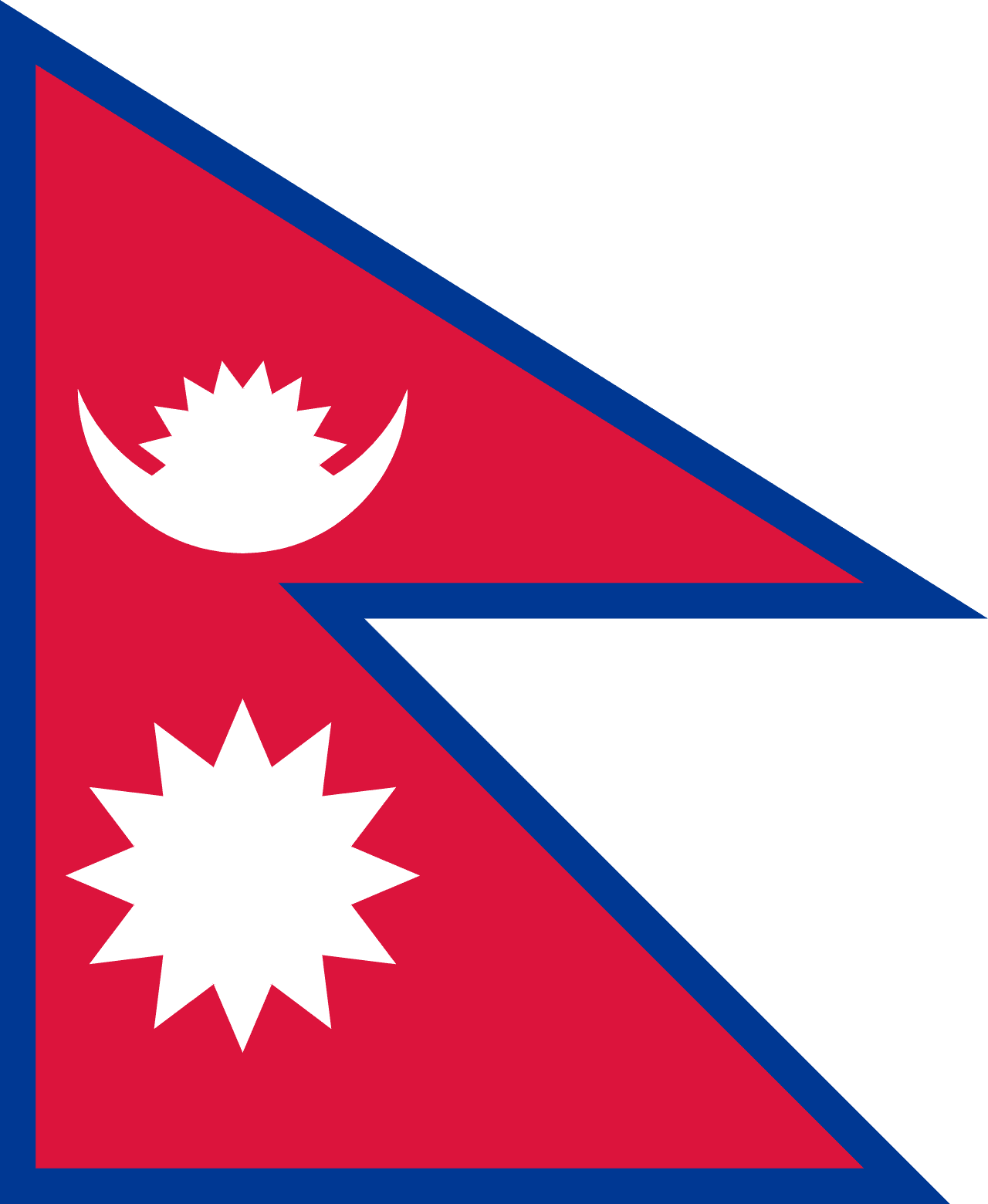
Look at the flags of the world and one immediately breaks the mold. Nepal's flag is a unique double pennant, two stacked triangles, making it the only national flag on Earth that is not a quadrilateral. The shape echoes the Himalayan peaks themselves, while the crimson background represents the rhododendron, Nepal's national flower, and the blue border symbolizes peace. The white moon and sun emblems express a hope that the nation will endure as long as those celestial bodies. The flag's exact construction is even spelled out with geometric instructions in the country's constitution. Discover the symbolism in detail in our piece on the flag of Nepal.
3. It Was Never Colonized
While Britain colonized neighboring India and most of South Asia, Nepal remained independent throughout the colonial era, a point of enduring national pride. The mountainous terrain made conquest costly, and the fierce reputation of Nepali fighters did the rest. After the Anglo-Nepalese War (1814–1816) and the resulting Treaty of Sugauli, the British East India Company gained respect for Nepali soldiers rather than control of the country. That respect gave rise to the famed Gurkha regiments, who have served in the British and Indian armies for more than two centuries and are renowned worldwide for their courage and their curved kukri knives.
4. The Birthplace of the Buddha
Siddhartha Gautama, the spiritual teacher who became the Buddha, was born around the 6th century BCE in Lumbini, in the southern Nepali plains. Today Lumbini is a UNESCO World Heritage Site and one of the most sacred pilgrimage destinations in the Buddhist world, drawing devotees from across Asia and beyond. The Maya Devi Temple marks the traditional birth spot, surrounded by ancient ruins, monasteries built by different nations, and a sacred pond. Nepal is one of the few countries where Hinduism and Buddhism have coexisted and intertwined for millennia, with many temples and rituals shared by both faiths.
5. Kathmandu Valley Holds Seven World Heritage Sites
The capital, Kathmandu, anchors a valley so dense with monuments that UNESCO lists seven separate sites within it. These include the ancient royal squares (Durbar Squares) of Kathmandu, Patan, and Bhaktapur, the Buddhist stupas of Boudhanath and Swayambhunath (the famous "Monkey Temple"), and the Hindu temples of Pashupatinath and Changu Narayan. The valley was once a string of competing Malla kingdoms, and their rivalry produced an extraordinary flowering of Newari art, pagoda architecture, and intricate woodcarving. Despite damage from the devastating 2015 earthquake, painstaking restoration has revived much of this living museum of medieval craftsmanship.
6. A Stunningly Diverse Population
Nepal is home to roughly 29 to 30 million people, but the headline number hides remarkable diversity. The country recognizes more than 120 distinct languages and well over 100 ethnic and caste groups, from the Newar artisans of the Kathmandu Valley to the Sherpa mountaineers of the high Himalaya and the Tharu of the lowland Terai. Nepali, written in the Devanagari script, is the official language and lingua franca, but Maithili, Bhojpuri, Tamang, and many others thrive alongside it. This mosaic of peoples gives Nepal a cultural richness that far outsizes its modest geographic footprint.
7. Dal Bhat Powers the Nation
Ask any Nepali about food and you'll hear the cheerful mantra "Dal bhat power, 24 hour." Dal bhat, lentil soup poured over steamed rice and served with vegetable curry, pickles, and often greens, is the daily staple eaten by most people twice a day. It is hearty, balanced, and traditionally refilled until you are full. Nepal's other culinary star is the momo, a steamed or fried dumpling stuffed with meat or vegetables that arrived via Tibetan influence and is now a national obsession. Round it out with sel roti, a sweet ring-shaped rice doughnut fried for festivals, and you have a cuisine shaped by altitude, geography, and centuries of cultural exchange.
8. Time Runs 45 Minutes Off the Hour
Most of the world keeps time in neat one-hour offsets from GMT, but Nepal famously sits at UTC+5:45, one of only a handful of places on Earth with a 45-minute offset. The standard is set to local solar time at a mountain near Kathmandu, meaning Nepal is fifteen minutes ahead of neighboring India. Travelers crossing the border have to nudge their watches by that odd quarter-hour. It is a small quirk, but a perfect example of Nepal's habit of doing things on its own terms rather than following the global default.
9. From Mountains to Jungle and One-Horned Rhinos
Nepal's elevation plunges from the 8,849-meter summit of Everest to lowlands barely 60 meters above sea level, all within about 200 kilometers. That dramatic range creates an extraordinary spread of ecosystems and wildlife. In the subtropical Terai, Chitwan National Park shelters greater one-horned rhinoceroses, Bengal tigers, and gharial crocodiles, while the high mountains hide elusive snow leopards and red pandas. Nepal has become a conservation success story, having doubled its wild tiger population in recent years and recorded long stretches with zero rhino poaching. For a country so famous for rock and ice, its jungles are an unexpected delight.
10. One of the World's Youngest Republics
Nepal was the world's last Hindu kingdom until startlingly recently. After a decade-long Maoist insurgency and mass pro-democracy protests, the centuries-old monarchy was formally abolished in 2008, transforming Nepal into a federal democratic republic. A new constitution adopted in 2015 reorganized the country into seven provinces and enshrined secularism and federalism. This makes Nepal one of the youngest republics on the planet, a nation still actively writing the next chapter of a history that stretches back thousands of years to the Kathmandu Valley's ancient dynasties.
Frequently Asked Questions
What is the capital of Nepal?
The capital is Kathmandu, the largest city and the cultural, political, and economic heart of the country. It sits in the Kathmandu Valley alongside the historic cities of Patan and Bhaktapur, and the valley collectively contains seven UNESCO World Heritage Sites.
What is Nepal most famous for?
Nepal is best known as the home of Mount Everest and eight of the world's ten highest peaks, making it the global capital of mountaineering and trekking. It is also celebrated as the birthplace of the Buddha at Lumbini and for its rich blend of Hindu and Buddhist culture.
Why is Nepal's flag such an unusual shape?
Nepal has the only non-rectangular national flag in the world, formed by two stacked triangular pennants. The shape is said to represent the Himalayan peaks, while the two pennants traditionally symbolize Hinduism and Buddhism, and the sun and moon express a wish for the nation's long endurance.
Conclusion
From the only crooked flag on Earth to the rooftop of the world, from rhino-filled jungles to a republic barely older than a teenager, Nepal defies easy summary. It is a country where ancient temples, soaring peaks, and a dazzling tapestry of peoples coexist in one compact, endlessly fascinating space. These ten facts only begin to scratch the surface, and the best way to appreciate Nepal is to keep exploring its mountains, its history, and its remarkable resilience.