
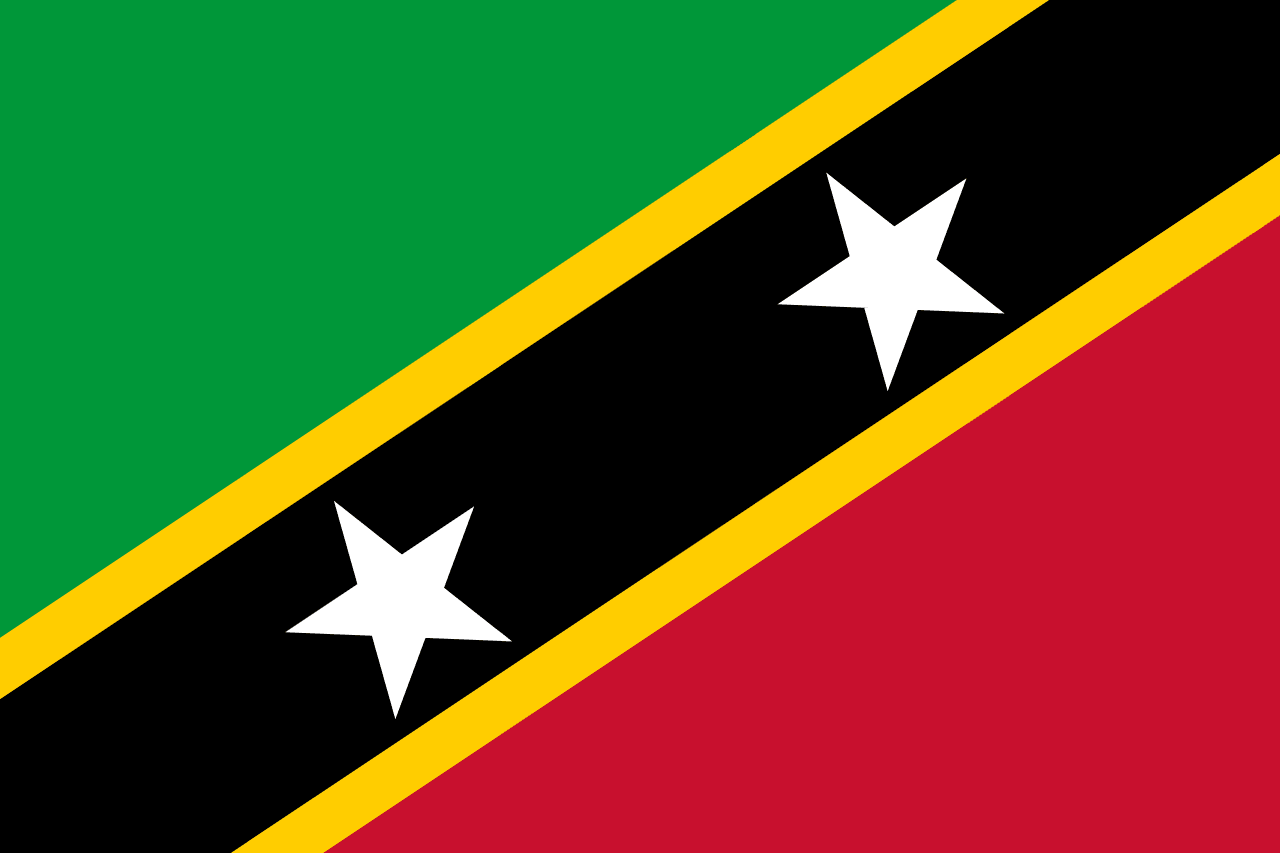
Tucked into the northern arc of the Lesser Antilles, Saint Kitts and Nevis is the smallest sovereign nation in the Western Hemisphere by both land area and population — yet it carries a history grand enough to rival countries many times its size. Once the launchpad of the entire British and French Caribbean, these two volcanic islands brim with sugar-era ruins, rainforest peaks, and monkeys that outnumber people. Here are ten facts that capture what makes this twin-island federation so unforgettable.
1. Two Islands, One Nation, Separated by a Narrow Strait
Saint Kitts and Nevis is a federation of two islands divided by a shallow channel just two miles wide called The Narrows. Saint Kitts is the larger island, shaped a bit like a paddle or a chicken drumstick, while Nevis is a near-perfect cone rising from the sea. Together they cover only about 261 square kilometres — smaller than many cities. Despite the tiny distance between them, the two islands have distinct personalities: Saint Kitts is busier and more developed, while Nevis is quieter and prides itself on its tranquillity. The relationship has not always been smooth, but their union forms one of the world's most compact and characterful countries. You can learn more in our country guide.
2. Basseterre Is a Capital Built Around a Circus
The capital, Basseterre, sits on the southern coast of Saint Kitts and is the federation's commercial and political heart. Founded by the French in 1627, its French name means "low land." Its most famous landmark is The Circus, a roundabout modelled on London's Piccadilly Circus, crowned by a green Victorian clock tower called the Berkeley Memorial. Nearby Independence Square, once a slave market, is now a peaceful park ringed by Georgian colonial buildings. Basseterre is also a busy cruise port, with Port Zante welcoming thousands of visitors who wander its pastel-coloured streets, duty-free shops, and waterfront cafes before heading off to explore the island's beaches and historic plantations.
3. Among the Smallest Populations on Earth
With roughly 47,000 residents, Saint Kitts and Nevis has one of the smallest populations of any independent country in the world. The vast majority of people are of African descent, the legacy of the enslaved Africans brought to work the sugar plantations during the colonial era. This intimate scale means community bonds run deep — neighbours know one another, family networks stretch across both islands, and the rhythms of daily life feel personal. Despite its size, the federation is a full member of the United Nations, the Commonwealth, and the Caribbean Community (CARICOM), proving that a nation's voice on the world stage is not measured by its head count.
4. English Is Official, but Kittitian Creole Is the Heartbeat
The official language is English, a legacy of British colonial rule, and it is used in schools, government, and business. In everyday conversation, however, most people speak Saint Kitts Creole, an English-based creole peppered with African and other influences. This lively dialect carries the warmth, humour, and rhythm of island life, and switching between formal English and creole is second nature to locals. The creole reflects centuries of cultural blending, and listening to it spoken in a market or at a festival is one of the most authentic ways to connect with the islands' character and people.
5. Britain's First Caribbean Colony — "The Mother Colony"
Saint Kitts holds a remarkable place in colonial history: in 1623 it became the first English settlement in the Caribbean, earning the nickname "The Mother Colony of the West Indies." The French arrived soon after, and for decades the two powers shared — and fought over — the island, even joining forces to massacre the indigenous Kalinago people at Bloody Point in 1626. Saint Kitts thus served as the springboard from which both nations colonised much of the rest of the region. This layered, often turbulent past is woven into place names, fortresses, and traditions across the islands, and you can see its echoes in the country's flag.
6. Brimstone Hill Fortress — "The Gibraltar of the West Indies"
Towering some 230 metres above the sea on Saint Kitts is Brimstone Hill Fortress National Park, a UNESCO World Heritage Site and one of the best-preserved historic fortifications in the Americas. Built by enslaved Africans over roughly a century beginning in the late 1600s, its massive volcanic-stone walls earned it the nickname "The Gibraltar of the West Indies." The fortress withstood numerous sieges, including a dramatic month-long French assault in 1782. Today visitors can climb its ramparts, explore the restored citadel, and take in sweeping views stretching to neighbouring islands like Sint Eustatius, Saba, and Montserrat — a panorama that makes the long climb thoroughly worthwhile.
7. Vervet Monkeys Outnumber the People
One of the islands' most surprising residents is the African green vervet monkey, brought over by French settlers during the colonial period. These cheeky primates have thrived so spectacularly that they now outnumber the human population, with estimates suggesting tens of thousands roaming the rainforests and even raiding gardens and resorts. Beyond the monkeys, the islands' lush interior — crowned by the dormant volcano Mount Liamuiga at about 1,156 metres — shelters tropical rainforest, while the surrounding waters host coral reefs, sea turtles, and abundant marine life. Birdwatchers can spot hummingbirds, herons, and the brown pelican gliding along the coastlines.
8. A Sugar Economy That Reinvented Itself as Paradise
For more than 300 years, sugar cane defined Saint Kitts and Nevis, and the island's economy revolved around vast plantations. The government ran the last state-owned sugar industry in the Caribbean until it finally closed in 2005, ending a centuries-long chapter. Today the economy is driven by tourism, financial services, and one of the world's oldest "citizenship by investment" programmes, launched in 1984, which allows foreigners to gain citizenship through economic contributions. A scenic narrow-gauge railway once built to haul cane now carries tourists around Saint Kitts as the "Sugar Train," offering a charming window into that bygone era.
9. A Carnival Culture Set to Soca, Calypso, and Masquerade
Music and festivity are central to life here. The biggest celebration is the National Carnival, known as Sugar Mas, which runs from late November through early January and bursts with soca, calypso, steel pan, parades, and elaborate costumes. Nevis hosts its own vibrant Culturama festival each summer. Among the most distinctive traditions are the Masquerades — dancers in tall, plumed headdresses and colourful ribbons who perform a hypnotic blend of African, French, and English folk dance. Christmas sports, string bands, and the "Big Drum" all reflect the deep African roots and creative spirit that animate the federation's cultural calendar year-round.
10. Goat Water and Conch: A Flavourful Island Table
Kittitian and Nevisian cuisine is bold, hearty, and unmistakably Caribbean. The unofficial national dish is "stewed saltfish" served with spicy plantains, coconut dumplings, and seasoned breadfruit, often eaten on weekends. Goat water, a rich and peppery goat-meat stew thickened with breadfruit and seasoned with cloves and rum, is a beloved celebration dish, especially on Nevis. Fresh seafood abounds — conch, lobster, and snapper feature heavily — alongside tropical fruits, johnny cakes, and the local "Ting" grapefruit soda. Wash it all down with a CSR (Cane Spirit Rothschild), the islands' own sugar-cane spirit, and you have a true taste of the federation.
Frequently Asked Questions
What is the capital of Saint Kitts and Nevis?
The capital is Basseterre, located on the southern coast of Saint Kitts. Founded by the French in 1627, it is the federation's largest town, main port, and the centre of government and commerce, famous for its landmark roundabout known as The Circus.
What is Saint Kitts and Nevis famous for?
The federation is famous for being the smallest sovereign nation in the Western Hemisphere, for the UNESCO-listed Brimstone Hill Fortress, for its centuries-old sugar heritage and "Sugar Train," and for its lush volcanic landscapes, beaches, and pioneering citizenship-by-investment programme.
Is it true that monkeys outnumber people?
Yes. African green vervet monkeys, introduced by French settlers centuries ago, have multiplied so successfully that they are widely believed to outnumber the roughly 47,000 human residents, making them one of the islands' most iconic — and mischievous — sights.
Conclusion
Saint Kitts and Nevis proves that the smallest nations can hold the biggest stories. From its role as Britain's "Mother Colony" and the fortress walls of Brimstone Hill to its monkey-filled rainforests, carnival drums, and goat-water stews, this twin-island federation rewards anyone curious enough to look closer. These ten facts are only the beginning of what makes this Caribbean gem so endlessly fascinating.
