
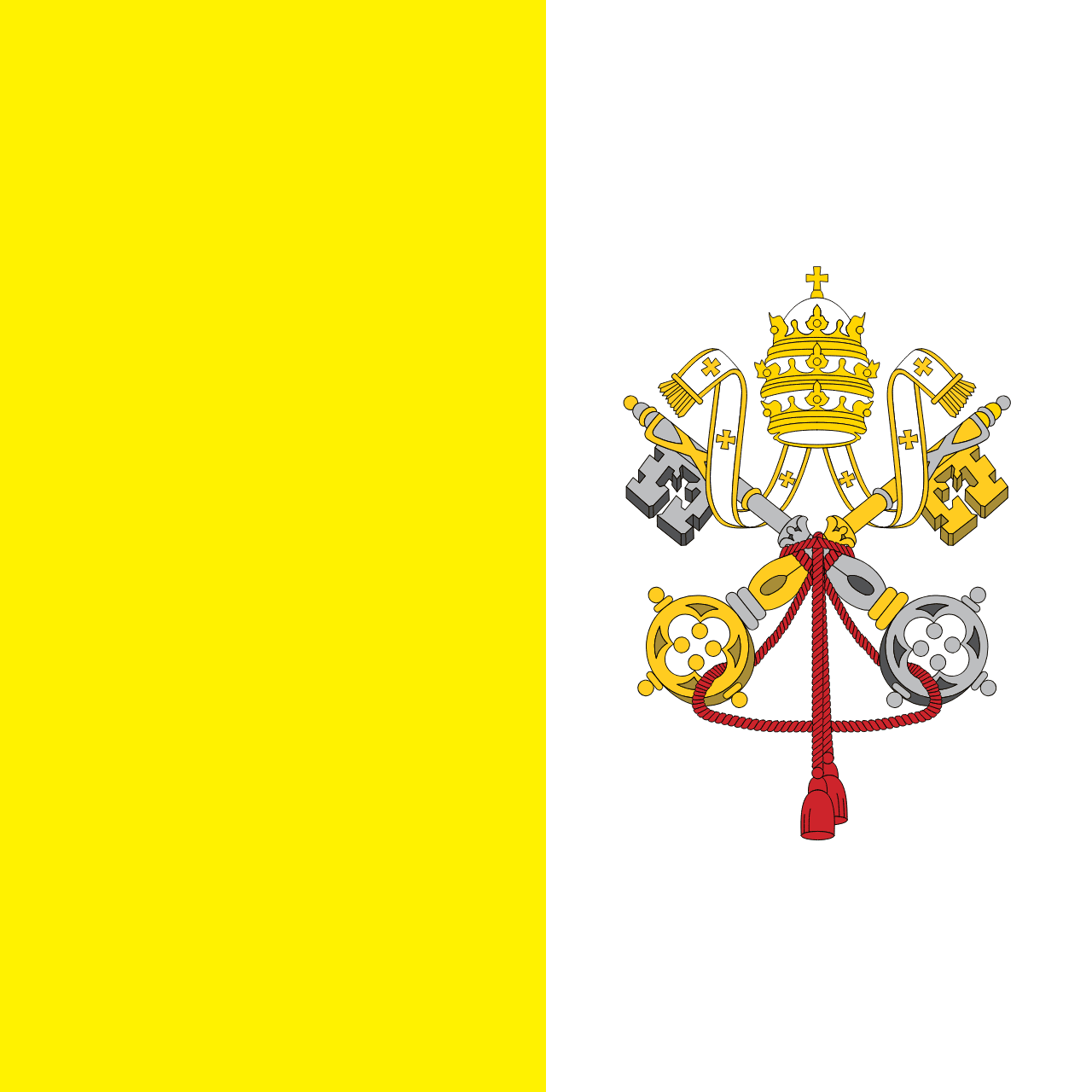
Tucked entirely inside the city of Rome sits a walled enclave so small you could walk across it in less time than it takes to brew a pot of coffee. Yet Vatican City is a fully sovereign nation, the spiritual headquarters of more than a billion Catholics, and home to some of the greatest art humanity has ever produced. Here are ten facts that reveal why the world's tiniest country is also one of its most extraordinary.
1. It Is the Smallest Country on Earth
Vatican City covers roughly 0.49 square kilometers (about 121 acres), making it the smallest internationally recognized sovereign state in the world by both area and population. The entire nation fits comfortably inside Rome, surrounded by ancient walls and bordered on one side by the curved colonnade of St. Peter's Square. To put it in perspective, you could fit dozens of Vatican Cities inside New York City's Central Park. Despite its minuscule footprint, the Vatican functions as a complete state with its own postal service, telephone system, radio station, pharmacy, supermarket, and railway station. For a closer look at the nation's makeup, see our country guide.
2. Its Population Is Tiny and Unusual
Only around 500 to 800 people hold Vatican citizenship, and the population skews in ways found nowhere else on Earth. Citizenship is not based on birth but on one's role, granted mostly to clergy, members of the Roman Curia, and the Swiss Guard. Because so few children are born there, the Vatican has one of the most distinctive demographics in the world, overwhelmingly adult and male. Citizenship typically lapses when a person's official duties end, meaning the population constantly shifts. Many of the people who work inside the Vatican each day actually live in surrounding Rome and commute across the border, swelling the daytime population well beyond the resident count.
3. Home to the Sistine Chapel's Breathtaking Ceiling
The Sistine Chapel holds one of the most famous works of art on the planet: Michelangelo's ceiling, painted between 1508 and 1512. Lying on scaffolding and craning his neck for years, the artist covered more than 500 square meters with over 300 figures, including the iconic Creation of Adam, where God and man reach toward one another. Decades later he returned to paint The Last Judgment on the altar wall. The chapel is more than a museum piece, though. It is where the College of Cardinals gathers in secret to elect a new pope, sealing themselves inside until white smoke signals their decision to the watching world.
4. The World's Smallest Army Wears Renaissance Uniforms
The Pope is protected by the Pontifical Swiss Guard, founded in 1506 and often called the world's smallest standing army. Recruits must be Catholic, Swiss, single men who have completed Swiss military training and stand at least 174 centimeters tall. Their flamboyant blue, red, orange, and yellow striped uniforms are often attributed to Michelangelo, though they were more likely designed in the early twentieth century inspired by Renaissance art. Behind the theatrical halberds and plumed helmets, however, the Guard is a serious modern security force trained in unarmed combat and firearms. They earned eternal respect in 1527 when they died defending the Pope during the Sack of Rome.
5. Latin Is Still an Official Language
While Italian is the everyday working language of Vatican City, Latin remains the official language of the Holy See and the language of formal documents and church law. The Vatican even maintains a Latin-language section that coins new terms for modern concepts, so that words for "computer," "helicopter," and "basketball" can all be expressed in the ancient tongue. The Vatican's ATMs once offered Latin as a menu option, and the Pope has tweeted in Latin to hundreds of thousands of followers. This commitment keeps a language that most of the world considers dead very much alive within these tiny walls. You can spot Latin mottos echoed on the nation's emblem and its flag.
6. St. Peter's Basilica Is an Architectural Giant
St. Peter's Basilica is one of the largest churches in the world, capable of holding tens of thousands of people. Built over the traditional burial site of Saint Peter, the apostle considered the first pope, the current structure took more than a century to complete and drew on the genius of Bramante, Michelangelo, Raphael, and Bernini. Michelangelo designed its colossal dome, which still dominates the Roman skyline and inspired domes from London to Washington, D.C. Inside, markers on the floor show how the world's other great cathedrals would fit within its nave. Bernini's sweeping elliptical colonnade outside seems to embrace visitors as they approach the most important church in Catholicism.
7. The Vatican Museums Hold Centuries of Treasure
The Vatican Museums house one of the greatest art collections ever assembled, built up by popes over five centuries. Millions of visitors a year wind through galleries packed with classical sculpture, Egyptian antiquities, tapestries, and Renaissance masterpieces before reaching the Sistine Chapel. The famous spiral staircase, the Raphael Rooms, and the Gallery of Maps are highlights of a route that stretches for kilometers. The collection is so vast that experts estimate it would take years to view every piece properly. Admission fees from these crowds, along with the Vatican's stamps, coins, and donations from Catholics worldwide, form a major pillar of the state's unusual economy.
8. It Has Its Own Bank, Stamps, and Euro Coins
For a country smaller than many shopping malls, the Vatican runs a surprisingly complete economy. It operates the Institute for the Works of Religion, commonly called the Vatican Bank, and although it does not use its own currency, it has a special agreement to mint its own euro coins. These rare Vatican euros, often bearing the Pope's image, are highly prized by collectors and seldom seen in actual circulation. The state also issues its own postage stamps, which are popular with philatelists worldwide. With no income tax and revenue from museums, donations known as Peter's Pence, and investments, the Vatican sustains itself in a way no other nation can quite replicate.
9. A Nation Born from a 1929 Treaty
Although the popes ruled large Papal States across central Italy for over a thousand years, modern Vatican City is surprisingly young. When Italy was unified in 1870, the papacy lost its territory and popes refused to recognize the new Italian state, considering themselves "prisoners in the Vatican" for nearly six decades. The standoff finally ended with the Lateran Treaty of 1929, signed between the Holy See and Italy, which created the independent state of Vatican City as we know it today. This makes one of the world's oldest institutions, the papacy, the sovereign of one of its newest countries, a fascinating wrinkle of history.
10. It Has the World's Shortest Railway and No Permanent Residents Born There
Vatican City is full of record-breaking quirks. It contains the shortest national railway in the world, a single track only about 300 meters long, originally built to transport goods and occasionally used for ceremonial journeys. There is no airport and no farmland, so nearly everything must be imported across the border from Italy. Because citizenship is tied to office rather than birthplace, the Vatican has essentially no native-born population, an almost unique situation among nations. It also boasts one of the highest densities of art and history per square meter anywhere on Earth, packing centuries of human achievement into a space smaller than many city parks.
Frequently Asked Questions
What is the capital of Vatican City?
Vatican City is a city-state, so the country and its capital are one and the same. There is no separate capital city, the entire sovereign territory is the city of Vatican City, governed from within its own walls inside Rome.
What is Vatican City famous for?
Vatican City is famous as the spiritual and administrative center of the Roman Catholic Church and the home of the Pope. It is renowned for St. Peter's Basilica, the Sistine Chapel and its Michelangelo ceiling, the Vatican Museums, and the colorful Swiss Guard.
Can anyone become a citizen of Vatican City?
Not in the usual sense. Vatican citizenship is granted based on a person's role, such as clergy, diplomats, or members of the Swiss Guard, rather than by birth or application. When someone's official duties end, their citizenship typically lapses, making it one of the few places where you cannot simply be born a citizen.
Conclusion
Vatican City proves that size has nothing to do with significance. In an area smaller than a large park, it concentrates priceless art, a living ancient language, the world's smallest army, and the headquarters of a global faith. Whether you are fascinated by Michelangelo's brushstrokes or the colorful pageantry of the Swiss Guard, this tiny nation rewards every bit of curiosity it inspires, and there is always more to discover behind its ancient walls.
