
Tropical rainforests cluster near the equator because this region receives the most intense and direct sunlight on Earth, creating conditions of consistently high temperatures and abundant rainfall year-round. The equatorial zone is where the Intertropical Convergence Zone (ITCZ) sits, a band of rising warm, moist air that produces the heavy convective rainfall necessary to sustain rainforest ecosystems.
Introduction
Rainforests typically occur between 10°N and 10°S latitude, receiving 2,000-4,000 millimeters of rain annually with no true dry season. The combination of heat, moisture, and consistent day length creates the most productive terrestrial ecosystems on Earth, supporting an estimated 50 percent of all plant and animal species despite covering only about 6 percent of the land surface.
The Short Answer
- Key Factor: Direct, intense sunlight at the equator drives evaporation and rainfall
- ITCZ: Band of rising warm air produces heavy convective rainfall
- Temperature: Consistently 25-28°C year-round with minimal seasonal variation
At the equator, the Sun is nearly overhead throughout the year, delivering maximum solar energy to the surface. This intense heating warms the land and ocean, causing massive evaporation. The warm, moist air rises rapidly (convection), cools at altitude, and releases its moisture as heavy rainfall. This process occurs daily in many equatorial regions, producing the characteristic afternoon thunderstorms of tropical rainforests.
The ITCZ (Intertropical Convergence Zone) is the atmospheric belt where the northeast and southeast trade winds converge. The converging air is forced upward, creating a persistent zone of rising air, cloudiness, and rainfall that circles the equator. The ITCZ shifts slightly north and south with the seasons, but remains near the equator year-round, providing the consistent moisture that rainforests require.
The Science Behind It
- Solar Angle: Sun nearly perpendicular at equator, maximizing energy input
- Convective Rainfall: Daily cycle of heating, evaporation, rising air, and rain
- Day Length: ~12 hours of daylight year-round at the equator
- Positive Feedback: Forests generate ~50% of their own rainfall through transpiration
The equatorial rainforest creates a powerful positive feedback loop. The dense canopy of trees transpires enormous quantities of water vapor, which rises, condenses, and falls as rain. Studies in the Amazon Basin show that trees recycle water 5-7 times between the Atlantic coast and the Andes, meaning the forest generates roughly half of its own rainfall. Without the forest, the region would receive dramatically less rain.
This feedback explains why deforestation in the tropics can trigger a tipping point. If enough forest is removed, the remaining forest may not generate sufficient rainfall to sustain itself. Climate models suggest the Amazon may be approaching such a tipping point, beyond which large areas could convert to savanna, releasing enormous amounts of stored carbon and devastating biodiversity.
Types & Variations
- Lowland Tropical: Classic equatorial rainforest at low elevation
- Montane Cloud Forest: High-altitude forests shrouded in persistent fog
- Tropical Seasonal: Rainforests with a brief dry season (monsoon forests)
- Mangrove Forests: Coastal tropical forests in saltwater environments
Not all equatorial regions have rainforests. Areas near the equator that are too dry (due to rain shadow effects or cold ocean currents) support savanna or even desert instead. East Africa near the equator is drier than expected because of complex topography and atmospheric patterns. Conversely, some rainforests exist outside the tropics where warm ocean currents and orographic rainfall provide sufficient moisture.
Cloud forests occur at higher elevations in the tropics, typically between 1,000 and 3,500 meters. Persistent cloud cover and fog drip provide moisture in addition to rainfall. These forests are characterized by stunted, moss-covered trees, high endemism, and incredible epiphyte diversity. They are among the most threatened forest types due to climate change pushing cloud levels higher.
Famous Examples
- Amazon Rainforest: 5.5 million km², the world's largest tropical rainforest
- Congo Rainforest: Second largest, covering 2 million km² in Central Africa
- Southeast Asian Rainforests: Borneo, Sumatra, New Guinea, among the most biodiverse
- Daintree Rainforest: World's oldest surviving tropical rainforest (180 million years, Australia)
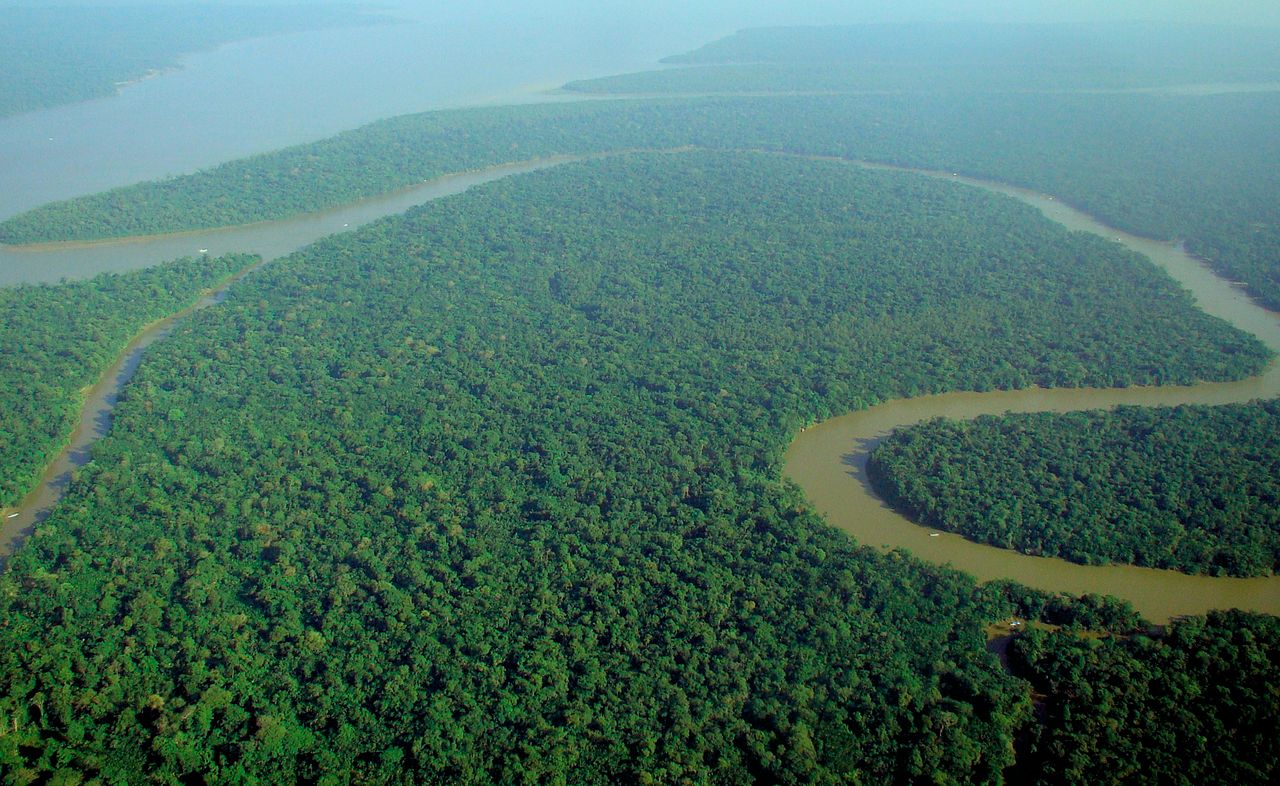
The Amazon Rainforest spans nine countries and covers approximately 5.5 million square kilometers, making it by far the world's largest tropical rainforest. It contains an estimated 390 billion individual trees belonging to 16,000 species, one in ten known species on Earth. The Amazon River, which flows through it, carries more water than any other river, and the forest influences weather patterns across South America and beyond.
The Congo Rainforest in Central Africa is the world's second largest, covering about 2 million square kilometers. It is home to forest elephants, gorillas, chimpanzees, and bonobos. Despite its ecological importance, the Congo receives far less scientific attention and conservation funding than the Amazon, and deforestation from logging, mining, and agriculture is accelerating.
Why It Matters
- Carbon Storage: Tropical forests store ~250 billion tons of carbon in trees and soil
- Biodiversity: ~50% of all species live in tropical rainforests
- Climate Regulation: Forests influence rainfall patterns far beyond their boundaries
Tropical rainforests are the most important terrestrial carbon stores on the planet, containing roughly 250 billion tons of carbon in their trees, roots, and soil. When these forests are burned or cleared, this carbon is released as CO₂, accelerating climate change. Tropical deforestation accounts for roughly 10 percent of global greenhouse gas emissions.
Beyond carbon, tropical rainforests are the pharmacy and genetic library of the planet. An estimated 25 percent of Western medicines are derived from rainforest plants, and only a fraction of tropical species have been studied for medicinal potential. The loss of rainforests represents an incalculable loss of biodiversity and potential discoveries.
Key Facts
- Tropical rainforests receive 2,000-4,000 mm of rainfall annually with no true dry season.
- The Amazon Rainforest generates roughly 50% of its own rainfall through transpiration.
- Rainforests cover only about 6% of Earth's land surface but harbor approximately 50% of all species.
- The ITCZ (Intertropical Convergence Zone) creates the persistent rainfall belt near the equator.
- Tropical forests store roughly 250 billion tons of carbon.
Fun Facts
- A single hectare of Amazon rainforest may contain more tree species than all of North America.
- The canopy of a tropical rainforest is so thick that rain can take 10 minutes to reach the forest floor.
- The Daintree Rainforest in Australia is roughly 180 million years old, making it the world's oldest.
- Some parts of the Amazon are so remote that uncontacted indigenous peoples still live there.
Final Thoughts
Tropical rainforests exist near the equator because this is where Earth's atmospheric engine delivers the combination of intense sunlight, constant warmth, and abundant rainfall that these extraordinary ecosystems require. The ITCZ, convective rainfall, and the forests' own transpiration create a self-sustaining system of remarkable productivity and biodiversity. Protecting these forests is critical not only for the millions of species they harbor but for the global climate, which depends on their capacity to store carbon and generate rainfall.
Test Your Knowledge!
Curious about geography? Test what you've learned!
Play Geography Games →