
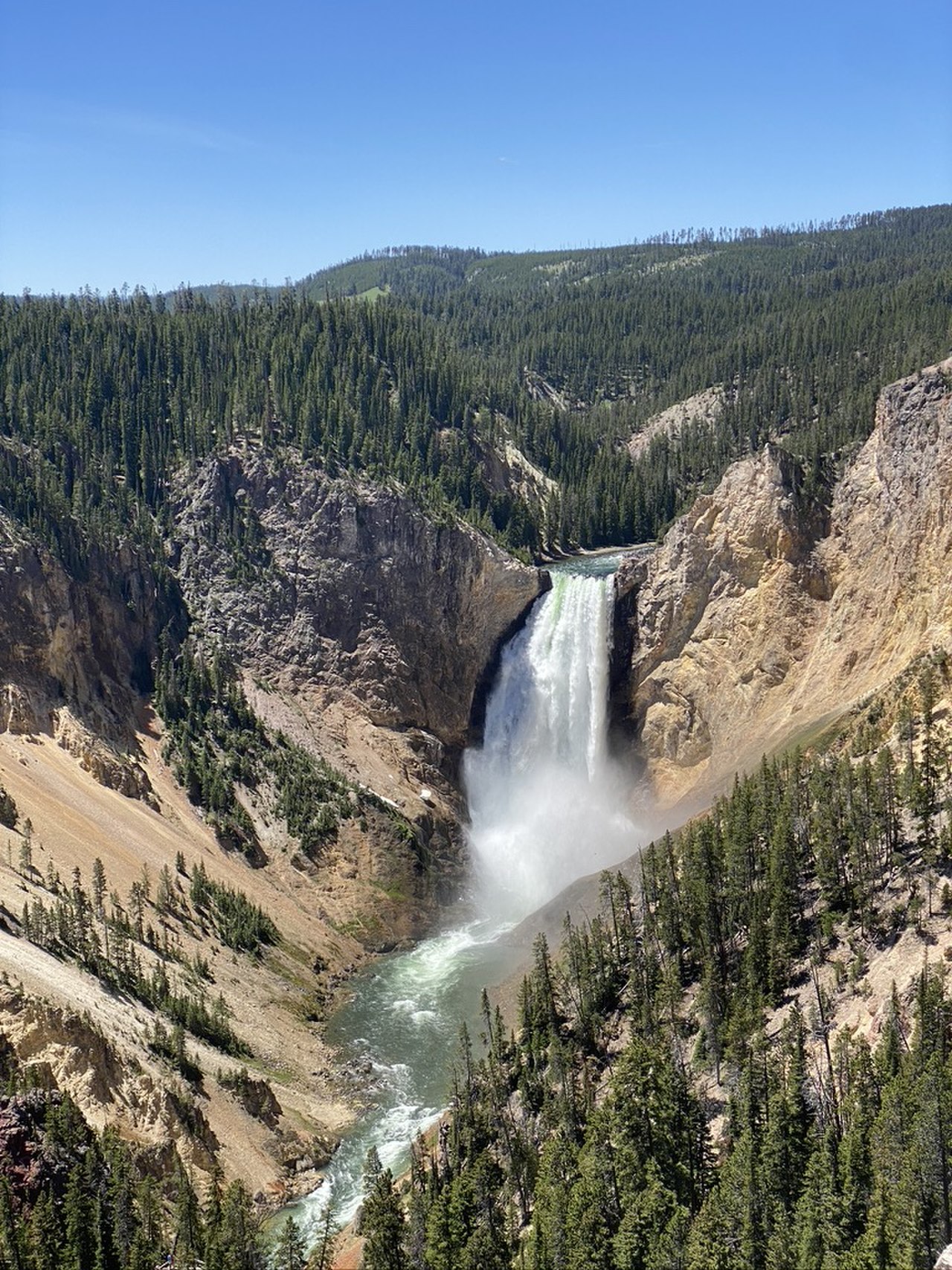
Yellowstone National Park, established in 1872 as the world's first national park, protects 8,991 square kilometers of volcanic plateau in the Rocky Mountains of Wyoming, Montana, and Idaho. Its geysers, hot springs, and dramatic landscapes are world-famous, but Yellowstone's greatest scientific significance lies in its wildlife — the most complete large-mammal ecosystem remaining in the temperate world.
Introduction
The park and surrounding Greater Yellowstone Ecosystem (GYE), covering roughly 80,000 square kilometers, support populations of grizzly bears, black bears, gray wolves, mountain lions, bison, elk, moose, bighorn sheep, pronghorn, and wolverines. The 1995 reintroduction of gray wolves — and the spectacular trophic cascade it triggered — has become one of the most celebrated stories in modern ecology.

Geography of the Greater Yellowstone Ecosystem
- Park Area: 8,991 km² of volcanic plateau
- Greater Ecosystem: ~80,000 km² including surrounding national forests
- Elevation: 1,600–3,462 m (Eagle Peak)
- Volcanic System: Yellowstone Caldera, one of the world's largest active volcanic systems
Yellowstone sits atop one of the world's largest active volcanic systems. The Yellowstone Caldera, measuring roughly 72 by 55 kilometers, was formed by a catastrophic eruption 640,000 years ago. The volcanic geology creates Yellowstone's famous geothermal features — over 10,000 hot springs, geysers, mudpots, and fumaroles — and influences the ecosystem by providing warm ground that melts snow early, creating critical winter habitat for bison and elk.
The Greater Yellowstone Ecosystem spans multiple jurisdictions including two national parks (Yellowstone and Grand Teton), portions of seven national forests, and private and tribal lands. This vast area encompasses alpine meadows, sagebrush steppe, lodgepole pine forests, and river valleys that together support the most diverse large-mammal community in North America south of Alaska.
Wolf Reintroduction and Trophic Cascades
- Reintroduction: 31 wolves released in 1995-1996 from Canada
- Current Population: ~500 wolves in the GYE, ~100 in the park
- Trophic Cascade: Wolves changed elk behavior, restoring riverbank vegetation
- Elk Impact: Elk herds reduced and shifted to less predictable movement patterns
The reintroduction of gray wolves to Yellowstone in 1995-1996 is one of the most significant wildlife management events in history. Wolves had been systematically exterminated from Yellowstone by 1926, and for nearly 70 years, elk populations exploded in the absence of their primary predator, overgrazing riverbanks, aspen groves, and willow thickets. In January 1995, 14 wolves captured in Alberta, Canada, were released into the park, followed by 17 more in 1996.
The wolves' return triggered a trophic cascade — a chain reaction through the food web. Wolves reduced elk numbers and, critically, changed elk behavior. Elk began avoiding areas where they were vulnerable to wolf predation, particularly riverbanks and valley bottoms. Aspen, willow, and cottonwood trees regenerated along rivers for the first time in decades. This increased beaver habitat, which created ponds that attracted songbirds, amphibians, and fish. The wolves even changed the rivers — bank-stabilizing vegetation reduced erosion, narrowing and deepening stream channels.
Bison: America's Last Wild Herd
- Population: ~5,500 in Yellowstone — the largest wild herd in the US
- Historic Decline: From 30-60 million to fewer than 1,000 by 1889
- Genetics: One of few herds without cattle genes
- Migration: Seasonal movements between summer and winter ranges
Yellowstone's bison herd, numbering approximately 5,500 animals, is the largest wild, free-ranging bison herd in the United States and one of the few that has continuously occupied its original range. American bison once numbered 30 to 60 million across North America before being reduced to fewer than 1,000 by 1889 through commercial hunting. Yellowstone's herd survived because a small population of roughly 23 bison persisted in the park's remote Pelican Valley.
Yellowstone bison are genetically significant because they are among the very few herds that have not been crossbred with domestic cattle. They make seasonal migrations between summer grazing areas in the park's high-elevation meadows and lower-elevation winter ranges, sometimes moving outside park boundaries. This migration creates conflict with ranchers concerned about brucellosis transmission, leading to the controversial practice of capturing and culling bison that leave the park.
Grizzly Bears and Predator Community
- Grizzly Bears: ~1,000 in the GYE, recovering from near-extinction
- Black Bears: ~600-700 in the park
- Mountain Lions: ~25-50 in the park, secretive and rarely seen
- Wolverines: A small but significant population in remote backcountry
Yellowstone's grizzly bear population has been one of the great conservation success stories of the Endangered Species Act. When grizzlies were listed as threatened in 1975, the Greater Yellowstone population had dwindled to roughly 136 bears. Decades of habitat protection, garbage management, and road closures allowed the population to recover to approximately 1,000 bears today, expanding into areas they hadn't occupied in decades.
The park's complete predator community — wolves, grizzly bears, black bears, mountain lions, coyotes, and wolverines — creates complex interactions that ecologists are only beginning to understand. Wolves and grizzlies frequently clash over carcasses, with grizzlies sometimes driving wolf packs from their kills. Coyote populations declined by roughly 50% after wolf reintroduction, as wolves kill coyotes as competitors. This in turn benefited rodent populations and the foxes, raptors, and weasels that prey on them.
Seasonal Wildlife and Conservation
- Elk: ~20,000 in the GYE, largest elk herds in the world
- Pronghorn: ~500 in the park, fastest land animal in the Western Hemisphere
- Trumpeter Swans: Among the rarest birds in Yellowstone
- Climate Threats: Warming temperatures, drought, pine beetle epidemics
Yellowstone's wildlife viewing changes dramatically with the seasons. Winter concentrates animals at lower elevations, with bison and elk gathering on thermally warmed ground near geysers and hot springs. Wolf packs are most visible in winter against the white landscape. Spring brings bear emergence, newborn bison calves, and returning migratory birds. Summer disperses animals across the landscape, while autumn brings spectacular elk bugling during the rut.
Climate change poses the newest threat to Yellowstone's ecosystem. Warmer temperatures have facilitated mountain pine beetle epidemics that killed vast stands of whitebark pine, whose seeds are a critical food source for grizzly bears preparing for hibernation. Earlier snowmelt is altering the timing of plant growth and animal migrations. Increased drought is reducing stream flows, affecting native cutthroat trout populations. Managing this ecosystem in a changing climate requires understanding the geographic connections between geology, water, vegetation, and wildlife.
Key Facts
- Yellowstone was established as the world's first national park in 1872.
- The Greater Yellowstone Ecosystem covers ~80,000 km² — larger than many countries.
- 31 wolves were reintroduced in 1995-1996, triggering one of the most famous trophic cascades in ecology.
- Yellowstone's ~5,500 bison form the largest wild, free-ranging herd in the United States.
- The grizzly bear population has recovered from ~136 in 1975 to ~1,000 today.
Fun Facts
- Wolf reintroduction literally changed the course of rivers in Yellowstone by allowing riverbank vegetation to recover, which stabilized stream banks and altered channel morphology.
- Yellowstone's bison are one of the few herds that have never been crossbred with domestic cattle, making them genetically pure American bison.
- Old Faithful geyser erupts approximately every 90 minutes, and bison have been observed resting near it for warmth during winter.
- Pronghorn in the GYE undertake the second-longest overland migration in North America, traveling up to 240 km between summer and winter ranges.
Final Thoughts
Yellowstone is more than a national park — it is a living experiment in ecosystem dynamics, where the reintroduction of a single predator species triggered cascading changes across an entire landscape. The park's complete assemblage of large mammals, from wolves to bison to grizzly bears, offers a window into what North American ecosystems looked like before European colonization. Protecting this ecosystem in the face of climate change, human encroachment, and political pressures remains one of America's most important conservation challenges.
Test Your Knowledge!
Think you know your wildlife geography? Try our interactive quiz!
Play Geography Games →