
Introduction to The ASEAN Nations
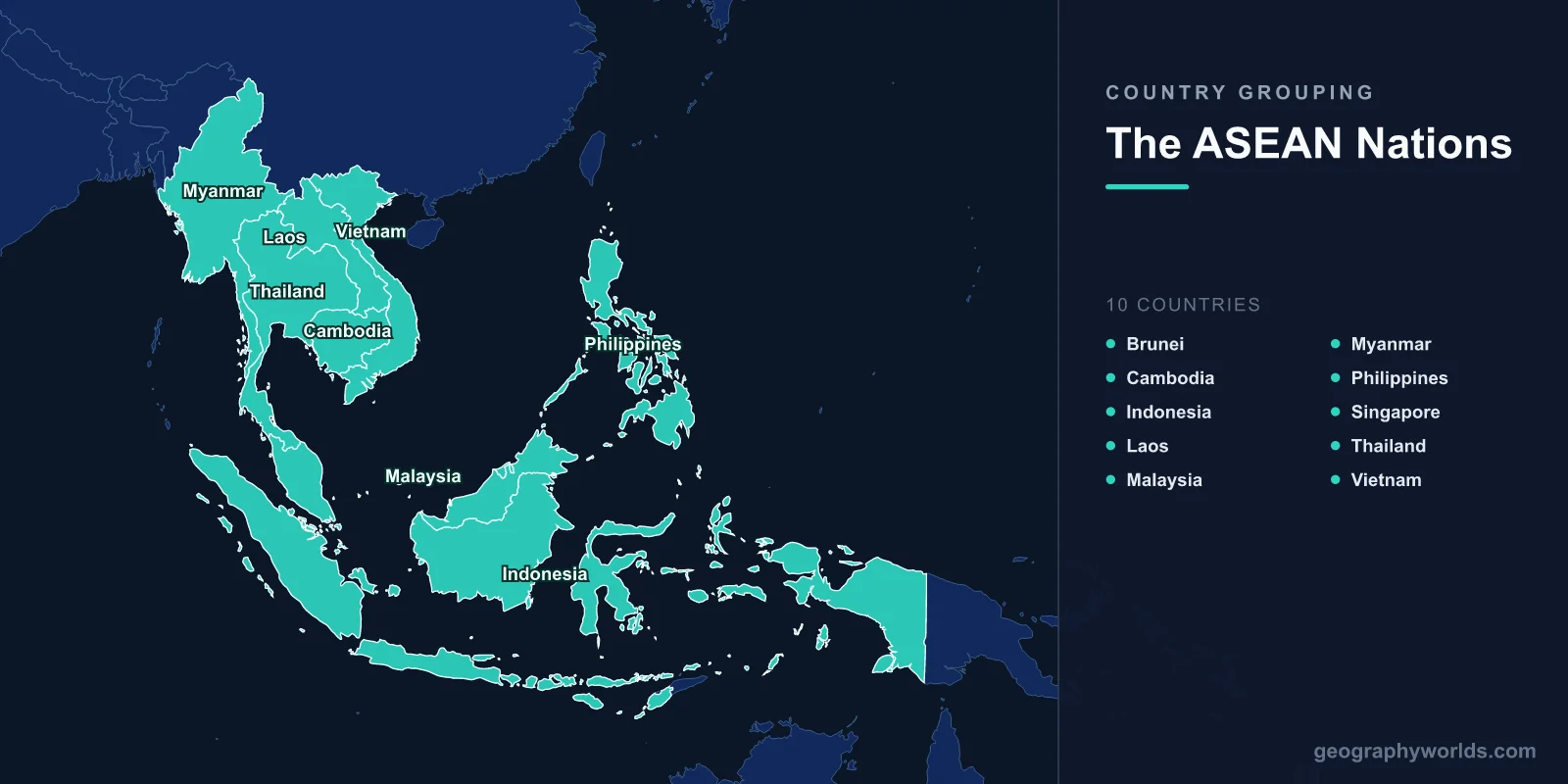
The Association of Southeast Asian Nations (ASEAN) unites ten diverse countries — Brunei, Cambodia, Indonesia, Laos, Malaysia, Myanmar, Philippines, Singapore, Thailand, and Vietnam — in one of the world's most dynamic economic and cultural regions. With a combined population exceeding 680 million people and a collective GDP making it the world's fifth-largest economy, ASEAN represents one of the fastest-growing regions on the planet. Southeast Asia is staggeringly diverse: it is home to the world's largest Muslim-majority country (Indonesia), the world's largest Buddhist populations (Thailand, Myanmar), and one of the world's most Catholic nations (Philippines). The region spans over 17,000 islands, the vast Mekong River basin, and some of the world's oldest tropical rainforests, hosting extraordinary biodiversity found nowhere else on Earth.

Countries in The ASEAN Nations
- Brunei
- Cambodia
- Indonesia
- Laos
- Malaysia
- Myanmar
- Philippines
- Singapore
- Thailand
- Vietnam
Location: Southeast Asia, between the Indian and Pacific Oceans
Shared Characteristics: Tropical climate, diverse religions, rapid economic growth, ASEAN membership
History
Southeast Asia's history is defined by powerful maritime and mainland kingdoms influenced by Indian, Chinese, and Islamic civilizations. The Khmer Empire built the magnificent Angkor Wat temple complex in Cambodia (the world's largest religious monument). The Srivijaya and Majapahit empires controlled the vital maritime trade routes through the Malay Archipelago. The spice trade brought European colonizers: the Portuguese, Spanish, Dutch, British, and French carved up the region between the 16th and 20th centuries. Only Thailand (then Siam) managed to maintain its independence by playing colonial powers against each other. The 20th century brought Japanese occupation during World War II, followed by independence movements and Cold War conflicts — most devastatingly the Vietnam War (1955-1975) and the Cambodian genocide under the Khmer Rouge (1975-1979). ASEAN was founded in 1967 primarily as an anti-communist bloc but has evolved into a comprehensive regional organization promoting economic integration and diplomatic cooperation.
Geography & Climate
Southeast Asia's geography is divided between the mainland peninsula (Myanmar, Thailand, Laos, Cambodia, Vietnam) and the vast maritime archipelagoes (Indonesia, Philippines, Malaysia's eastern states, Brunei, Singapore). Indonesia alone comprises over 17,000 islands spanning 5,000 km — a distance equivalent to London to Baghdad. The region sits on the Pacific Ring of Fire, making it one of the most seismically active areas on Earth: the 2004 Indian Ocean tsunami killed over 230,000 people, mostly in Indonesia. The Mekong River, one of the world's great waterways, flows through five ASEAN countries before reaching the sea in Vietnam's vast delta. Borneo, shared between Malaysia, Indonesia, and Brunei, contains some of the planet's oldest and most biodiverse tropical rainforests, home to orangutans, pygmy elephants, and the world's largest flower (Rafflesia). Mount Kinabalu in Malaysian Borneo and Indonesia's volcanic peaks offer dramatic highland environments.
Culture & Society
Southeast Asian culture is a kaleidoscope of traditions reflecting Indian, Chinese, Islamic, and indigenous influences. Theravada Buddhism shapes daily life in Thailand, Myanmar, Laos, and Cambodia, where saffron-robed monks collecting morning alms are a common sight. Islam is the dominant religion in Indonesia, Malaysia, and Brunei, practiced with a distinctly Southeast Asian character that incorporates pre-Islamic traditions. The Philippines' Catholic heritage, a legacy of 333 years of Spanish rule, gives it a unique cultural identity in the region. Food is perhaps Southeast Asia's most celebrated cultural export: Thai curries, Vietnamese pho, Indonesian rendang (voted the world's most delicious food), Malaysian laksa, and Filipino adobo represent just a fraction of the region's culinary wealth. Traditional performing arts — from Balinese dance to Thai classical dance to Vietnamese water puppets — showcase extraordinary artistic sophistication.
Economy
ASEAN's economies span an extraordinary range of development levels. Singapore is one of the world's wealthiest nations, a global financial center with GDP per capita exceeding most Western European countries. Brunei's oil wealth provides generous subsidies to its small population. Indonesia, the region's largest economy, is a G20 member with a rapidly growing middle class. Vietnam has been one of Asia's economic stars, with GDP growth averaging 6-7% annually as manufacturing shifts from China. Thailand and Malaysia have established diverse manufacturing and service economies. The Philippines has become a global hub for business process outsourcing. Cambodia and Laos are growing rapidly from lower bases, driven by garment manufacturing and hydroelectric power respectively. Myanmar's economy has been severely disrupted by political instability since the 2021 military coup. Together, ASEAN aims to achieve deeper economic integration, creating a single market and production base that could rival China and India.
The Region Today
Southeast Asia today is at the center of global geopolitical competition, with the United States and China vying for influence in a region that controls critical shipping lanes including the South China Sea — through which roughly one-third of global trade passes. Territorial disputes in the South China Sea remain the region's most significant security challenge. The climate crisis poses severe threats: rising sea levels endanger coastal megacities like Jakarta and Bangkok, while deforestation and biodiversity loss accelerate. Indonesia is building a new capital, Nusantara, on Borneo to replace sinking Jakarta. The region's digital economy is booming, with unicorn startups in ride-hailing (Grab), e-commerce (Shopee, Tokopedia), and fintech transforming daily life across the region.
Interesting Facts About The ASEAN Nations
- Indonesia is the world's largest archipelago with over 17,000 islands, of which about 6,000 are inhabited
- Singapore is one of only three surviving city-states in the world (along with Monaco and Vatican City)
- Angkor Wat in Cambodia is the largest religious monument in the world, covering over 400 acres
- The Philippines is named after King Philip II of Spain, who colonized the islands in the 16th century
- Thailand is the only Southeast Asian country that was never colonized by a European power
- Vietnam is the world's second-largest coffee producer, after Brazil
Conclusion
The ASEAN Nations (Brunei, Cambodia, Indonesia, Laos, Malaysia, Myanmar, Philippines, Singapore, Thailand, Vietnam) represent a fascinating regional grouping with shared history, cultural ties, and common challenges. Whether you're studying world geography, planning travel, or simply curious about how the world's nations connect, understanding these regional groupings provides valuable context for making sense of our complex and interconnected world.
