
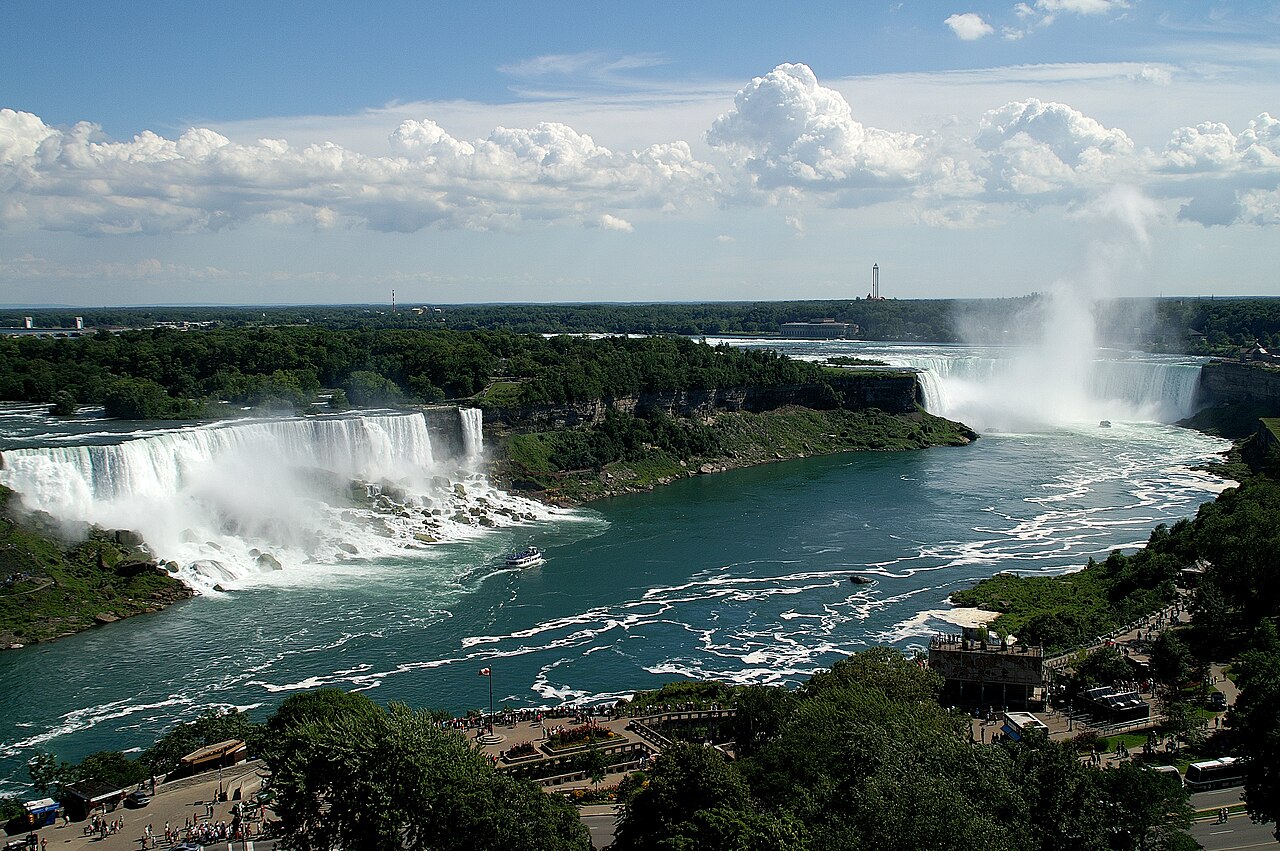
Niagara Falls — straddling the US-Canada border on the Niagara River — is the collective name for three waterfalls: Horseshoe Falls (the largest, primarily on the Canadian side, 57 m high, 670 m wide), American Falls (on the US side, 21-34 m high, 290 m wide), and Bridal Veil Falls (a small US-side fall separated from American Falls by Luna Island). The combined falls carry approximately 168,000 m³ of water per minute during peak summer flow — the highest flow rate of any waterfall in North America (though not the tallest). The Canadian city (Niagara Falls, Ontario, population 94,000) has more developed tourism infrastructure with iconic Skylon Tower views, casino tourism, and the famous Clifton Hill entertainment district. The US side (Niagara Falls, New York, population 48,000) is dominated by Niagara Falls State Park (the oldest state park in the US, designed by Frederick Law Olmsted in 1885), which provides closer pedestrian access to American Falls plus access to Goat Island between the falls. The Canadian side is generally considered to offer better panoramic views of Horseshoe Falls; the US side offers more intimate close-range experiences via Cave of the Winds (the wooden walkway directly under Bridal Veil Falls). The famous boat tours — Maid of the Mist (US side, operating since 1846, making it one of North America's oldest tourist attractions) and Hornblower Niagara Cruises (Canada side) — provide the iconic up-close-to-falls experience. Climate is humid continental with maritime moderation from Lake Ontario; the falls' constant mist creates distinctive microclimate around the immediate falls area.
Quick verdict
Best overall: June-September.
Best for boat tours (Maid of the Mist, Hornblower Niagara Cruises): Mid-April-late October.
Best for Winter Festival of Lights: Mid-November-mid-January.
Best for Friday and Sunday night fireworks (Canadian side): Late May-early September.
Best for partial frozen falls photography: January-February (when sustained -20 °C cold creates the famous ice formations).
Best for budget travelers: April-May and October-November.
Best for Niagara-on-the-Lake wine region: June-October.
Best for the famous Floral Showcase: Year-round (heated greenhouse).
Best for Cave of the Winds (US side): Mid-May-mid-October (the wooden walkway is removed in winter).
Best for journey behind the falls (Canadian side): Year-round (tunnels operate continuously).
Best for Niagara SkyWheel and Clifton Hill: Year-round.
Avoid if you can: July weekends without timed-entry boat tour booking; expecting fully frozen falls (the last full freeze was 1848 — only partial freezing occurs in most modern winters); driving the Robert Moses Parkway during summer peak weekends; Niagara casino hotels without checking event calendars.
Summer (June-September) — Niagara's tourism peak
Niagara at its full operational tourism peak. Daytime 22-28 °C; humidity moderate; sunny weather typical. The Maid of the Mist (US side, departing Niagara Falls State Park, in operation since 1846) and Hornblower Niagara Cruises (Canada side, departing Clifton Hill, since 2014) provide the iconic "wet boat ride to the basin of the falls" experience — each vessel carries 600+ passengers wearing waterproof ponchos directly into the spray cloud at the base of Horseshoe Falls. The tours run roughly mid-April through late October, weather dependent. The Cave of the Winds (US side) takes visitors via elevator down to a wooden walkway built each spring directly under Bridal Veil Falls — the "Hurricane Deck" provides the famous immersive falls experience. The Journey Behind the Falls (Canada side) provides year-round tunnel access to viewing portals directly behind Horseshoe Falls.
Friday and Sunday night fireworks (10 pm, late May-early September) provide free 15-minute pyrotechnic displays launched directly over the falls. The famous illumination of the falls (every night year-round, with the falls floodlit by 4,000+ LED lights in changing colors from sunset through midnight) provides defining Niagara nighttime photography.
Niagara-on-the-Lake — the famous wine country town 20 minutes north of the falls — provides essential day-trip combination. The town's preserved 19th-century main street holds the Shaw Festival (one of North America's premier theater festivals, running April-October), boutique hotels, and access to 30+ Ontario wine country wineries (the Niagara Peninsula is Canada's largest wine region, particularly famous for ice wine and Riesling). The famous Niagara Wine Route extends 35 km from Niagara-on-the-Lake through Jordan, Vineland, and Beamsville.
The Botanical Gardens (Canadian side), the Floral Showcase, Queen Victoria Park (the famous formal gardens along the Niagara Parkway), the White Water Walk (boardwalk along Class 6 rapids downstream of the falls), and the Whirlpool Aero Car (the famous 1916 cable car crossing the Niagara Whirlpool) provide additional summer experiences.
Spring (April-May) and autumn (October-November)
Niagara's shoulder seasons. April-May daytime 12-22 °C as boat tours resume operation (typically reopening mid-April). October-November daytime 6-18 °C; the famous "Festival of Lights" begins in mid-November and runs through mid-January. October's autumn foliage along the Niagara Parkway provides extraordinary photography conditions — the famous "Niagara Parkway" was called by Winston Churchill "the prettiest Sunday afternoon drive in the world." Crowds drop significantly compared to summer peak, with hotel rates 30-50% lower.
The Shaw Festival in Niagara-on-the-Lake continues through October. The famous Welland Canal (just east of the falls, connecting Lake Erie to Lake Ontario) provides shipping spectacle as Great Lakes freighters traverse the locks.
Winter (December-March) — Festival of Lights
Niagara's distinctive winter window. The famous Winter Festival of Lights (mid-November-mid-January) is one of Canada's largest outdoor light displays — millions of LED lights illuminate Queen Victoria Park, Dufferin Islands, and surrounding areas with extensive themed displays. The falls themselves remain spectacular under winter conditions — the famous frozen mist coats trees, railings, and overlooks with extraordinary ice formations during sustained cold snaps (-15 °C or colder). The falls have never fully frozen since 1848 (when ice dams briefly stopped flow); modern partial freezing creates the famous "ice bridge" formations near the basin without stopping water flow.
The boat tours close November through mid-April. The Cave of the Winds wooden walkway is dismantled each winter (the boards reconstructed each spring). However, the Journey Behind the Falls operates year-round, the Skylon Tower observation deck remains open, the famous Niagara Falls casinos (Casino Niagara and Fallsview Casino on the Canadian side, Seneca Niagara Casino on the US side) provide indoor entertainment, and the Niagara SkyWheel operates year-round.
Daytime December-March 0 to -8 °C with regular -15 to -20 °C cold snaps; the famous "lake effect snow" from Lake Ontario can produce significant winter snowfall. The Falls Avenue indoor entertainment complex on the Canadian side (Sheraton on the Falls, Crowne Plaza, the famous Skywheel, and connected indoor attractions) provides extensive bad-weather options.
Festivals & cultural events
Winter Festival of Lights (mid-November-mid-January): Major outdoor light display.
Niagara Falls Fireworks (Friday and Sunday evenings, late May-early September): Free pyrotechnic displays.
Shaw Festival (Niagara-on-the-Lake, April-October): Major theater festival.
Niagara Icewine Festival (mid-January-mid-February): Major wine region celebration of Niagara's signature ice wine.
Niagara Wine Festival (mid-September): Major Niagara Peninsula wine celebration in St. Catharines.
Niagara Falls Comic Con (early June): Major regional comic and pop culture event.
Canadian Niagara Falls New Year's Eve concert (December 31): Free outdoor concert and fireworks.
Friendship Festival (Canada Day-Independence Day weekend, late June-early July): Joint Canadian-American celebration of the Peace Bridge.
Niagara Parks Heritage events (varies): Historical reenactments along the Niagara Parkway.
Cultural and practical notes
English is the primary language; French widely available on Canadian side. Canadian Dollar (CAD) on Canadian side; US Dollar (USD) on US side. Tipping 15-20%. Driving on the right side. The Canadian side requires passport/enhanced ID for US travelers (the Rainbow Bridge is the famous pedestrian and vehicle border crossing — typically 15-30 minute wait at peak times). Both sides have visa-free entry for most Western nationalities (or ESTA for US, ETA for Canada).
Practical considerations
Buffalo Niagara International Airport (BUF, 30 minutes from US side) and Toronto Pearson International (YYZ, 90 minutes from Canadian side) are the main aviation hubs. Internal travel by rental car, taxi, or the famous WEGO bus system (Canadian side). Both sides are walkable from major hotels to the falls. The Rainbow Bridge connects the two sides (pedestrians 50¢ each way; vehicles $4.50).
Traveler-type advice
First-time visitors: June-September for full operations.
Boat tour travelers: Mid-April-late October.
Photographers: Mid-October for fall foliage; January-February for frozen mist; year-round for nighttime illumination.
Family travelers: June-August for fireworks and full operations.
Honeymooners (the famous Niagara honeymoon tradition): May-October.
Wine travelers (Niagara-on-the-Lake): June-October; January-February for icewine.
Theater travelers (Shaw Festival): April-October.
Casino travelers: Year-round.
Budget travelers: April-May and October-November.
Combined US-Canada travelers: Toronto + Niagara Falls + Buffalo provides natural 3-day circuit.
Bottom line
Niagara Falls rewards June-September visits decisively for the full operational experience — boat tours, fireworks, Cave of the Winds, and ideal weather. Mid-November-mid-January provides distinctive Festival of Lights culture. The Canadian side generally offers better panoramic views and more developed tourism; the US side provides closer pedestrian access and natural park environment. Allow 2 days minimum — one for the falls themselves and one for Niagara-on-the-Lake and surroundings.