
Białowieża Forest is the last significant remnant of the immense primeval lowland forest that once covered the entire European Plain from the Atlantic coast to the Ural Mountains. Straddling the border between Poland and Belarus, it covers approximately 1,500 square kilometers and contains areas that have never been commercially logged — a distinction no other lowland forest in Europe can claim.
Introduction
The forest is most famous as the last stronghold of the European bison (wisent), which was hunted to extinction in the wild in 1919 and saved only by a captive breeding program. Today, roughly 800 bison roam freely through Białowieża, the largest free-living population in the world. The forest is a UNESCO World Heritage Site and a Biosphere Reserve.
Geography & History
- Total Area: ~1,500 km² (Poland ~600 km², Belarus ~900 km²)
- Strict Reserve (Poland): 47.5 km² — no logging, no entry without guide
- UNESCO Status: World Heritage Site (1979, extended 1992, 2014)
- Age of Old-Growth: Continuously forested for at least 8,000 years
Białowieża Forest lies on the watershed between the Baltic Sea and the Black Sea, at elevations of 130 to 200 meters. The terrain is flat to gently rolling, typical of the North European Plain. The Polish portion includes the Białowieża National Park, whose strict reserve of 47.5 square kilometers has been protected from logging since 1921 and represents the most pristine section of the forest.
The forest has been protected by monarchs for centuries. Polish kings and later Russian tsars used Białowieża as a royal hunting ground, inadvertently preserving it from the clearing that destroyed the rest of Europe's lowland forests. The last wild aurochs died in Białowieża in 1627, and the last wild European bison was shot there in 1919. Both events underscored the forest's role as a final refuge for Europe's vanishing megafauna.
Forest Structure
- Tree Species: ~26 native species
- Dominant Trees: Oak, hornbeam, lime, spruce, pine, alder
- Deadwood Volume: Up to 150 m³/hectare in strict reserve
- Canopy Height: 30-45 m
- Oldest Trees: Oaks over 500 years old
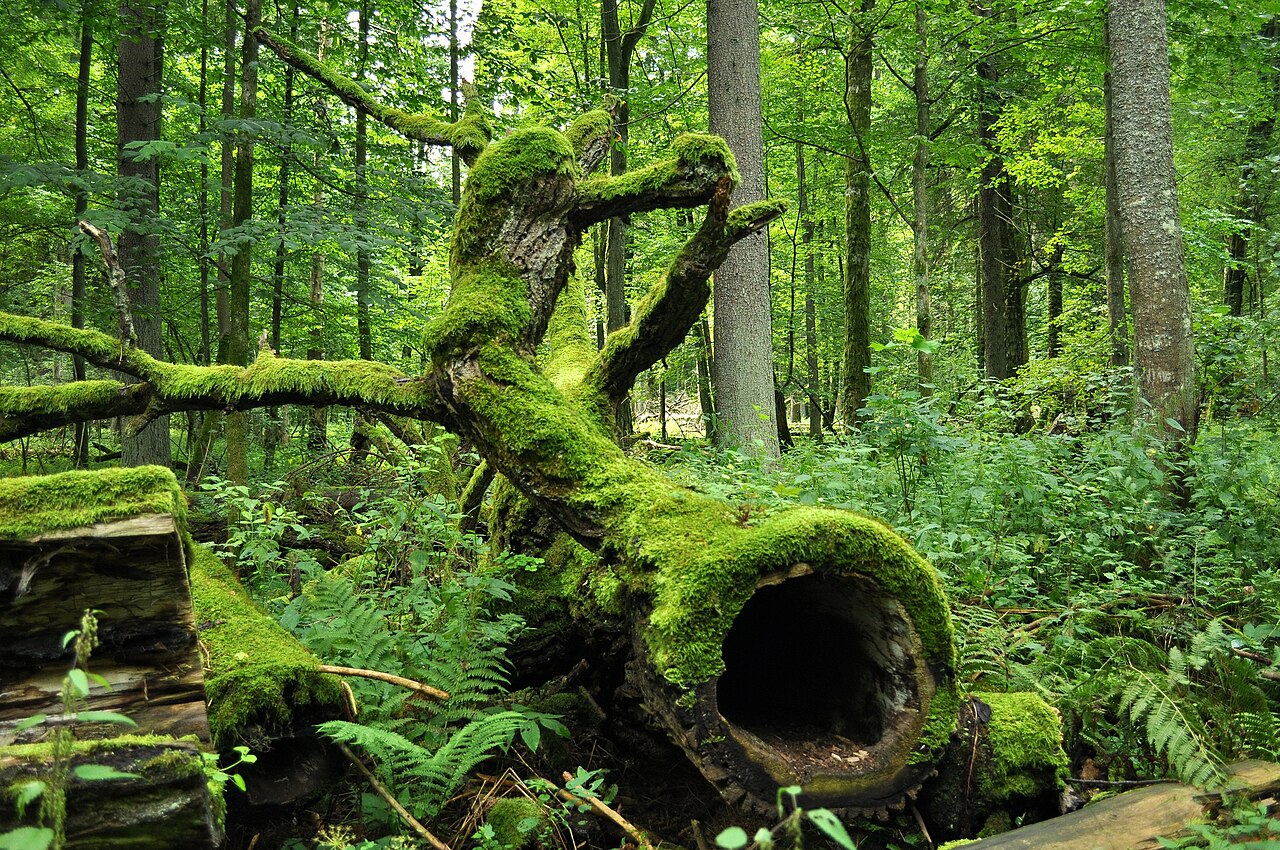
Białowieża's most striking feature is its naturalness. In the strict reserve, the forest develops without human intervention — trees grow, fall, and decay naturally, creating a structural complexity absent from managed European forests. Standing dead trees (snags) and fallen logs are everywhere, supporting a community of fungi, insects, and woodpeckers unmatched anywhere else on the continent.
The volume of deadwood in Białowieża's strict reserve — up to 150 cubic meters per hectare — is ten to twenty times higher than in typical managed European forests. This deadwood is critical habitat for over 5,500 species of invertebrates, 1,500 species of fungi, and all ten European woodpecker species, including the white-backed woodpecker, which depends on old, insect-rich dead trees.
Biodiversity
- Mammal Species: 59 (including European bison, wolf, lynx)
- Bird Species: ~250
- Insect Species: ~12,000
- Fungi Species: ~3,500
- Vascular Plants: ~1,070
Białowieża harbors the full suite of European large mammals, including approximately 800 European bison, plus wolves, lynx, wild boar, red deer, roe deer, elk, and beaver. The forest supports one of the highest densities of large predators in Europe, with wolf packs that depend on the bison, deer, and wild boar populations.
The insect fauna is extraordinary, with over 12,000 documented species, many dependent on the old-growth deadwood habitat. Over 3,500 species of fungi have been recorded, including many that are extinct or extremely rare elsewhere in Europe. The ten-spotted pot beetle, an insect thought to be extinct for decades, was rediscovered in Białowieża's rotting wood in 2016.
The European Bison
- Current Population: ~800 free-roaming in Białowieża (Poland + Belarus)
- Extinction in Wild: 1919 (last wild bison shot in Białowieża)
- Recovery From: Just 12 individuals that survived in zoos
- Global Population: ~7,500 (all descended from those 12)
The European bison is the largest land animal in Europe, with bulls weighing up to 1,000 kilograms. The species was hunted to extinction in the wild by 1927, with the last wild Białowieża bison killed in 1919. Only 54 individuals survived in zoos across Europe, and all living bison today descend from just 12 of those captive animals.
Reintroduction to Białowieża began in 1952, and the population has grown to roughly 800 in the forest (split between Poland and Belarus). The bison are ecosystem engineers: their grazing maintains open glades within the forest, their wallowing creates pools used by amphibians, and their dung supports a specialized community of beetles. However, the extremely narrow genetic base of the population (all descended from 12 founders) makes bison vulnerable to disease and inbreeding.
Threats & Controversies
- Logging Controversy: Polish government authorized logging in 2016-2018; halted by EU court
- Bark Beetle: Ips typographus outbreak used to justify logging
- Political Tension: Forest straddles Poland-Belarus border; cooperation limited
- Climate Change: Spruce decline, shifting species composition
In 2016, the Polish government authorized large-scale logging in parts of Białowieża outside the strict reserve, citing the need to control an outbreak of the European spruce bark beetle (Ips typographus). Scientists and conservationists argued that bark beetle outbreaks are a natural process in primeval forests and that logging would damage the ecosystem far more than the beetles. The European Court of Justice ruled in 2018 that the logging violated EU law.
Climate change is shifting the forest's composition, with Norway spruce declining in response to warmer temperatures and drier summers. Hornbeam and lime are expanding at the expense of spruce and birch. Some scientists view this as a natural adaptation, while others worry that the pace of change may outstrip the forest's ability to adjust. Political tensions between Poland and Belarus have complicated cross-border forest management since 2021.
Key Facts
- Białowieża is the last remaining primeval lowland forest in Europe, continuously forested for at least 8,000 years.
- The strict reserve has never been commercially logged — the only lowland forest in Europe with this distinction.
- All ~7,500 European bison alive today descend from just 12 captive individuals.
- Białowieża harbors over 12,000 insect species, 3,500 fungi species, and all 10 European woodpecker species.
- Deadwood volume in the strict reserve (150 m³/ha) is 10-20 times higher than in managed European forests.
Fun Facts
- The last wild aurochs (ancestor of domestic cattle) died in Białowieża Forest in 1627.
- Polish kings once kept a "forest court" at Białowieża, with foresters who could impose the death penalty for poaching bison.
- A single oak tree in Białowieża can support over 500 species of insects and fungi.
- The European Court of Justice's 2018 ruling against logging in Białowieża was the first time an EU member state was found to have violated nature protection law through forestry operations.
Final Thoughts
Białowieża is irreplaceable — the last window into what lowland Europe looked like before human civilization cleared the continent's forests. Its ancient oaks, its herds of bison, and its astonishing diversity of life dependent on deadwood and natural processes represent an ecological heritage that took thousands of years to develop and cannot be recreated. Protecting Białowieża from logging, climate change, and political division remains one of Europe's most important conservation responsibilities.
Test Your Knowledge!
Think you know the world's forests? Try our interactive geography quiz!
Play Geographic Features Quiz →