
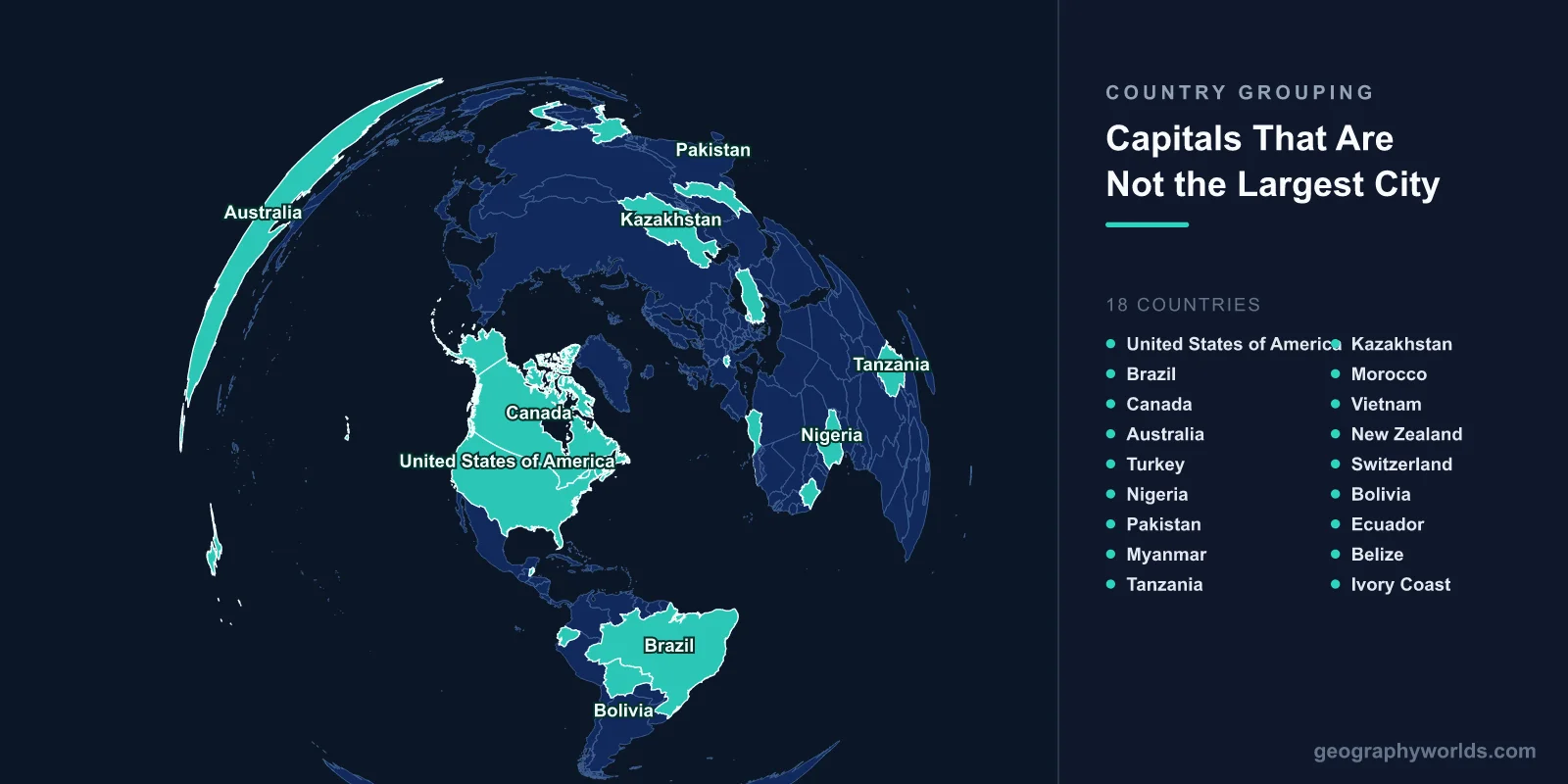
In a substantial minority of countries the capital is not the largest city — among them the United States, Brazil, Canada, Australia, Turkey, Nigeria, Pakistan, Myanmar, Tanzania, Kazakhstan, Morocco, Vietnam, New Zealand, Switzerland, Bolivia, Ecuador, Belize and Ivory Coast. In almost every case the split was deliberate. Capitals get moved, invented or chosen precisely because the biggest city is the wrong place to put a government.
The Four Reasons a Capital Moves
Read the list and the same handful of motives recur.
Compromise between rivals. When two cities both want it, a third is chosen. Ottawa, Canberra and Wellington all exist as capitals for this reason, and so, in effect, does Washington.
Pulling development inland. A coastal primate city concentrates wealth; a capital in the interior is meant to redistribute it. Brasília, Abuja, Astana and Dodoma were all justified this way.
Security. A capital far from a border, a coast or a restive population is harder to attack or to besiege. Naypyidaw and Islamabad were both built with this reasoning.
Ethnic or regional balance. Abuja sits between the Muslim north and Christian south. Astana shifted the centre of gravity toward the Russian-majority north of Kazakhstan.
The Purpose-Built Capitals
Several of these cities did not exist, or barely existed, before they were made capitals.
Brasília was built from nothing on the central plateau and inaugurated in 1960, replacing Rio de Janeiro. Laid out by Lúcio Costa in the shape sometimes described as an aeroplane and filled with Oscar Niemeyer's buildings, it was inscribed by UNESCO in 1987 as a masterpiece of modernist planning. São Paulo, the largest city, has well over ten times the population of the federal district.
Canberra was chosen in 1908 and designed by Walter Burley Griffin and Marion Mahony Griffin after an international competition, precisely because Sydney and Melbourne could not agree. Melbourne served as the interim seat until 1927. Canberra remains smaller than Sydney, Melbourne, Brisbane, Perth and Adelaide.
Naypyidaw was built in secret in the early 2000s and announced as Myanmar's capital in 2005, replacing Yangon. Its twenty-lane highways are famously empty, and its administrative area is several times the size of Singapore.
Abuja was designated in 1976 and became Nigeria's capital in 1991, replacing Lagos, which remains the largest city in Africa by some counts and many times Abuja's size.
Astana became Kazakhstan's capital in 1997, replacing Almaty, which is still the larger and the commercial centre. It has been renamed more than once — Akmola, Astana, Nur-Sultan, and back to Astana in 2022.
The Compromise Capitals
Washington, D.C. was created by the Residence Act of 1790 on land ceded by Maryland and Virginia, the product of a bargain in which southern states accepted federal assumption of state debts in exchange for a capital on the Potomac. New York City is roughly twelve times its size.
Ottawa was selected by Queen Victoria in 1857 from a shortlist that included Toronto, Montreal, Quebec City and Kingston, partly because it sat on the boundary between Canada East and Canada West and was far enough from the American border to be defensible. Toronto and Montreal are both larger.
Wellington replaced Auckland as New Zealand's capital in 1865, chosen for its central position between the two islands at a time when the South Island's gold wealth made secession a live possibility. Auckland is around three times larger.
Bern was chosen as the Swiss federal city in 1848 as a compromise between Zurich and Lucerne, and remains smaller than Zurich, Geneva, Basel and Lausanne. Switzerland formally has no capital in law — Bern is the seat of federal authorities.
Turkey: A Capital as a Statement
Ankara became the capital of Turkey in 1923, replacing Istanbul, and the choice was ideological as much as practical. Istanbul was the seat of the Ottoman sultanate and the caliphate, a cosmopolitan imperial port looking outward across the Bosphorus.
Mustafa Kemal Atatürk's republic was Anatolian, secular and inward-facing, and Ankara — a provincial town of a few tens of thousands, in the middle of the plateau, and the base of the nationalist movement during the war of independence — expressed all of that. Istanbul today has more than four times Ankara's population and remains the economic capital in every sense but the formal one.
The Ones With More Than One
Several countries on this list complicate the question further by having more than one capital.
Bolivia has Sucre as its constitutional capital and seat of the judiciary, and La Paz as the seat of government and legislature. Neither is the largest city: Santa Cruz de la Sierra overtook both. La Paz, at over 3,600 metres, is the highest seat of government in the world.
Ivory Coast moved its official capital to Yamoussoukro in 1983, the birthplace of president Félix Houphouët-Boigny, where he built the Basilica of Our Lady of Peace — larger than St Peter's in Rome. Abidjan remains the economic capital, the seat of most government activity and many times larger.
Tanzania designated Dodoma as capital in 1974 to pull development inland, and the transfer of ministries took decades; Dar es Salaam is far larger and remains the commercial hub.
The Quiet Cases
Some entries on this list surprise people because the split is not dramatic.
Morocco: Rabat is the capital; Casablanca, about 90 kilometres down the coast, is much larger and is the economic centre.
Vietnam: Hanoi is the capital; Ho Chi Minh City, the former Saigon, is larger and commercially dominant — a split that maps directly onto the country's division before 1975.
Pakistan: Islamabad was built in the 1960s beside Rawalpindi to replace Karachi, which remains several times larger. The move put the capital close to the army's headquarters and away from the coast.
Ecuador: Quito is the capital and Guayaquil the larger port city, a rivalry that runs through Ecuadorean politics.
Belize: Belmopan was built inland after Hurricane Hattie devastated Belize City in 1961. It is one of the smallest capitals in the world, with a population in the low tens of thousands.
What Counts as Largest
The list depends on a definition, and two reasonable people can disagree about several entries.
City proper, urban agglomeration and metropolitan area give different answers. Delhi is a standard example: New Delhi is a district within the larger National Capital Territory, and whether India belongs on this list depends entirely on whether you treat New Delhi as a separate city from Delhi. Most lists exclude India for that reason.
The Philippines is another. Manila is the capital and is smaller than Quezon City by population, but both sit within Metro Manila, so the distinction is administrative rather than real.
China is sometimes wrongly included. Beijing is the capital, and while Shanghai is larger by city proper, Beijing's municipality is enormous, and the two are close enough that the comparison depends on the boundary chosen.
The Countries Where It Is the Same City
The majority of the world does put the capital in the biggest city, and the reasons are as instructive as the exceptions. London, Paris, Tokyo, Seoul, Moscow, Bangkok, Mexico City, Buenos Aires, Cairo, Jakarta and Madrid are all the largest city and the seat of government.
These are mostly old capitals of centralised states, where the city grew because the government was there. France's dominance by Paris is the textbook case of a primate city — several times larger than the second city, with the political, economic, cultural and transport systems all converging on it.
The exceptions on this page are therefore mostly federal states, post-colonial states that inherited a coastal colonial capital, or countries that had a reason to start again.
The Smallest Capitals of Large Countries
Because these capitals were chosen rather than grown, several are startlingly small relative to the country they govern.
Belmopan administers Belize with a population in the low tens of thousands. Yamoussoukro governs a country of more than 30 million. Naypyidaw's residential population is a small fraction of Yangon's despite an administrative footprint many times larger in area. Canberra, at under half a million, runs a country of 27 million.
That disproportion produces a recognisable kind of city: heavy on ministries, embassies, universities and national museums, light on industry and nightlife, and populated during the week by people who go home at weekends. Washington, Canberra, Ottawa, Brasília and Abuja all share the pattern, and all have spent decades trying to shed the reputation that goes with it.
When the Largest City Takes It Back
The movement is not always one way. Several countries have moved a capital and then reversed, or found the designation ignored in practice.
Ivory Coast's transfer to Yamoussoukro in 1983 remains formally in force and functionally incomplete: embassies, ministries and the presidency have largely stayed in Abidjan for four decades. Tanzania declared Dodoma the capital in 1974 and did not complete the move of government offices until the late 2010s.
Malta moved its capital from Mdina to Valletta in the sixteenth century after the Great Siege; Nigeria's shift to Abuja took fifteen years from designation to inauguration. A capital is a set of institutions rather than a line in a statute, and institutions move slowly or not at all.
Does Moving a Capital Work
The record is mixed, and the ambition is usually redistribution.
Brasília did shift population into Brazil's interior and the central-west has grown, though São Paulo's dominance is undiminished. Abuja succeeded in creating a neutral federal centre and is among Africa's fastest-growing cities, but Lagos kept the economy. Naypyidaw has not attracted a civilian population at anything like the scale planned. Dodoma took nearly fifty years to receive the ministries it was designated for.
Egypt and Indonesia are both attempting it now — a new administrative capital east of Cairo, and Nusantara on Borneo to replace a sinking, congested Jakarta. Whether either becomes a real city or an expensive office park is the question every entry on this list has already had to answer. Our guide to the highest capital cities in the world covers the altitude records among them, and countries with multiple capitals takes on the ones that could not settle on a single seat.
