
Caves are natural underground chambers or passages formed through various geological processes, most commonly the dissolution of limestone by slightly acidic groundwater. The world's largest known cave, Hang Son Doong in Vietnam, is large enough to contain a 40-story building, while the longest cave system, Mammoth Cave in Kentucky, extends over 676 kilometers of mapped passages.
Introduction
Cenotes are natural sinkholes formed when the ceiling of a limestone cave collapses, exposing the groundwater below. They are most famously associated with Mexico's Yucatan Peninsula, which contains an estimated 6,000 cenotes connected by the world's longest underwater cave systems. The ancient Maya considered cenotes sacred portals to the underworld.
Formation & Process
- Cave Formation: Dissolution of limestone by acidic groundwater over millions of years
- Cenote Formation: Collapse of cave ceiling exposing underground water table
- Cave Types: Solution, lava tube, sea cave, glacier cave
- Cenote Types: Open, semi-open, underground (cave cenote)
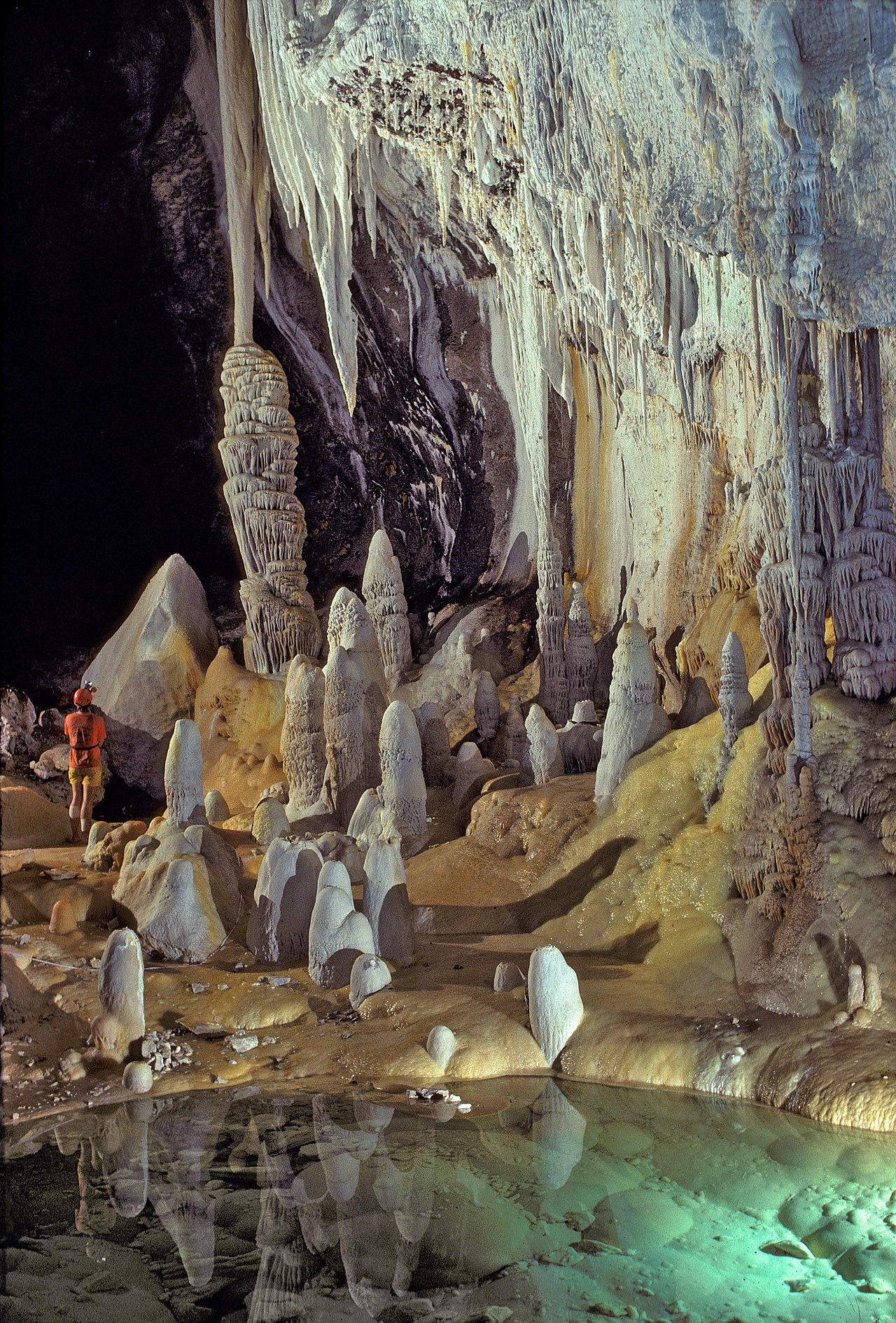
Limestone caves form when rainwater absorbs carbon dioxide from the atmosphere and soil, creating a weak carbonic acid. This acid dissolves calcium carbonate in limestone, gradually enlarging cracks into passages and chambers over hundreds of thousands to millions of years. Stalactites grow down from the ceiling and stalagmites grow up from the floor where mineral-laden water drips and deposits calcium carbonate.
Cenotes form specifically in karst landscapes where limestone dissolution creates cave systems near the water table. When the ceiling of a water-filled cave becomes too thin to support its own weight, it collapses, creating an opening to the surface. The resulting sinkhole fills with groundwater, creating the characteristic pools of crystal-clear water found throughout the Yucatan.
Types & Variations
- Solution Caves: Limestone dissolution (most common type)
- Lava Tubes: Formed by flowing lava in volcanic regions
- Open Cenotes: Fully exposed surface pools (like swimming holes)
- Cave Cenotes: Underground chambers with small surface openings
- Sea Caves: Carved by wave action on coastlines
Caves come in extraordinary variety. Solution caves in limestone are the most common and can grow to immense size. Lava tubes, formed when the surface of a lava flow solidifies while molten rock continues flowing beneath, can extend for kilometers — Kazumura Cave in Hawaii is over 65 kilometers long. Sea caves, carved by wave erosion, include Fingal's Cave in Scotland, famous for its basalt columns.
Cenotes exist on a spectrum from fully open (resembling a natural swimming pool) to semi-open (partially covered by rock overhangs) to fully enclosed cave cenotes accessible only through narrow passages. The crystal-clear water in cenotes results from natural limestone filtration — the porous rock acts as an enormous filter, removing particles and producing visibility of 30 meters or more.
Famous Caves
- Mammoth Cave, USA: 676+ km (world's longest cave system)
- Hang Son Doong, Vietnam: World's largest cave chamber (5 km long, 150 m wide, 200 m high)
- Carlsbad Caverns, USA: Massive chambers with spectacular formations
- Waitomo, New Zealand: Famous for glowworm colonies
Mammoth Cave in Kentucky contains over 676 kilometers of surveyed passages, with new sections still being discovered. The cave system formed in 300-million-year-old limestone and was known to indigenous peoples for at least 5,000 years. Mummified remains and artifacts suggest extensive use for mining gypsum and other minerals.
Hang Son Doong, discovered in 2009, redefined what caves could be. Its largest chamber is 5 kilometers long, 150 meters wide, and 200 meters high — large enough to fly a Boeing 747 through. Two massive dolines (ceiling collapses) allow light and rain into the cave, creating underground jungles with their own localized weather systems.
Famous Cenotes
- Cenote Sagrado, Chichén Itzá: Sacred Maya ceremonial cenote (60 m diameter, 27 m deep)
- Gran Cenote, Tulum: Popular crystal-clear swimming cenote
- Sistema Sac Actun: World's longest underwater cave system (376+ km)
- Ik Kil, Yucatan: Dramatic open cenote with hanging vines (26 m to water surface)
The Sacred Cenote at Chichén Itzá was the most important ceremonial cenote for the ancient Maya. Archaeological excavation has recovered gold, jade, pottery, and human remains from its depths, confirming historical accounts of offerings to the rain god Chaac. The cenote is roughly 60 meters in diameter with sheer walls dropping 27 meters to the water surface.
Sistema Sac Actun in the Yucatan was confirmed in 2018 as the world's longest underwater cave system at over 376 kilometers of surveyed passages. It connects hundreds of cenotes in a vast underground network. The system contains archaeological treasures including 12,000-year-old human remains and bones of extinct Pleistocene megafauna, providing crucial evidence of early human migration in the Americas.
Why They Matter
- Cave Importance: Geological records, unique ecosystems, archaeology, water resources
- Cenote Importance: Freshwater supply, Maya heritage, underwater archaeology, tourism
- Shared Significance: Both reveal Earth's hidden water systems and geological processes
Caves are critical archives of climate history. Stalagmites and stalactites record past climate conditions in their growth layers, much like tree rings. Cave deposits have helped reconstruct rainfall, temperature, and vegetation patterns over hundreds of thousands of years. Cave ecosystems also harbor unique species adapted to permanent darkness, including blind fish, albino crayfish, and bacteria that derive energy from minerals.
Cenotes are the primary source of fresh water in the Yucatan Peninsula, where there are virtually no surface rivers. The limestone bedrock is so porous that rainfall immediately percolates underground, feeding the water table that cenotes expose. For the ancient Maya, cenotes were the primary water source and held deep spiritual significance as entrances to Xibalba, the Maya underworld.
Key Facts
- Caves form through limestone dissolution; cenotes form when cave ceilings collapse to expose groundwater.
- Mammoth Cave (676+ km) is the world's longest cave; Hang Son Doong is the largest chamber.
- The Yucatan Peninsula has an estimated 6,000 cenotes connected by underwater cave systems.
- Sistema Sac Actun is the world's longest underwater cave at 376+ km.
- Both caves and cenotes serve as critical freshwater resources in karst landscapes.
Fun Facts
- Hang Son Doong in Vietnam is large enough to fit a 40-story building and has its own underground jungle.
- The Sacred Cenote at Chichén Itzá yielded gold, jade, and human remains offered to Maya rain gods.
- Some cave-dwelling species have been isolated so long they've lost all pigmentation and eye function.
- Cenote water can be so clear that visibility exceeds 30 meters due to natural limestone filtration.
Final Thoughts
Caves and cenotes are complementary expressions of the same geological process — water dissolving limestone over vast timescales. Caves reveal the hidden architecture of underground worlds, with chambers and passages that can extend for hundreds of kilometers. Cenotes are nature's skylights into these underground systems, exposing crystal-clear water that sustained ancient civilizations and continues to supply fresh water today. Together, they remind us that some of Earth's most remarkable landscapes lie beneath our feet.
Test Your Knowledge!
Think you can tell geographic features apart? Test your knowledge!
Play Geography Games →