
Introduction
Chile 🇨🇱 and Argentina 🇦🇷 share the longest land border in South America and the entire spine of the Andes between them, yet the two Southern Cone neighbors face opposite oceans and feel like mirror images of one another. This comparison weighs them up across area, population, capitals, climate, and the landscapes that make each so distinctive.
Whether you are studying for an exam, planning a trip down the continent, or just curious how these two compare, the figures below lay out what matters most.
Size & Geography
| Feature | Chile 🇨🇱 | Argentina 🇦🇷 |
|---|---|---|
| Area | 756,102 km² | 2,780,400 km² |
| Continent | South America | South America |
| Region | South America | South America |
| Land Borders | Peru, Bolivia, Argentina | Chile, Bolivia, Paraguay, Brazil, Uruguay |
| Landscape | long narrow strip; Andes in east, Pacific coast, Atacama Desert | Pampas plains, Andes mountains, Patagonian steppe, subtropical north |
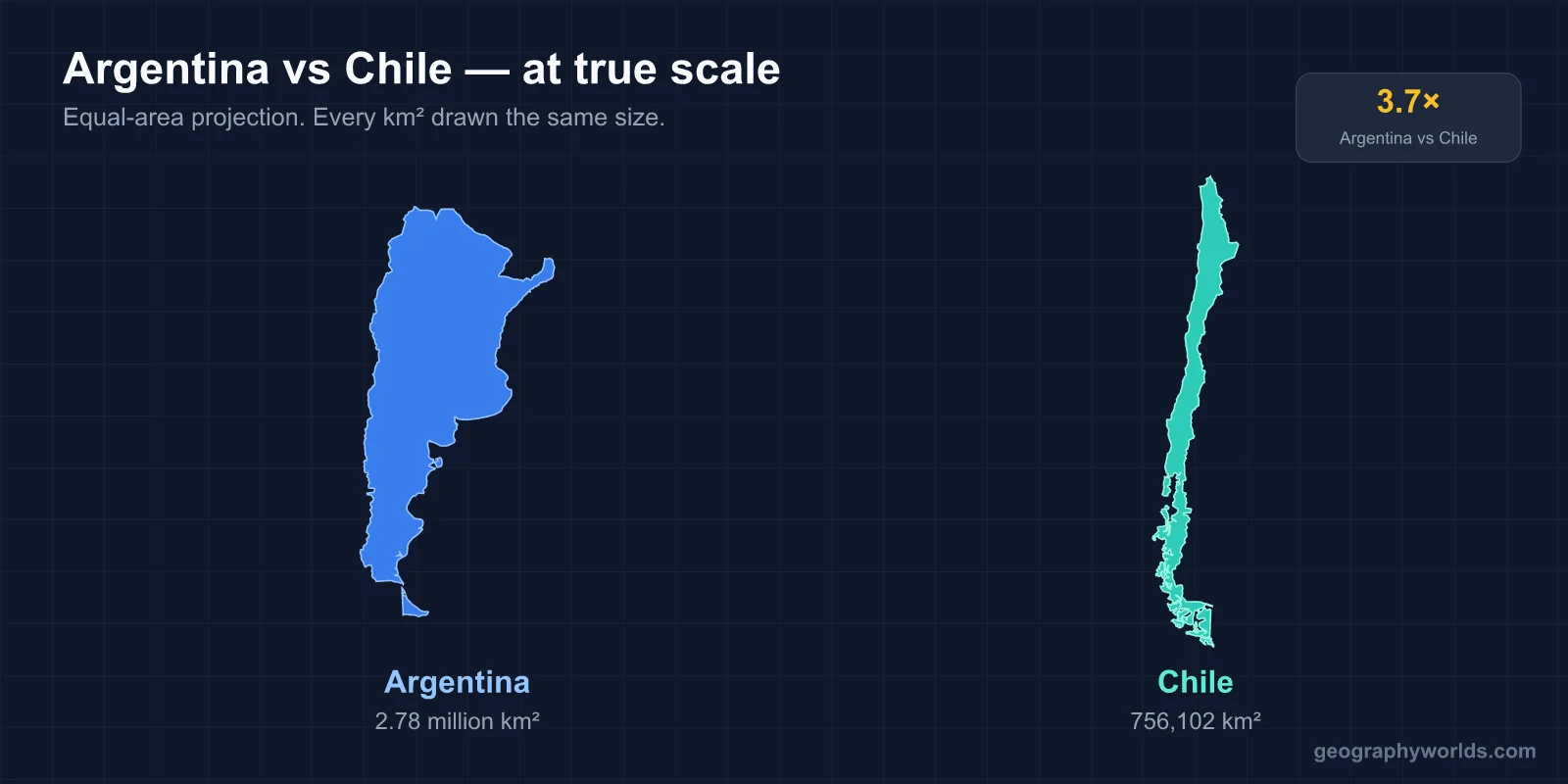
Argentina is much the larger of the two, covering 2,780,400 km² to Chile's 756,102 km² — about 3.7 times the area. Their shapes explain a lot. Chile is a long, narrow ribbon pinned between the Andes to the east and the Pacific to the west, opening at its northern end into the Atacama Desert. Argentina spreads out behind that mountain wall into the broad Pampas plains, the Patagonian steppe, and a subtropical north, with the Andes forming the shared frontier the two countries face from opposite sides.
Population & Demographics
| Metric | Chile 🇨🇱 | Argentina 🇦🇷 |
|---|---|---|
| Population | 19.9 million | 46.0 million |
| Population Density | 26.4 per km² | 16.5 per km² |
Argentina also has the bigger population at 46.0 million, roughly 2.3 times Chile's 19.9 million. The density figures, though, flip the picture: Chile packs people more tightly at 26.4 per km² versus Argentina's 16.5, a difference of about 9.8 per km². That makes sense given how little habitable width Chile's narrow strip offers compared with Argentina's wide-open interior.
Capital Cities
Chile's capital is Santiago, set in a central valley with the Andes as its backdrop, while Argentina governs from Buenos Aires on the Atlantic shore of the Río de la Plata. Both are the largest cities in their respective countries and the unmistakable hubs of national life.
Language, Currency & Culture
| Aspect | Chile 🇨🇱 | Argentina 🇦🇷 |
|---|---|---|
| Languages | Spanish (official) | Spanish (official) |
| Currency | Chilean Peso (CLP) | Argentine Peso (ARS) |
Here the two countries are close cousins. Spanish is the official language on both sides of the Andes, a shared legacy of Spanish colonial rule, even if the accents and slang are famously different. Where they part ways is money: each prints its own peso, the Chilean Peso (CLP) in one and the Argentine Peso (ARS) in the other.
Climate & Natural Features
| Aspect | Chile 🇨🇱 | Argentina 🇦🇷 |
|---|---|---|
| Climate | diverse; desert in north, Mediterranean in center, oceanic in south | mostly temperate; arid in southeast; subantarctic in southwest |
| Key Features | Atacama Desert, Patagonia, Easter Island, Torres del Paine | Andes, Patagonia, Iguazu Falls, Tierra del Fuego, Pampas |
| Economy | copper mining, agriculture (wine, fruit), fishing, forestry | agriculture (beef, soy), mining, automotive, IT |
Stretching across so many latitudes gives Chile an unusually varied climate: desert in the north, Mediterranean conditions through the center, and a cool oceanic south. Its star attractions span that range too, from the Atacama Desert and Easter Island far out in the Pacific to the granite towers of Torres del Paine and Chilean Patagonia. Argentina is mostly temperate, turning arid in the southeast and subantarctic in the southwest, and counts the Andes, Patagonia, Iguazu Falls, Tierra del Fuego, and the Pampas among its highlights. The two even split Patagonia between them. Economically, Chile leans heavily on copper mining alongside wine and fruit farming, fishing, and forestry, while Argentina builds on beef and soy, mining, automotive manufacturing, and IT.
What Makes Each Country Unique
Chile is internationally renowned for the Atacama Desert (driest place on Earth), Patagonia, Easter Island, and world-class wine. Chile is the longest north-south country in the world, stretching over 4,300 km — yet it averages only 177 km wide.
Argentina is best known for tango dancing, beef and asado culture, Patagonia, Iguazu Falls, and football legends like Maradona and Messi. Argentina named a glacier (Perito Moreno) that is one of the few in the world still growing — it advances about 2 meters per day.
Key Differences at a Glance
- Area: Chile (756,102 km²) vs Argentina (2,780,400 km²) — Argentina is 3.7x larger
- Population: Chile (19.9 million) vs Argentina (46.0 million) — Argentina is 2.3x more populous
- Capitals: Santiago vs Buenos Aires
- Currency: Chilean Peso (CLP) vs Argentine Peso (ARS)
- Continents: South America vs South America
- Density: Chile is more densely populated (difference of ~9.8 people per km²)
- Languages: Spanish (official) vs Spanish (official)
Verdict
Chile and Argentina are Southern Cone neighbors that share a language, a mountain range, and a slice of Patagonia, yet differ sharply in scale. Argentina is the bigger country on both counts, with 3.7 times the area and 2.3 times the population, while Chile makes up for its slender footprint with a noticeably higher population density.
Chile's appeal lies in its astonishing climatic range, from the desert north through a Mediterranean center to an oceanic south, anchored by sights like the Atacama and an economy built on copper mining. Argentina, mostly temperate with subantarctic extremes in the southwest, is defined by the Andes, the Pampas, and an economy resting on beef, soy, mining, automotive, and IT. Geographic neighbors, yes, but each with its own character.
Side by side, they show how two countries pressed against the same mountains can develop in completely different directions. Whether you are planning a visit, studying world geography, or simply curious, comparing them deepens the picture of South America's far south.
Test Your Knowledge!
Think you know your countries? Try our interactive geography quiz!
Play Geography Games →