

Introduction
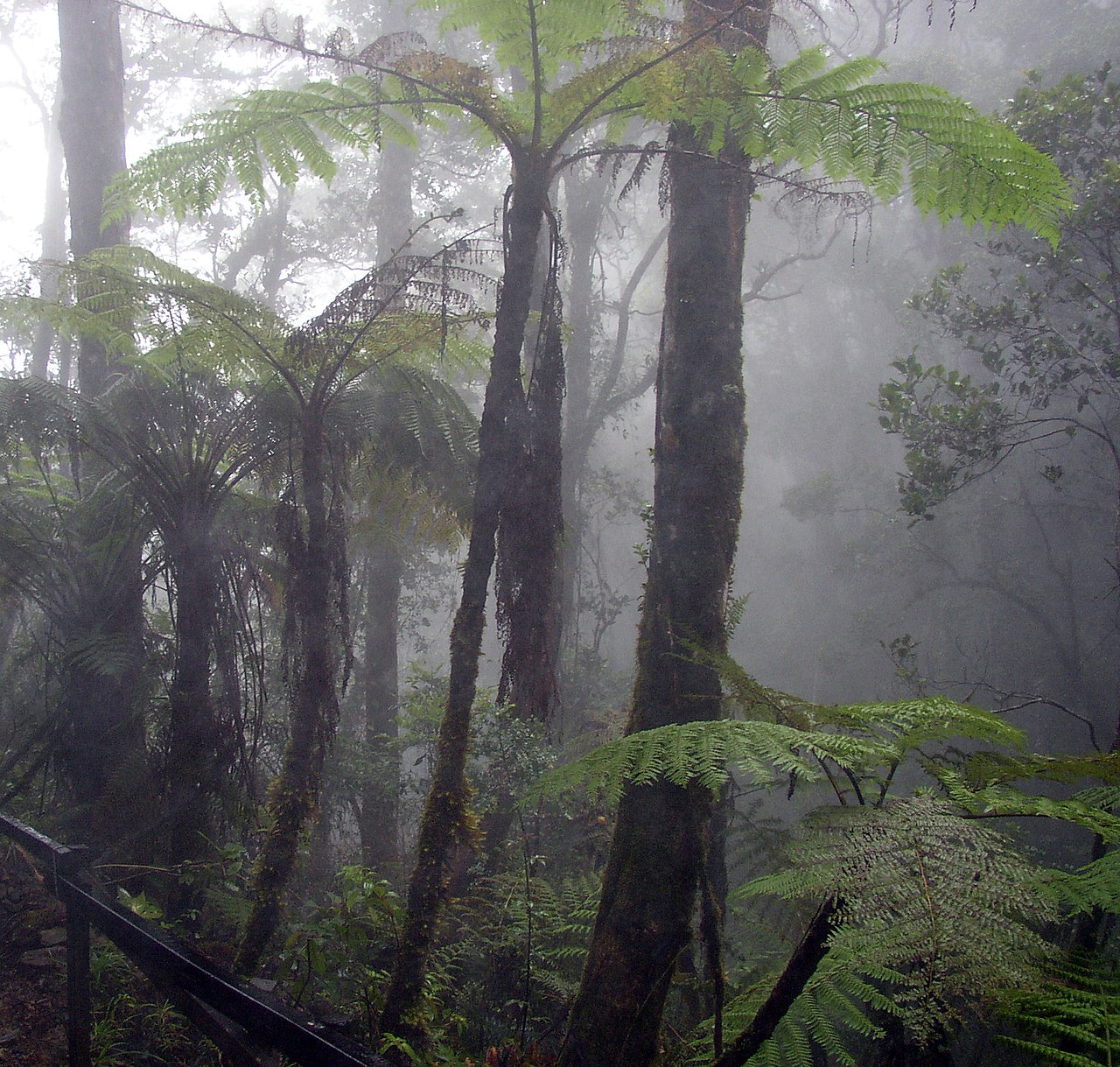
Cloud forests, also known as montane cloud forests or moss forests, are a rare and enchanting type of tropical or subtropical forest found on mountain slopes where persistent low-level cloud cover bathes the canopy in mist and fog. They typically occur between 1,000 and 3,500 meters elevation, where rising air masses cool and condense into clouds.
Though cloud forests cover less than 1% of the world's total forest area, they harbor a disproportionate share of global biodiversity. The constant moisture from fog and cloud immersion supports a stunning profusion of epiphytes — orchids, bromeliads, mosses, and ferns that grow on every available surface, creating layered vertical gardens in the canopy.
Geography & Distribution
- Global Coverage: ~1% of world's forest area
- Elevation Range: Typically 1,000-3,500 m
- Regions: Central America, Andes, East Africa, Southeast Asia, Oceania
- Fog Contribution: Up to 60% of total moisture input
Cloud forests are found on tropical and subtropical mountains worldwide, wherever the topography forces moist air masses to rise and cool to their condensation point. The largest concentrations occur in Central and South America, particularly along the Andes, but significant areas also exist in East Africa, the mountains of Borneo, New Guinea, and the islands of the Pacific.
The geographical distribution of cloud forests is determined by the cloud condensation level, which varies by region and aspect. On windward slopes facing prevailing moisture-bearing winds, cloud forests may occur as low as 500 meters. On drier leeward slopes or at continental locations, they may not appear until 2,000 meters or higher.
Climate & Hydrology
- Temperature: Typically 10-20°C
- Humidity: Near 100% for extended periods
- Fog Drip: Can add 5-20% to total water input
The defining characteristic of cloud forests is persistent immersion in cloud or fog for significant portions of the day, creating conditions of near-constant saturation. This fog drip — water condensing on leaves and dripping to the forest floor — can contribute 5-20% of the total water input to the forest beyond what rainfall alone provides.
Cloud forests act as critical water catchment areas, intercepting moisture from clouds and releasing it gradually to streams and rivers below. Many tropical and subtropical cities depend on cloud forests in their watersheds for clean drinking water. Bogota, Quito, Mexico City, and Dar es Salaam all receive a significant portion of their water from cloud forest catchments.
Biodiversity
- Epiphyte Diversity: Extraordinary — thousands of species
- Endemism: Very high, many species restricted to single peaks
- Orchid Species: Cloud forests are global centers of orchid diversity
- Amphibians: Many endemic frog species
Cloud forests are global centers of endemism — species found nowhere else. Because cloud forests occur on isolated mountain peaks, they function as ecological "sky islands," with species evolving independently on each summit. A single cloud forest mountain in the Andes can harbor dozens of endemic orchid, bromeliad, and frog species found on no other mountain.
Epiphytes are the defining organisms of cloud forests. A single tree can support hundreds of individual orchids, bromeliads, mosses, liverworts, and ferns growing on its trunk and branches. These epiphytes create aerial gardens that hold water, accumulate soil, and provide habitat for insects, frogs, and other animals high above the forest floor.
Threats & Conservation
- Main Threats: Climate change (rising cloud base), deforestation, agriculture
- Area Lost: Estimated 50%+ of original cloud forests globally
- Climate Vulnerability: Among the most climate-sensitive ecosystems on Earth
Cloud forests are among the most threatened ecosystems on the planet. Climate change is causing the altitude at which clouds form to rise, effectively pushing cloud forests upslope. Species adapted to specific elevations are forced higher, and those already near mountain summits have nowhere to go — a phenomenon scientists call "mountain-top extinction."
Conversion to agriculture, particularly coffee, tea, and cattle grazing, has destroyed large areas of cloud forest in Central America, the Andes, and East Africa. The irony is that shade-grown coffee beneath cloud forest canopy is one of the most bird-friendly forms of agriculture, yet the market pressure for sun-grown varieties continues to drive forest clearance.
Ecological Services
- Water Supply: Critical watershed protection for millions
- Carbon Storage: Dense biomass stores significant carbon
- Climate Regulation: Moisture recycling and temperature moderation
Cloud forests provide ecosystem services far out of proportion to their small global area. Their role in water supply is particularly critical: by intercepting fog moisture and releasing it to streams, cloud forests maintain river flows during dry seasons when lowland rainfall is absent. The loss of cloud forest in a watershed can reduce dry-season river flow by 10-50%.
The dense biomass of cloud forests, including the enormous weight of epiphytes and the thick organic soils on the forest floor, stores significant quantities of carbon. Cloud forest soils can be several meters deep and contain more carbon per hectare than many lowland tropical forests. Destroying cloud forests releases this stored carbon while simultaneously reducing the landscape's capacity to capture moisture.
Key Facts
- Cloud forests cover less than 1% of the world's forest area but harbor disproportionate biodiversity.
- Fog drip can contribute 5-20% of total moisture input beyond rainfall.
- Cloud forests function as "sky islands" with extremely high rates of endemic species.
- Rising cloud base due to climate change is pushing cloud forest species toward mountain-top extinction.
- Many tropical cities depend on cloud forests for a significant portion of their drinking water.
Fun Facts
- A single tree in a cloud forest can support more epiphyte species than exist in the entire flora of some temperate countries.
- The golden toad of Monteverde, Costa Rica, was one of the first species declared extinct due to climate change in 1989.
- Some cloud forest mosses can absorb up to 20 times their dry weight in water, acting as living sponges.
- Cloud forests are so misty that photographers often describe them as the hardest ecosystems on Earth to capture clearly.
Final Thoughts
Cloud forests are among the most magical and fragile ecosystems on Earth. Their misty canopies, draped in orchids and mosses, harbor species found nowhere else and provide water to millions of people downstream. As climate change pushes the clouds higher, the race to protect these mountain sanctuaries becomes ever more urgent. Losing cloud forests would mean losing irreplaceable species and critical water supplies in a single blow.
