
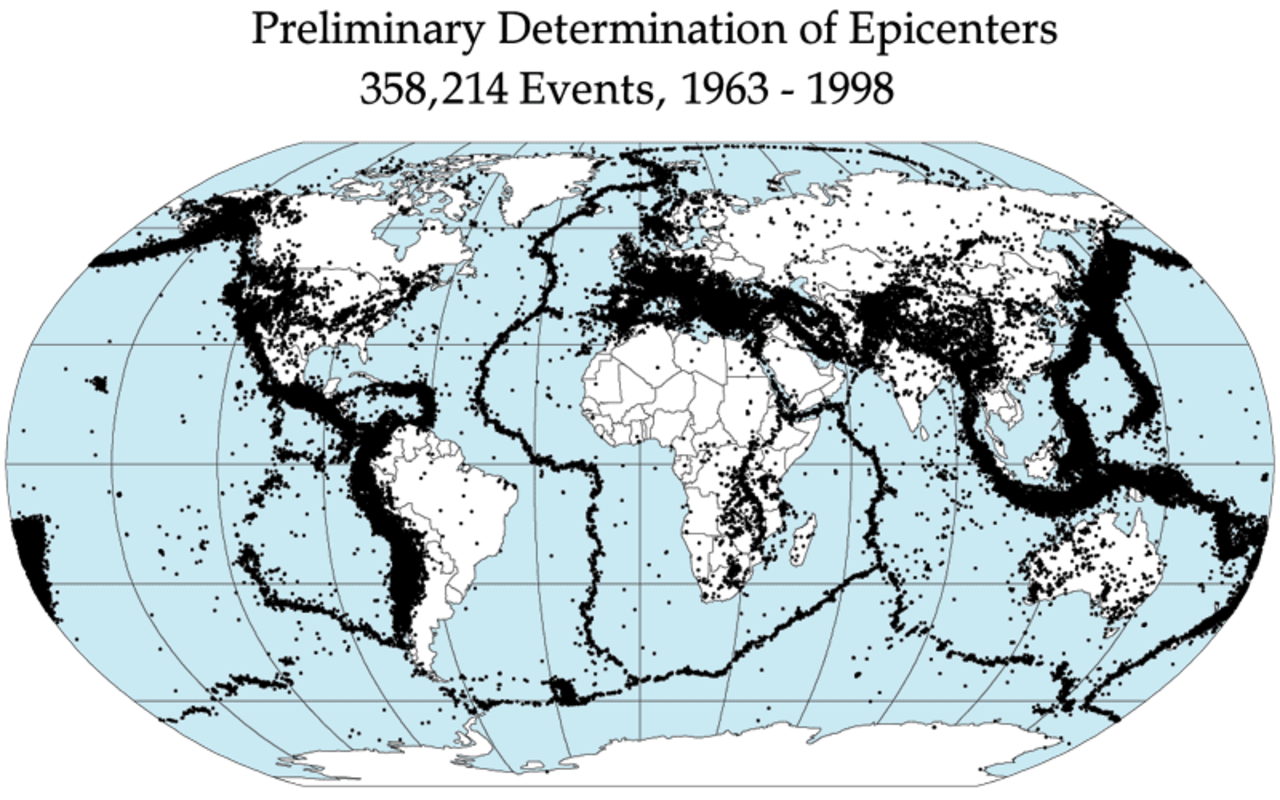
Japan records the most earthquakes of any country, with roughly 1,500 quakes of magnitude 4 or greater each year. It is followed by Indonesia (~300 significant events/year), China (~100/year), the Philippines (~100/year), and Iran (~90/year). Almost every nation on this list sits on or near a major tectonic plate boundary, especially the Pacific Ring of Fire.
Earthquakes are not distributed evenly across the planet. They cluster tightly along the seams where Earth's tectonic plates grind, dive, and collide. Understanding which countries shake most often — and why — reveals a clear geographic pattern: seismic risk follows plate boundaries. This guide ranks the world's most earthquake-prone nations, explains the geology behind each, and shows why frequency alone does not determine how deadly a quake will be.

Why Earthquakes Cluster Where They Do
The outer shell of the Earth is broken into about a dozen large tectonic plates that float on the hotter, partly molten mantle beneath them. These plates move only a few centimeters a year — about the speed your fingernails grow — but the stress that builds along their edges is enormous. When that stress is suddenly released, the ground ruptures and an earthquake occurs.
Three kinds of plate boundaries produce most of the world's seismic activity:
- Subduction zones, where one plate dives beneath another, generate the largest and most dangerous "megathrust" earthquakes (and often tsunamis). Japan, Indonesia, Chile, and the Pacific Northwest all sit on subduction zones.
- Collision zones, where two continental plates push against each other, build mountains and trigger powerful inland quakes — as in Nepal, Iran, and western China.
- Transform faults, where plates slide horizontally past one another, produce frequent shallow quakes, like those along California's San Andreas Fault.
Roughly 90% of all earthquakes — and 80% of the largest ones — occur along the Pacific Ring of Fire, a 40,000-kilometer horseshoe-shaped belt of subduction zones and volcanoes encircling the Pacific Ocean.
The Most Seismically Active Countries
1. Japan — ~1,500 earthquakes M4+/year
Japan is the most seismically active developed nation on Earth. It sits at the junction of four tectonic plates (the Pacific, Philippine Sea, Eurasian, and North American plates) and experiences roughly 1,500 earthquakes of magnitude 4 or greater every year. The devastating 2011 Tohoku earthquake (M9.1) and the tsunami it spawned killed nearly 20,000 people and triggered the Fukushima nuclear disaster — yet Japan's world-leading building codes and early-warning systems prevent far greater losses from its constant smaller quakes.
2. Indonesia — ~300 significant earthquakes/year
Indonesia sits squarely on the Ring of Fire at the meeting point of three major plates and records about 300 significant earthquakes annually. The 2004 Indian Ocean earthquake (M9.1), centered off Sumatra, generated a tsunami that killed over 230,000 people across 14 countries — the deadliest natural disaster of the 21st century. You can learn more about the country in our Indonesia flag guide.
3. China — ~100 significant earthquakes/year
China experiences roughly 100 significant earthquakes per year, concentrated along the fault systems of western China and the Himalayan collision zone. The 2008 Sichuan earthquake (M7.9) killed over 87,000 people, while the 1556 Shaanxi earthquake — which collapsed cave dwellings carved into soft loess soil — remains the deadliest in recorded history, claiming an estimated 830,000 lives.
4. Philippines — ~100 significant earthquakes/year
The Philippines lies along the Ring of Fire between the Philippine Sea Plate and the Eurasian Plate, recording around 100 significant earthquakes a year. The offshore Manila Trench is capable of generating megathrust earthquakes and tsunamis that threaten the densely populated coastal cities of Luzon. See our Philippines flag guide for more on the archipelago.
5. Iran — ~90 significant earthquakes/year
Iran sits on several major fault zones where the Arabian Plate collides with the Eurasian Plate, crumpling the land into the Zagros and Alborz mountains. The country suffers frequent destructive quakes, including the 2003 Bam earthquake (M6.6), which killed over 26,000 people and destroyed the 2,000-year-old citadel of Arg-e Bam.
6. Turkey — ~80 significant earthquakes/year
Turkey straddles the boundary between the Anatolian, Arabian, and Eurasian plates, with the North Anatolian Fault running across the country. The 2023 Turkey-Syria earthquake sequence (M7.8 and M7.7) killed over 59,000 people, one of the deadliest disasters in modern Turkish history.
7. Peru — ~70 significant earthquakes/year
Peru lies along the Peru-Chile Trench, where the Nazca Plate subducts beneath the South American Plate. The 1970 Ancash earthquake (M7.9) triggered a catastrophic landslide that buried the town of Yungay, killing an estimated 70,000 people.
8. Chile — ~60 significant earthquakes/year
Chile's entire western border sits above the Nazca Plate subduction zone, making it a producer of some of the most powerful earthquakes ever recorded — including the 1960 Valdivia earthquake (M9.5), the strongest ever measured by instruments. Decades of experience have made Chile a global leader in earthquake-resistant construction.
9. Mexico — ~50 significant earthquakes/year
Mexico is shaped by the subduction of the Cocos Plate beneath the North American Plate along its Pacific coast. The 1985 earthquake (M8.0) killed over 10,000 people in the capital despite an epicenter 350 km away, because the soft former lake-bed sediments beneath Mexico City dramatically amplified the ground motion.
10. United States — ~50 significant earthquakes/year
The US records about 50 significant earthquakes a year, concentrated in Alaska, California, and the Pacific Northwest. Alaska alone accounts for roughly 11% of the world's earthquakes, and the 1964 Great Alaska earthquake (M9.2) was the second most powerful ever recorded.
11. Italy — ~30 significant earthquakes/year
Italy sits on the complex boundary between the African and Eurasian plates, fractured by several microplates running down the Apennine mountains. The 2009 L'Aquila earthquake (M6.3) killed 309 people, and the 2016 Amatrice earthquake (M6.2) devastated historic central Italian towns.
12. Nepal — ~30 significant earthquakes/year
Nepal sits directly on the collision zone between the Indian and Eurasian plates — the same forces that built the Himalayas and continue to lift Mount Everest a few millimeters each year. The 2015 Gorkha earthquake (M7.8) killed nearly 9,000 people and damaged or destroyed over 600,000 structures.
Frequency Versus Deadliness
The country with the most earthquakes is not necessarily the one where they are most deadly. Japan shakes constantly yet usually survives with minimal loss of life, thanks to rigorous building codes, base-isolated skyscrapers, and a nationwide early-warning network that can give residents seconds to brace before strong shaking arrives.
By contrast, the world's deadliest quakes have often struck regions with poor construction — unreinforced masonry, mudbrick homes, or buildings on soft soil. Magnitude measures the energy released, but casualties depend on depth, distance from population centers, time of day, soil type, and above all the quality of the buildings people live in. This is why a moderate M6 quake can kill thousands in one country while a far stronger M8 causes few deaths in another.
Key Facts
- Most earthquakes (by count): Japan, ~1,500 M4+ events per year
- Main cause: Movement along tectonic plate boundaries
- Ring of Fire share: About 90% of the world's earthquakes
- Strongest ever recorded: 1960 Valdivia, Chile (M9.5)
- Deadliest in history: 1556 Shaanxi, China (~830,000 deaths)
- Global total: Several million quakes per year, but only ~100,000 are felt and ~100 cause damage
- Biggest survival factor: Building codes and earthquake engineering, not magnitude alone
Final Thoughts
The countries most prone to earthquakes are overwhelmingly clustered along tectonic plate boundaries, especially the Pacific Ring of Fire and the great collision belt running from the Mediterranean through Iran to the Himalayas. Frequency cannot be controlled, but the examples of Japan and Chile prove that engineering, early warning, and public education can turn potentially catastrophic events into survivable ones.
Test Your Knowledge!
How well do you know world geography? Try our interactive games!
Play Geography Games →Frequently Asked Questions
Which country has the most earthquakes?
Japan has the most earthquakes of any country, recording roughly 1,500 quakes of magnitude 4 or greater every year. Its position at the junction of four tectonic plates makes it the most seismically active developed nation on Earth.
Why does Japan have so many earthquakes?
Japan sits where the Pacific, Philippine Sea, Eurasian, and North American plates meet. The Pacific Plate is being forced beneath Japan in a subduction zone, building up enormous stress that is released as frequent earthquakes — and occasionally as massive megathrust quakes like the 2011 Tohoku event.
What is the Ring of Fire?
The Ring of Fire is a roughly 40,000-kilometer horseshoe-shaped belt of subduction zones, fault lines, and volcanoes encircling the Pacific Ocean. About 90% of the world's earthquakes and many of its most active volcanoes occur along it, which is why so many of the countries on this list border the Pacific.
Where was the strongest earthquake ever recorded?
The strongest earthquake ever recorded by instruments was the 1960 Valdivia earthquake in Chile, which measured magnitude 9.5. Chile's western coast sits above the Nazca Plate subduction zone, which is capable of producing the planet's most powerful quakes.
