
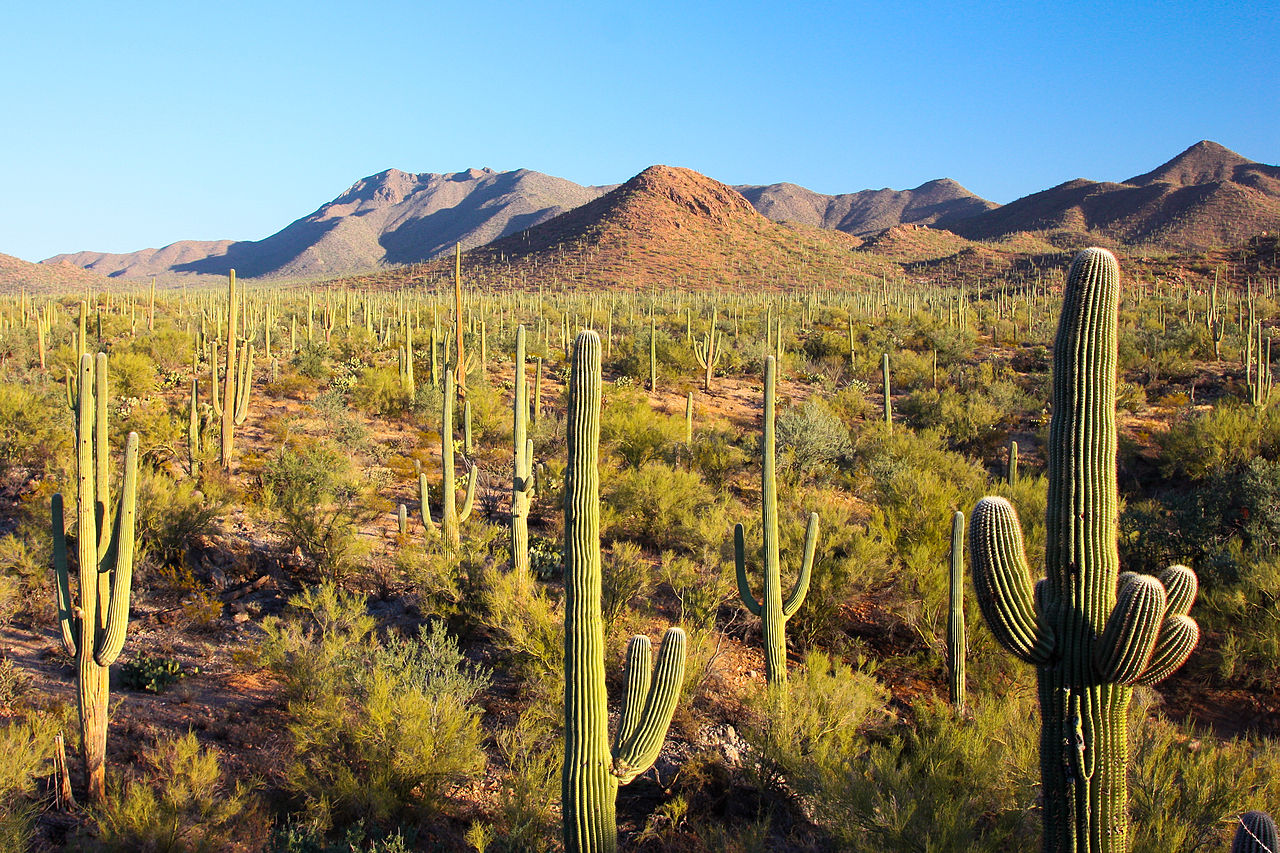
Arizona is the most desert-rich state in the United States, containing portions of four of North America's five major desert ecosystems: the Sonoran, Chihuahuan, Mojave, and Great Basin deserts. Each desert has its own distinct character, ecology, and visual identity, shaped by differences in elevation, rainfall patterns, and geological history.
Introduction
Despite the common perception of deserts as barren wastelands, Arizona's deserts are remarkably diverse and alive. The Sonoran Desert alone supports over 2,000 plant species and is one of the most biodiverse desert ecosystems on Earth. The state's desert landscapes range from the iconic saguaro-studded valleys of the south to the colorful badlands of the Painted Desert in the north.

Major Geographic Features
Sonoran Desert
The Sonoran Desert covers approximately 312,000 square km across southern Arizona, southeastern California, and northwestern Mexico. In Arizona, it dominates the southern and western portions of the state, including the Phoenix and Tucson metropolitan areas. The Sonoran is the hottest desert in North America, with summer temperatures regularly exceeding 48°C (118°F), yet it is also the wettest North American desert thanks to biseasonal rainfall (summer monsoons and winter storms). It is the only place in the world where the saguaro cactus (Carnegiea gigantea) grows naturally.
Saguaro Cactus Habitat
The saguaro cactus is the iconic symbol of Arizona's desert landscape, growing exclusively in the Sonoran Desert at elevations between 180 and 1,370 meters. These magnificent plants can reach heights of 12 meters (40 feet), weigh up to 4,800 kg when fully hydrated, and live for 150-200 years. A saguaro does not grow its first arm until it is roughly 50-70 years old. Saguaro National Park near Tucson protects one of the densest concentrations of these giant cacti.
Painted Desert
The Painted Desert stretches approximately 240 km from near the Grand Canyon to the Petrified Forest National Park in northeastern Arizona. Its colorful badlands formations display vivid bands of red, orange, pink, purple, gray, and white, created by varying mineral content in layers of the Chinle Formation deposited during the Late Triassic period (roughly 225 million years ago). The colors intensify after rainfall, making the landscape appear almost painted by hand.
Chihuahuan Desert
The Chihuahuan Desert extends into southeastern Arizona from its main body in Mexico and New Mexico. In Arizona, it occupies the Sulphur Springs Valley and parts of the San Pedro and San Simon valleys at elevations typically between 1,000 and 1,500 meters. This higher elevation makes the Chihuahuan cooler and drier than the Sonoran, supporting a different plant community dominated by creosote bush, tarbush, and various agave species rather than saguaros.
Mojave Desert Influence
The Mojave Desert extends into a small portion of northwestern Arizona, primarily along the Colorado River corridor and in the area around Kingman. The Mojave is characterized by the Joshua tree (Yucca brevifolia), though Joshua trees are found in only limited areas of Arizona. The Mojave is the smallest and driest of the North American deserts, receiving less than 13 cm of annual rainfall in many areas.
Great Basin Desert Influence
The Great Basin Desert — the largest desert in North America by area — extends its influence into northeastern Arizona, primarily on the Colorado Plateau above 1,500 meters elevation. This cold desert is dominated by sagebrush and receives most of its modest precipitation as winter snow. The Arizona Strip, the remote region north of the Grand Canyon, shows the strongest Great Basin Desert characteristics in the state.
Desert Adaptations and Biodiversity
Arizona's deserts support an astonishing diversity of life adapted to extreme conditions. The Sonoran Desert alone harbors over 2,000 plant species, 350 bird species, 100 reptile species, and 60 mammal species. Adaptations include the saguaro's accordion-like ribs that expand to store water, the Gila monster's ability to survive on just three large meals per year, and the kangaroo rat's ability to live its entire life without drinking water, obtaining all moisture from its food.
Key Geographic Facts
- Arizona contains portions of four major North American desert ecosystems
- The Sonoran Desert covers approximately 312,000 square km across three countries
- The Painted Desert stretches 240 km across northern Arizona
- The saguaro cactus grows naturally only in the Sonoran Desert
- Arizona's deserts range from below 60 meters elevation to over 1,500 meters
Fun Facts
- Saguaro cacti can live for 150-200 years and don't grow their first arm until age 50-70
- The Sonoran Desert is paradoxically both the hottest and the wettest desert in North America
- Kangaroo rats in Arizona's deserts can live their entire lives without ever drinking water
- The Painted Desert's colors intensify dramatically after rainfall, creating an almost surreal landscape
- A fully hydrated saguaro cactus can weigh up to 4,800 kg — about as much as a pickup truck
Final Thoughts
Arizona's deserts are far more than empty sand and heat. They represent four distinct desert ecosystems, each with unique geology, climate, and ecology. From the saguaro forests of the Sonoran to the painted badlands of the north, Arizona's desert landscapes are among the most diverse, beautiful, and ecologically rich arid regions on the planet.
Test Your Knowledge!
Think you know your US state geography? Try our interactive quiz!
Play Country Quiz →