
The Edinburgh Festival Fringe is the world's largest open-access arts festival, presenting over 3,800 shows across more than 300 venues in Scotland's capital each August. From stand-up comedy in converted basements to Shakespeare in castle courtyards, the Fringe transforms Edinburgh's dramatic volcanic landscape into a 25-day celebration of performing arts that attracts over 3 million ticket purchases annually.
Introduction
Edinburgh's geography is uniquely suited to hosting a festival of this scale. The city is built on a series of volcanic hills — the dramatic Castle Rock, Arthur's Seat (251 m), and Calton Hill — connected by the medieval Royal Mile and the Georgian grid of the New Town. This compact, walkable urban core allows festivalgoers to move between dozens of venues on foot within minutes.
The Fringe is technically separate from (but concurrent with) the Edinburgh International Festival, the Edinburgh International Book Festival, the Edinburgh Art Festival, and the Royal Edinburgh Military Tattoo — all held in August, collectively making Edinburgh the cultural capital of the world for one month each year.
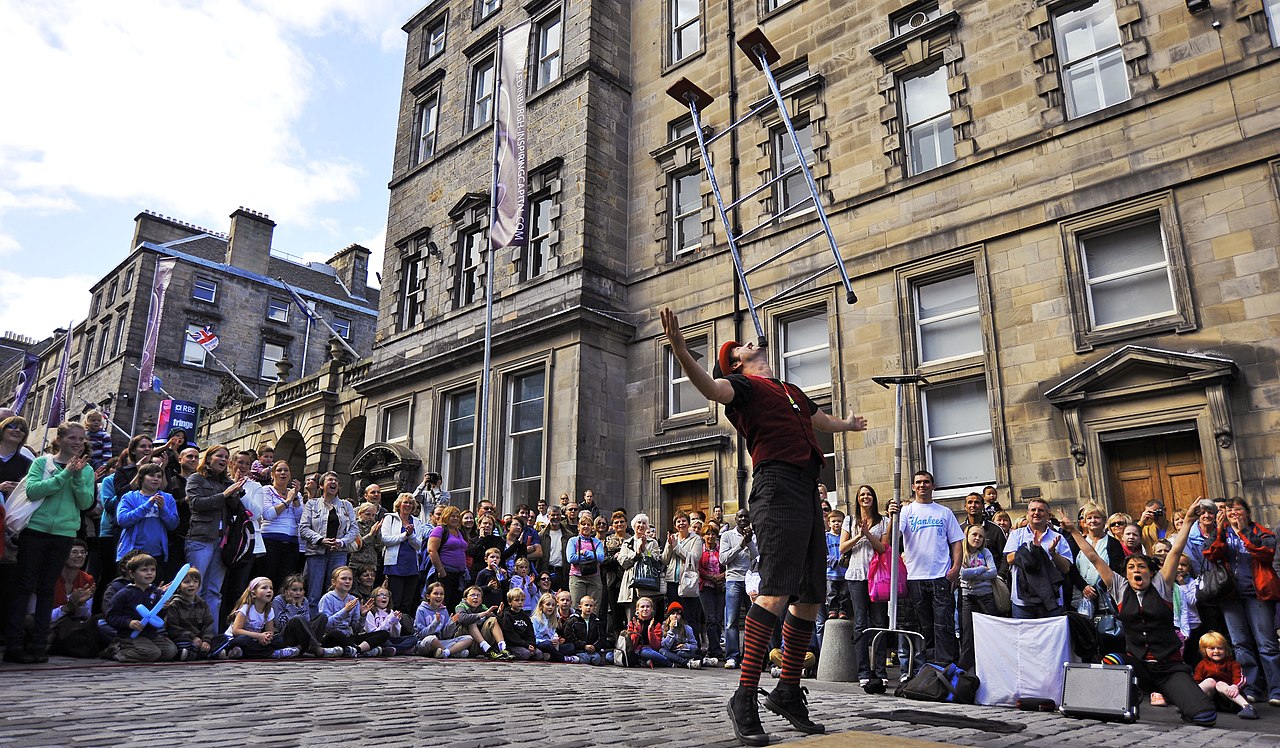
Geography & Venues
- City Location: 55.95°N, 3.19°W, east coast of Scotland
- Elevation: Castle Rock: 130 m, Arthur's Seat: 251 m
- Key Areas: Royal Mile, Bristo Square, Pleasance, George Square
- Venues: 300+ (theaters, bars, churches, tents, buses, apartments)
Edinburgh's Old Town, centered on the Royal Mile — a roughly 1.6-kilometer street descending from Edinburgh Castle to the Palace of Holyroodhouse — is the geographic heart of the Fringe. The medieval closes (narrow alleyways) and wynds (lanes) branching off the Mile create an intimate, labyrinthine performance landscape. Shows take place in every conceivable space: church halls, university lecture theaters, shipping containers, double-decker buses, and even public toilets.
The Pleasance courtyard complex (a converted university building) and Bristo Square / George Square area form the main Fringe hubs, where major venue operators (Pleasance, Underbelly, Assembly, Gilded Balloon) concentrate their programming. The New Town's Charlotte Square hosts the Book Festival, while Edinburgh Castle's Esplanade is commandeered for the Military Tattoo. The city's volcanic topography provides natural amphitheaters and dramatic backdrops that no purpose-built venue could match.
History & Origins
- International Festival Founded: 1947 (post-war cultural renewal)
- First Fringe: 1947 (8 uninvited companies performed alongside)
- Fringe Society Founded: 1958
- Open Access: Anyone can register and perform
The Edinburgh Fringe was born in 1947 as an act of creative rebellion. When the Edinburgh International Festival launched that year as a prestigious, invitation-only event to promote European cultural unity after World War II, eight theater companies showed up uninvited and performed on the "fringe" of the official program. The word "fringe" stuck, and the principle of open access — anyone can register and perform, regardless of reputation — became the festival's defining feature.
The Fringe grew gradually through the 1950s and 1960s, exploding in scale from the 1980s onward as comedy became its dominant art form. Today, the Fringe features over 58,000 performances across 25 days, covering comedy, theater, dance, music, spoken word, circus, children's shows, and experimental forms that defy categorization. The festival has launched the careers of countless performers, from Monty Python's original Edinburgh shows to early appearances by Eddie Izzard, Phoebe Waller-Bridge, and Fleabag.
Scale & Economics
- Shows: 3,800+ (2023)
- Performances: 58,000+ across 25 days
- Ticket Sales: 3+ million annually
- Economic Impact: £400+ million for Edinburgh
The Fringe's economic impact on Edinburgh is immense: over £400 million injected into the local economy during August, with hotels, restaurants, bars, and retailers all experiencing their busiest month. Room rates in central Edinburgh triple during the festival, and many residents rent out their homes entirely and leave the city.
For performers, the economics are less favorable. The vast majority of Fringe shows lose money: venue hire, accommodation, transportation, and marketing costs typically exceed ticket revenue for all but the most successful acts. A comedian performing a one-hour show for 25 days might spend £10,000–£20,000 on the experience. The Fringe is an investment in exposure and career development rather than a profitable venture for most participants.
Comedy & Cultural Impact
- Comedy Dominance: ~40% of all Fringe shows
- Edinburgh Comedy Award: Formerly Perrier Award, most prestigious comedy prize
- Notable Alumni: Python, Izzard, Waller-Bridge, Hannah Gadsby, Bo Burnham
Comedy has dominated the Fringe since the 1980s, now comprising approximately 40% of all shows. The Edinburgh Comedy Award (formerly the Perrier Award), presented annually since 1981, is the most prestigious prize in stand-up comedy, and winning it can transform a career overnight. Past winners include Steve Coogan, Lee Mack, Al Murray, and Hannah Gadsby, whose Nanette won in 2017 before becoming a global Netflix phenomenon.
The Fringe also serves as a crucial development ground for theater. Productions frequently transfer to London's West End or New York's Broadway after successful Edinburgh runs. Fleabag, one of the most acclaimed TV shows of the 2010s, began as a one-woman Fringe show by Phoebe Waller-Bridge at the 2013 festival. The festival's open-access model ensures that radical and experimental work exists alongside mainstream entertainment.
Visitor Information
- Dates: First three weeks of August + final days
- Getting There: Edinburgh Airport (EDI), Waverley Station (rail)
- Climate: 12–19°C, frequent rain possible
- Free Shows: Hundreds of free Fringe shows daily
Edinburgh in August is a city transformed: every wall is plastered with posters, every street corner features performers, and the population effectively doubles. The Royal Mile becomes an open-air stage where performers distribute flyers and deliver mini-performances (known as "flyering") to attract audiences to their shows. The sensory overload is part of the experience.
Visitors should plan accommodation well in advance — Edinburgh during the Fringe is one of the most expensive and fully booked cities in Europe. The climate is unpredictable: August temperatures range from 12°C to 19°C, with rain always possible. Comfortable walking shoes are essential, as the city's volcanic terrain means steep hills between venues. The Fringe app and program are indispensable for navigating the thousands of available shows.
Key Facts
- The Edinburgh Fringe features 3,800+ shows and 58,000+ performances across 25 days each August.
- The festival generates over £400 million in economic impact for Edinburgh.
- The Fringe began in 1947 when 8 uninvited theater companies performed alongside the official Edinburgh International Festival.
- Edinburgh's volcanic geography — Castle Rock, Arthur's Seat, the Royal Mile — provides a dramatic natural stage.
- The open-access model means anyone can register and perform, regardless of experience or reputation.
Fun Facts
- The Edinburgh Fringe program is over 300 pages long and lists more shows than could be seen if you attended 15 per day for the entire festival.
- The smallest Fringe venue is a modified taxi cab that seats an audience of two.
- Edinburgh becomes the second-most expensive city in the UK (after London) during August due to festival demand.
- The Royal Mile during the Fringe features so many poster-distributing performers that walking its 1.6-kilometer length can take over an hour.
Final Thoughts
The Edinburgh Festival Fringe is a testament to what happens when extraordinary geography meets unlimited creative ambition. Edinburgh's compact volcanic landscape, medieval architecture, and walkable urban core create the perfect stage for the world's largest arts festival — a month-long celebration of human creativity that transforms an already beautiful city into something truly extraordinary.
Test Your Knowledge!
Think you know your world festivals and cultural geography? Try our interactive quiz!
Play Geography Games →