
Introduction
Egypt 🇪🇬 and India 🇮🇳 are two of the oldest continuously inhabited places on Earth, each home to a river civilization that took root thousands of years ago. Yet they sit in very different settings: one anchored to a single life-giving river cutting through desert, the other spread across a subcontinent of mountains, plains, and tropical coasts. This comparison lays them side by side across the things that shape a country most: how big it is, how many people live there, where the capital sits, what the climate does, and how the economy makes its living.
If you are studying for a geography exam, mapping out travel, or just want the numbers in one place, the tables below give you the essentials at a glance, with a bit of context to make the figures mean something.
Size & Geography
| Feature | Egypt 🇪🇬 | India 🇮🇳 |
|---|---|---|
| Area | 1,002,450 km² | 3,287,263 km² |
| Continent | Africa | Asia |
| Region | North Africa | South Asia |
| Land Borders | Libya, Sudan, Israel, Palestine | Pakistan, China, Nepal, Bhutan, Bangladesh, Myanmar |
| Landscape | vast desert with the fertile Nile Valley | Himalayan mountains, Indo-Gangetic plain, Deccan Plateau, coastal regions |
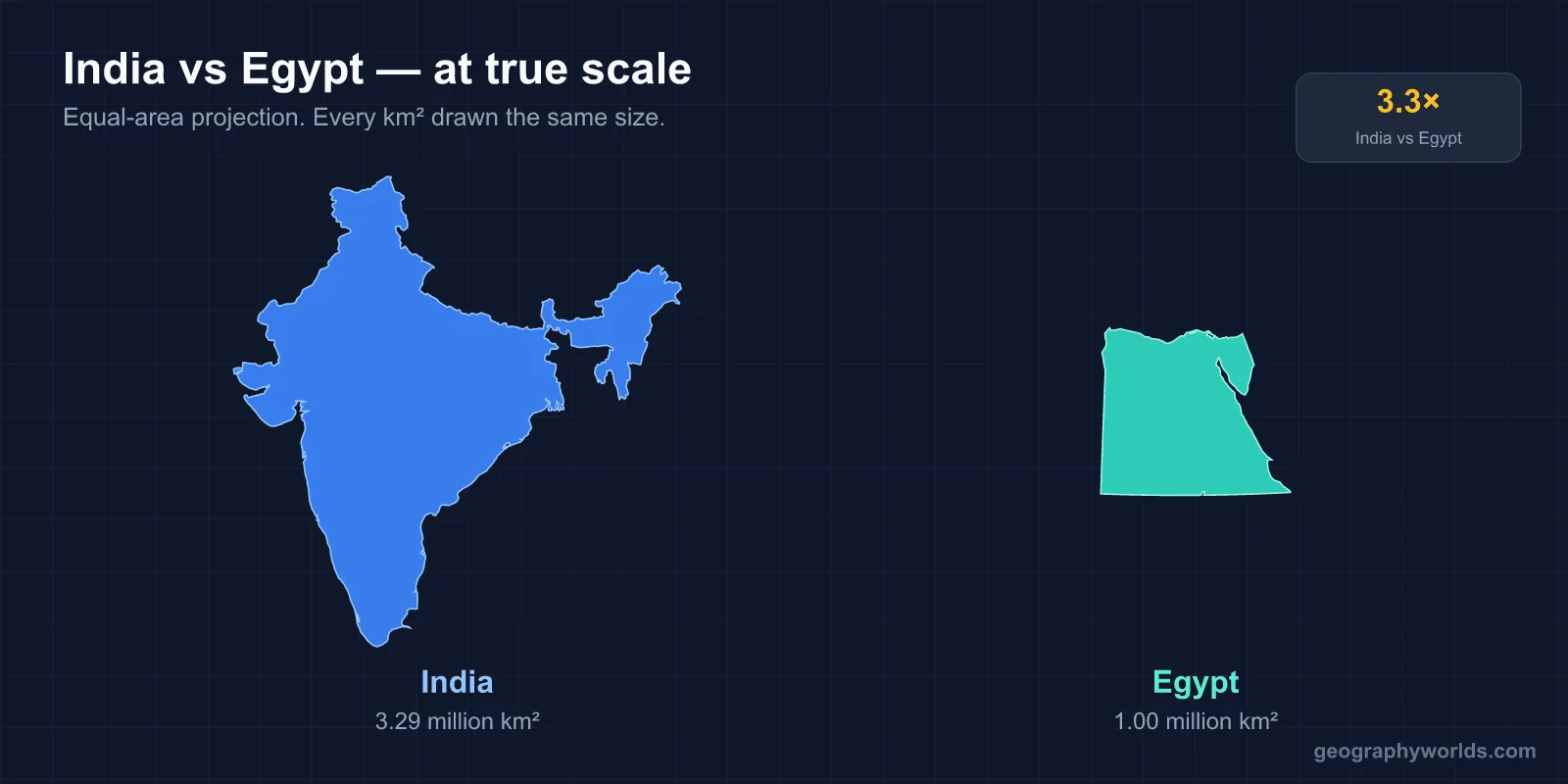
At 3,287,263 km², India covers more than three times the ground Egypt does, with its 1,002,450 km². But raw size tells only part of the story. Most of Egypt is the vast desert that surrounds the fertile Nile Valley, so the area where people actually live and farm is a thin green ribbon along the river rather than the whole map. India's territory, by contrast, is genuinely varied and largely usable, running from the Himalayan mountains in the north down through the Indo-Gangetic plain, across the Deccan Plateau, and out to long coastal regions on two seas. The border lists reflect this too: Egypt touches four neighbors at the crossroads of Africa and the Middle East (Libya, Sudan, Israel, and Palestine), while India shares frontiers with six countries across South Asia, from Pakistan and China to Nepal, Bhutan, Bangladesh, and Myanmar.
Population & Demographics
| Metric | Egypt 🇪🇬 | India 🇮🇳 |
|---|---|---|
| Population | 120.1 million | 1.48 billion |
| Population Density | 119.8 per km² | 449.2 per km² |
The population gap is the widest difference between these two countries. India is home to roughly 1.48 billion people, about 12.3 times Egypt's 120.1 million, and is the most populous nation on Earth. Density widens the contrast further: India averages 449.2 people per km² against Egypt's 119.8, a gap of about 329.4 people per km². It is worth remembering, though, that Egypt's national density figure is misleading on the ground. Because almost everyone is packed into the Nile Valley and Delta, the lived density along the river is far higher than the country-wide average suggests, while the surrounding desert stays nearly empty.
Capital Cities
Egypt is governed from Cairo, the sprawling metropolis on the Nile that is one of the largest cities in both Africa and the Arab world. India's capital is New Delhi, the purpose-built seat of government within the wider Delhi area in the country's north. One sits on the African continent, the other in Asia, and both rank among the busiest urban centers their regions have to offer.
Language, Currency & Culture
| Aspect | Egypt 🇪🇬 | India 🇮🇳 |
|---|---|---|
| Languages | Arabic (official), Egyptian Arabic widely spoken | Hindi and English (official), plus 21 other scheduled languages |
| Currency | Egyptian Pound (EGP) | Indian Rupee (INR) |
Language is where the two countries diverge most sharply. Egypt is largely unified around a single tongue: Arabic is the official language, and the Egyptian Arabic dialect is widely spoken in daily life. India is the opposite story, holding Hindi and English as its official languages alongside 21 other scheduled languages, which makes day-to-day communication genuinely multilingual across regions. On money, Egyptians pay in the Egyptian Pound (EGP) while Indians use the Indian Rupee (INR).
Climate & Natural Features
| Aspect | Egypt 🇪🇬 | India 🇮🇳 |
|---|---|---|
| Climate | desert; hot, dry summers and mild winters | varies from tropical monsoon to alpine in the north |
| Key Features | Nile River, Sahara Desert, Suez Canal, Sinai Peninsula | Himalayas, Ganges River, Thar Desert, Western Ghats |
| Economy | tourism, Suez Canal revenues, oil, agriculture | IT services, agriculture, manufacturing, pharmaceuticals |
Egypt's weather is consistent and largely predictable: a desert climate with hot, dry summers and mild winters, rain a rarity outside the coast. India is far more variable, ranging from a tropical monsoon climate, with its make-or-break summer rains, to alpine conditions in the north. The landmarks follow suit. Egypt's standout features cluster around water and sand, including the Nile River, the Sahara Desert, the Suez Canal, and the Sinai Peninsula. India's geography reads like a tour of extremes, taking in the Himalayas, the Ganges River, the Thar Desert, and the Western Ghats. Those settings shape how each country earns a living. Egypt leans on tourism, Suez Canal revenues, oil, and agriculture, with the canal turning its location between two seas into a steady source of income. India's economy is broader and more industrialized, built on IT services, agriculture, manufacturing, and pharmaceuticals.
What Makes Each Country Unique
Egypt is internationally renowned for the Pyramids of Giza, ancient pharaonic civilization, and the Nile River. The Great Pyramid of Giza was the tallest man-made structure in the world for over 3,800 years, a record almost impossible to imagine being held today.
India is best known for the Taj Mahal, Bollywood cinema, diverse cuisine, and being the world's largest democracy. India has 22 officially recognized languages and over 19,500 dialects, making it one of the most linguistically diverse countries on the planet.
Key Differences at a Glance
- Area: Egypt (1,002,450 km²) vs India (3,287,263 km²) — India is 3.3x larger
- Population: Egypt (120.1 million) vs India (1.48 billion) — India is 12.3x more populous
- Capitals: Cairo vs New Delhi
- Currency: Egyptian Pound (EGP) vs Indian Rupee (INR)
- Continents: Africa vs Asia
- Density: India is more densely populated (difference of ~329.4 people per km²)
- Languages: Arabic (official) vs Hindi and English (official)
Verdict
Comparing Egypt and India is really a study in scale and concentration. India is the bigger country on almost every count, 3.3x the land area and 12.3x the population, and far more densely settled. Egypt is the more compact nation, but its real story is concentration: a huge share of its 120.1 million people lives within reach of the Nile, which makes the country feel far more crowded than its national density of 119.8 per km² implies.
Climate and economy follow the same divide. Egypt is the steady desert country, hot dry summers and mild winters, earning its keep from tourism, the Suez Canal, oil, and farming along the Nile. India is the country of variety, swinging from tropical monsoon to alpine in the north, with an economy spread across IT services, agriculture, manufacturing, and pharmaceuticals. Two ancient river civilizations, two very different ways of filling a map.
Whether you are planning a visit, studying world geography, or simply satisfying your curiosity, understanding these differences helps build a richer picture of our diverse planet.
Test Your Knowledge!
Think you know your countries? Try our interactive geography quiz!
Play Geography Games →