

The English Channel (La Manche in French, meaning "the sleeve") is a narrow arm of the Atlantic Ocean that separates southern England from northern France. At its narrowest point — the Strait of Dover — the channel is just 33.3 kilometers (20.7 miles) wide, making it one of the most strategically important and heavily trafficked waterways in the world. Beneath its waters runs the Channel Tunnel, one of the greatest engineering achievements of the 20th century.
Introduction
The English Channel has shaped the history of both Britain and France more than perhaps any other body of water. It served as Britain's natural moat against invasion for centuries, was the stage for the D-Day landings in 1944, and has been a highway for trade since Roman times. Today, it is the busiest shipping lane on the planet and a symbol of the close yet complex relationship between Britain and continental Europe.
Geography & Dimensions
- Length: ~560 km (350 mi)
- Width: 33.3 km at Strait of Dover; 240 km at widest
- Average Depth: ~63 m (207 ft)
- Maximum Depth: ~174 m (571 ft) in the Hurd Deep
The English Channel stretches from the Atlantic Ocean in the west (between Land's End in Cornwall and Ushant island off Brittany) to the Strait of Dover in the east, where it narrows dramatically before connecting to the North Sea. The channel is shaped like a funnel, widening from 33 km at Dover to approximately 240 km where it meets the Atlantic. This funnel shape amplifies tidal ranges, creating some of the largest tides in the world at its western end.
The Hurd Deep, a narrow trench about 150 km southwest of the Strait of Dover, reaches the channel's maximum depth of approximately 174 metres. The rest of the channel is relatively shallow, averaging about 63 metres. The Channel Islands — Jersey, Guernsey, and smaller islets — lie in the wider western section near the French coast, despite being British Crown Dependencies. The Isle of Wight sits off England's southern coast in the central channel.
Formation & Geology
- Formation: ~450,000 years ago (initial breach) and ~8,200 years ago (final flooding)
- Cause: Catastrophic overflow of a glacial lake
- Previous Land Bridge: Weald-Artois anticline connected Britain to France
- White Cliffs: Chalk formations on both English and French sides
Britain was connected to continental Europe by a chalk ridge called the Weald-Artois anticline until approximately 450,000 years ago, when a vast glacial lake that had formed in what is now the southern North Sea breached the ridge in a catastrophic megaflood. Scientists believe two separate megafloods — the first around 450,000 years ago and a second around 160,000 years ago — carved the channel's distinctive valley and the Strait of Dover.
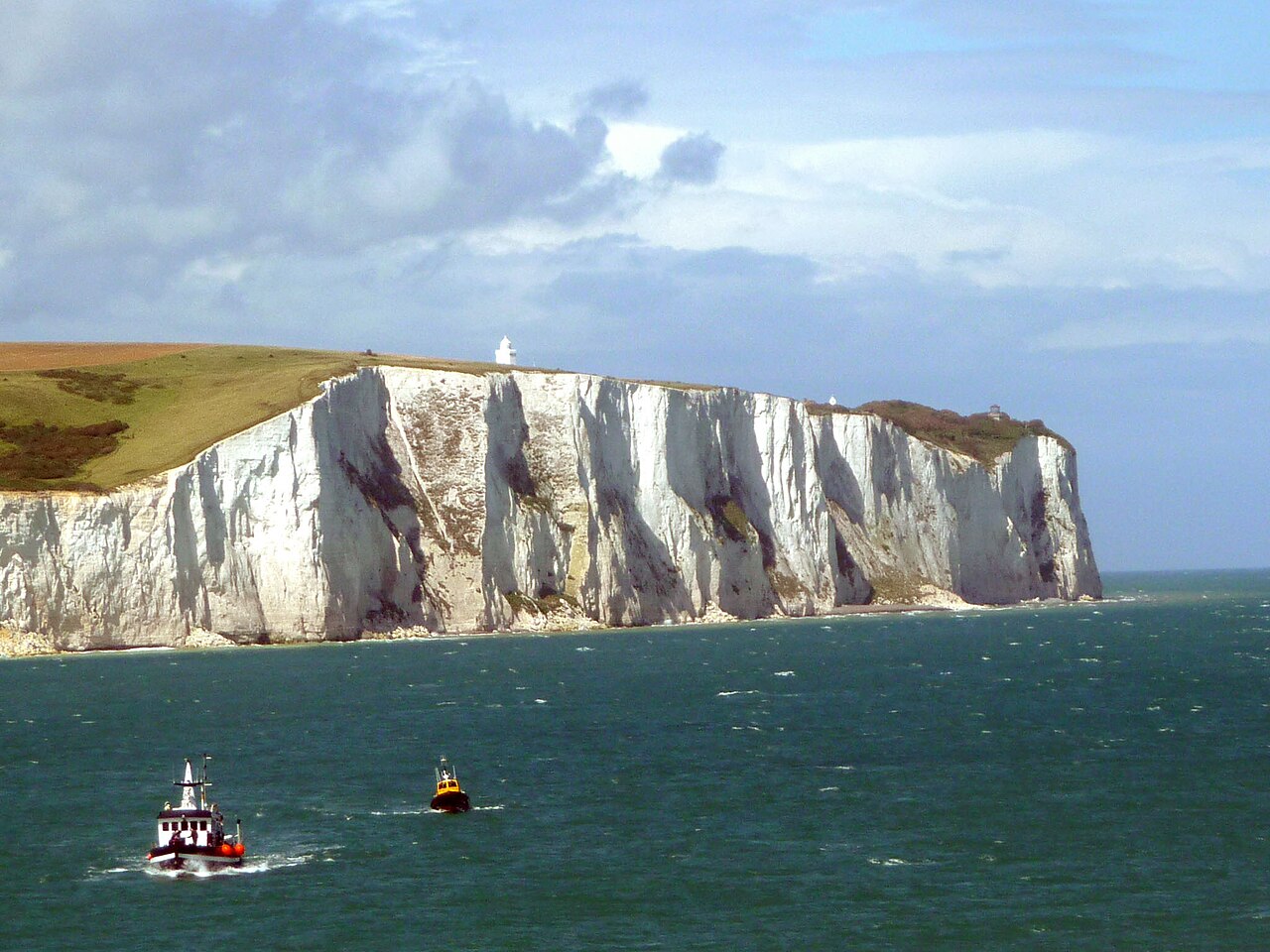
The final severing of the land connection occurred around 8,200 years ago as post-glacial sea level rise flooded the remaining low-lying land between Britain and France. The iconic White Cliffs of Dover and their counterpart, Cap Blanc-Nez on the French side, are remnants of the same chalk formation that once connected the two countries. Standing on either shore, you can see the opposing cliffs on clear days — a visible reminder of how narrow this barrier truly is.
Shipping & Navigation
- Daily Traffic: ~500 vessel movements through the Strait of Dover
- Annual Tonnage: Among the highest of any waterway globally
- Traffic Separation Scheme: Mandatory since 1967
- Ferry Routes: Dover-Calais, Portsmouth-Le Havre, and many more
The English Channel is the busiest shipping lane in the world. Approximately 500 vessels transit the Strait of Dover daily, ranging from supertankers and container ships to ferries and fishing boats. A mandatory Traffic Separation Scheme (TSS), established in 1967 and monitored by the Channel Navigation Information Service, divides shipping into two lanes with a separation zone between them — effectively a motorway at sea.
Cross-channel ferry services have operated since the early 19th century. The Dover-Calais route, at 33.3 km the shortest crossing, carries millions of passengers and vehicles annually. P&O Ferries, DFDS, and Irish Ferries operate the busiest routes. The port of Dover handles approximately 2.5 million freight vehicles per year, making it one of the most important freight gateways in Europe. Despite the Channel Tunnel's opening in 1994, ferries remain essential to cross-channel trade and travel.
The Channel Tunnel
- Length: 50.45 km (31.4 mi) — longest undersea tunnel in the world
- Undersea Section: 37.9 km
- Opened: May 6, 1994
- Construction Cost: ~£9.5 billion (1994; ~£21 billion today)
- Travel Time: ~35 minutes London-to-Paris (Eurostar)
The Channel Tunnel, often called the Chunnel, is one of the greatest engineering feats of the modern era. Consisting of three parallel tunnels — two rail tunnels and a central service tunnel — it runs 50.45 km between Folkestone in Kent, England, and Coquelles near Calais, France. The undersea portion, at 37.9 km, remains the longest undersea tunnel in the world.
Construction took six years (1988-1994) and employed over 13,000 workers at its peak. Eleven tunnel boring machines carved through the chalk marl beneath the seabed, meeting in the middle on December 1, 1990. The Eurostar high-speed train service connects London to Paris in approximately 2 hours 15 minutes and to Brussels in about 2 hours. Le Shuttle (formerly Eurotunnel Shuttle) carries cars, coaches, and freight vehicles through the tunnel on specially designed trains.
Swimming the Channel
- First Crossing: Captain Matthew Webb, August 25, 1875 (21 hours 45 minutes)
- Current Record: ~6 hours 55 minutes (Trent Grimsey, 2012)
- Successful Swims: Over 2,500 solo and relay crossings
- Water Temperature: 14-18°C in summer
Swimming the English Channel is considered the ultimate test of open-water swimming endurance. Captain Matthew Webb made the first successful crossing on August 25, 1875, swimming breaststroke from Dover to Calais in 21 hours and 45 minutes. The feat made him an instant celebrity and established Channel swimming as a pursuit that has attracted thousands of attempts since.
The Channel Swimming Association, founded in 1927, governs and ratifies crossings. Swimmers must follow strict rules: no wetsuits, no touching the escort boat, and no artificial aids. The actual swimming distance is typically 30-50% longer than the 33.3 km strait due to tidal currents that sweep swimmers sideways. Water temperatures of 14-18°C, jellyfish, shipping traffic, and the psychological challenge of open water make Channel swimming extraordinarily demanding.
Key Facts
- The English Channel is 33.3 km wide at the Strait of Dover, the narrowest point.
- The Channel Tunnel, at 50.45 km, is the longest undersea tunnel in the world.
- Approximately 500 vessels transit the Strait of Dover daily, making it the world's busiest shipping lane.
- Britain was physically connected to France until approximately 8,200 years ago.
- Captain Matthew Webb made the first Channel swim in 1875, taking nearly 22 hours.
Fun Facts
- The French name "La Manche" means "the sleeve" — a reference to the channel's shape. The British and French have never agreed on a single name for this body of water.
- On clear days, you can see France from the White Cliffs of Dover — the opposing coastline is visible to the naked eye across the 33 km strait.
- During the D-Day invasion on June 6, 1944, over 156,000 Allied troops crossed the English Channel in the largest amphibious military operation in history.
- A Frenchman named Louis Bleriot made the first airplane crossing of the English Channel in 1909, completing the 36.6 km flight in just 36 minutes.
Final Thoughts
The English Channel is one of the most significant narrow waterways in the world — a thin strip of sea that has shaped the destiny of nations for millennia. As Britain's natural defence, the world's busiest shipping lane, the site of the D-Day landings, and the location of one of engineering's greatest achievements in the Channel Tunnel, this modest body of water has played an outsized role in world history. Whether crossed by ferry, train, or swimming, the English Channel remains a powerful symbol of the connection and separation between Britain and Europe.
Test Your Knowledge!
Think you know your straits and channels? Try our interactive quiz!
Play Water Body Quiz →