

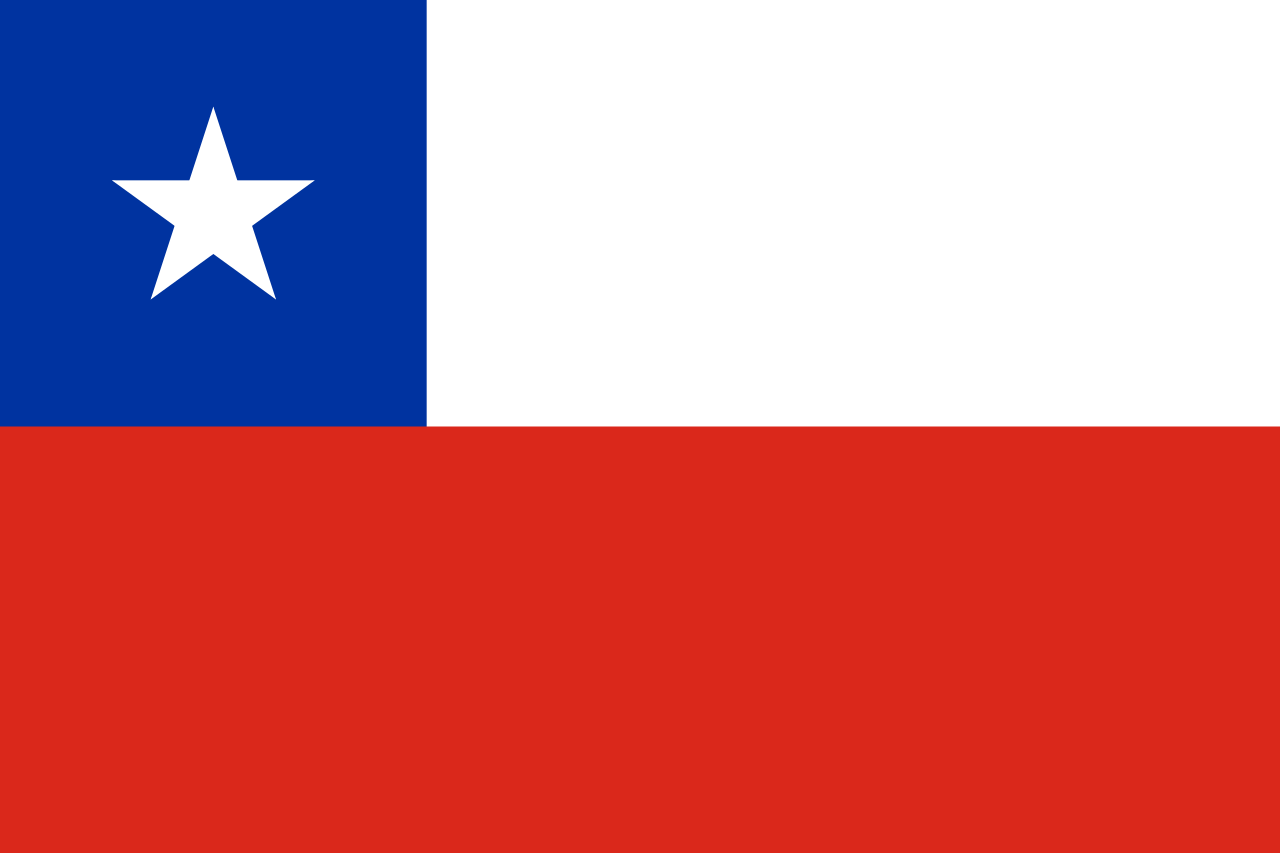
The flag of Chile features a white horizontal band on top and a red band on the bottom, with a blue square canton in the upper-left corner bearing a single white five-pointed star. Known as "La Estrella Solitaria" (The Lone Star), Chile's flag was adopted on October 18, 1817, making it one of the oldest flags still in use in the Americas.
Chile's flag is instantly recognizable thanks to its clean geometric design and the bold lone star on the blue canton. Its striking similarity to the Texas flag has made it a favorite topic among flag enthusiasts and a source of frequent confusion on social media.
Design and Colors
Chile's flag is divided into two horizontal bands. The upper band is split: a blue square on the hoist side (the canton) and a white rectangle extending to the fly. The lower band is entirely red. A white five-pointed star sits centered within the blue canton. The flag's proportions are 2:3.
The blue canton occupies exactly one-third of the flag's width and half of its height. The star is precisely positioned within the canton — its center point sits at the intersection of the canton's diagonals, and its diameter equals half the canton's height.
Symbolism of the Colors
Each element of Chile's flag carries specific meaning. The blue canton represents the sky and the Pacific Ocean that borders Chile's entire western coast. The white band symbolizes the snow-capped Andes Mountains that form the country's eastern border. The red band represents the blood shed by Chile's heroes in the fight for independence. The white star — la estrella solitaria — serves as a guide to progress and honor, and also symbolizes the powers of the state.
Some interpretations trace the colors to the Mapuche people, the indigenous inhabitants of Chile who fiercely resisted Spanish colonization. Mapuche warriors used blue, white, and red in their battle dress, and one theory holds that the flag's designers drew inspiration from these traditional colors.
Historical Origins
Chile's independence movement began in 1810 when the country formed its first national government (the First Government Junta). The first Chilean flag, known as the "Patria Vieja" flag, featured three horizontal stripes of blue, white, and red — similar to the Dutch flag. This was replaced in 1817 by a transitional flag and then by the current design, adopted on October 18, 1817, during the government of Bernardo O'Higgins, Chile's first supreme director.
The flag was designed by Antonio Arcos, a Spanish-born military officer who fought for Chilean independence, with input from the statesman José Ignacio Zenteno. The design drew inspiration from the United States flag and incorporated elements meaningful to Chile's geography and struggle for freedom.

Chile vs Texas: Why Do the Flags Look So Similar?
The most common question about Chile's flag is why it looks almost identical to the Texas state flag. Both feature a vertical blue bar on the hoist side with a white star, a white horizontal band, and a red horizontal band. The key differences are: Chile's blue is a square canton (not extending the full height of the flag), while Texas's blue bar runs the entire height. Chile's star is centered in the canton, while Texas's star is centered in the full-height blue bar. Chile's flag was adopted in 1817, while Texas adopted its flag in 1839 — making Chile's flag 22 years older.
Despite the visual similarity, there is no evidence that Texas copied Chile's design. Both flags independently drew from common 19th-century revolutionary symbolism — red, white, and blue were popular colors among nations seeking independence, and the lone star was a widespread symbol of sovereignty and unity.
Fiestas Patrias and Flag Display
Chileans display their flag prominently during Fiestas Patrias, the national holiday celebrations on September 18-19 (Independence Day and Army Day). Chilean law actually requires all homes and buildings to display the flag during this period, and failure to comply can result in a fine. The flag also appears everywhere during the Copa América and FIFA World Cup when the Chilean national team is playing.
Flag Protocol
Chilean law establishes strict protocols for the national flag. The flag must be flown with the blue canton at the upper-left corner (from the viewer's perspective). When displayed horizontally, the white band is always on top. Defacing or disrespecting the flag is a criminal offense in Chile. During national mourning, the flag is flown at half-mast. The law also specifies that the flag must be in good condition — torn or faded flags should be replaced.
Fun Facts About Chile's Flag
- Emoji confusion: People frequently use the Chilean flag emoji (🇨🇱) when they mean to post the Texas flag, since Texas has no official emoji.
- One of the oldest: Chile's flag (1817) is one of the oldest continuously used national flags in the world.
- Star orientation: The star must point upward — an inverted star on the Chilean flag is considered a sign of distress or disrespect.
- Mapuche influence: The Mapuche war cry "Chi-Chi-Chi, Le-Le-Le" and the national colors both reflect indigenous heritage.
- Giant flag: The Bicentennial Flag, a 27 x 18 meter Chilean flag, flies permanently on a 62-meter pole in Santiago's Bicentennial Park.
Final Thoughts
Chile's flag is a masterful blend of geographic symbolism and revolutionary heritage. The blue Pacific, white Andes, and red sacrifice of patriots are all captured in a design that has endured for over two centuries. Whether confused with Texas or celebrated at Fiestas Patrias, la estrella solitaria remains a source of deep national pride for Chileans and one of the most elegant flag designs in the Americas.
Test Your Knowledge!
Think you know your world geography? Try our interactive quiz!
Play Geography Games →