
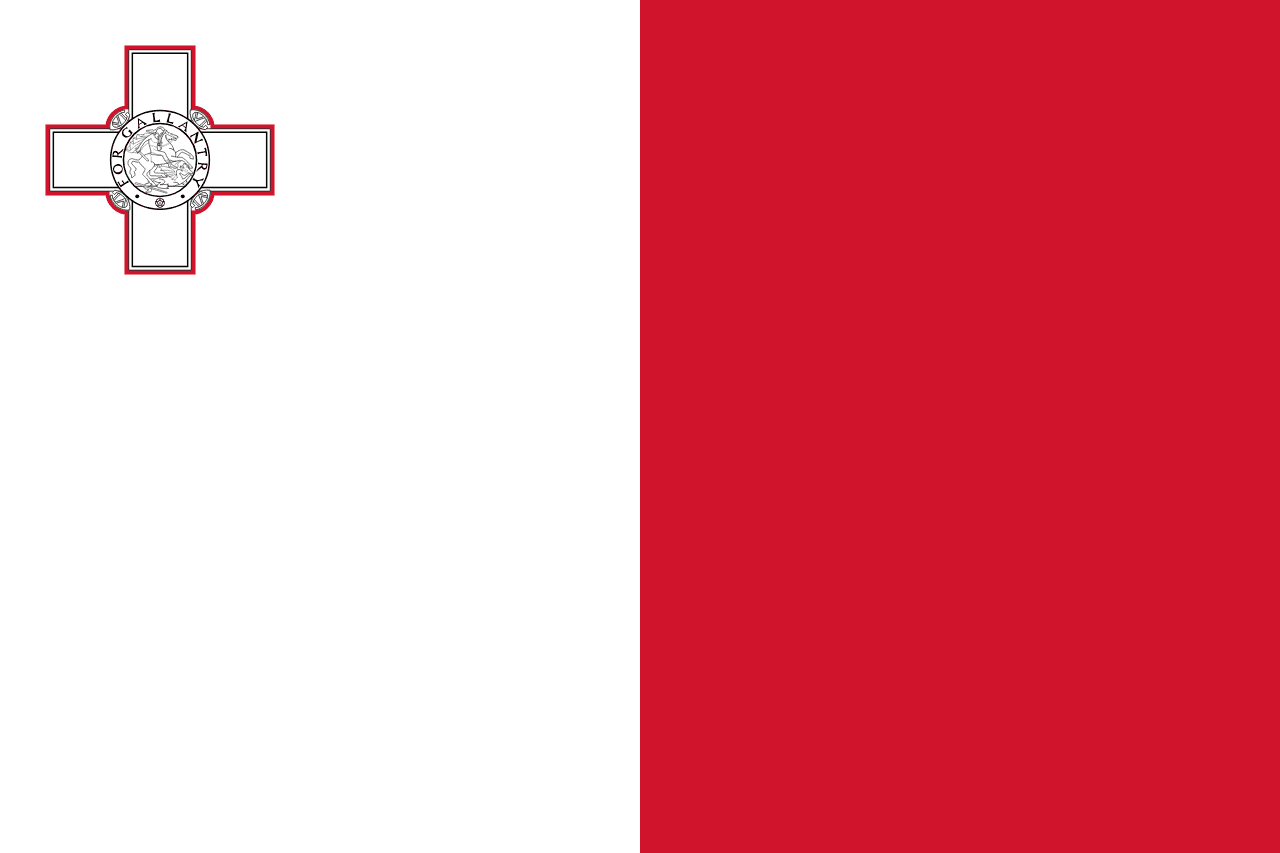
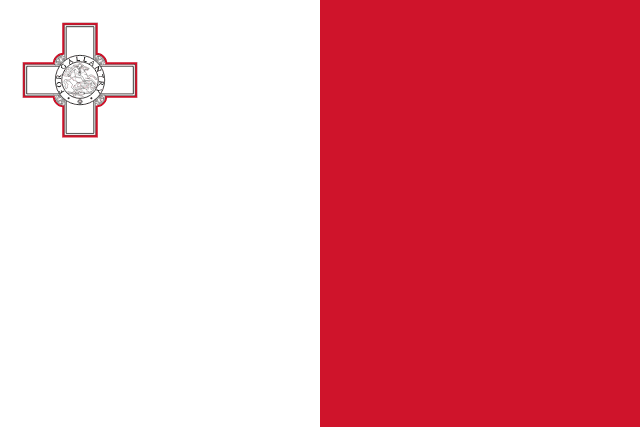
Few national banners carry a story quite as unusual as the flag of Malta. At first glance it looks almost austere: two equal vertical bands, white beside red, with a small grey cross tucked into the upper corner. Yet that modest emblem is unlike anything else flown by a sovereign nation. It is a medal — a military decoration awarded for courage — woven permanently into the fabric of the state. Adopted in 1964 when Malta became independent, the flag captures both the deep historical roots of this tiny Mediterranean archipelago and one extraordinary chapter of wartime endurance that the islanders refused to let fade.
A Flag That Wears a Medal
The single feature that sets Malta apart from every other country is the George Cross in the canton — the upper hoist corner of the white band. The George Cross is a real British honour, the highest civilian award for gallantry, and it was bestowed on the people of Malta as a collective. No other national flag in the world incorporates a military or civilian decoration awarded to the nation itself. Where most flags assemble abstract symbols — stars, stripes, suns — Malta's design quietly says, this is what we earned. That distinction turns an otherwise simple bicolor into one of the most narratively loaded flags on Earth.
The Colours and What They Mean
The Maltese flag is built from three tones, each pulling its own weight. The white band stands for purity, a value long associated with the islands' faith and their self-image as a steadfast people. The red band represents sacrifice — the blood and hardship endured across centuries of siege, occupation, and war. The grey of the cross is not decorative neutrality but the literal colour of the George Cross decoration as it was rendered onto the flag, edged in red to keep it visible against the white field.
White and red have clung to Malta for a very long time. Tradition links the colours to the Norman count Roger I of Sicily, who is said to have given the islanders a portion of his own red-and-white banner in the eleventh century. Whether legend or fact, the pairing became fixed in Maltese identity well before the modern state existed, which is why independence-era designers kept it rather than inventing something new.
Reading the Design and Layout
The construction is deliberately clean. The flag is a vertical bicolor divided down the middle: white occupies the hoist side (the half nearest the pole), red occupies the fly side. Placing white in the position of honour at the hoist is itself a statement of priority. In the top corner of the white half sits the George Cross, depicted in grey and outlined with a thin red border so it does not vanish into the pale background.
Because the cross is small and confined to one corner, the overall impression remains that of a bold two-tone field rather than a busy emblem flag. This balance is intentional. The bicolor carries the ancient heritage; the cross adds the singular twentieth-century honour without overwhelming it. Read together, the elements compress nearly a thousand years of Maltese self-understanding into a rectangle.
How the Flag Evolved
Malta's red-and-white colours predate any unified flag, surviving as a regional emblem through the long rule of the Knights of St John, the brief Napoleonic interlude, and more than a century and a half of British administration. The decisive change came during the Second World War. Sitting on the supply route between Europe and North Africa, Malta endured one of the most sustained bombing campaigns of the war as Axis aircraft tried to pound it into submission. The civilian population's refusal to break led King George VI to award the entire island the George Cross in 1942, an honour without real precedent.
That award was first added to a blue corner on the colonial-era flag, but when Malta gained independence on 21 September 1964, the design was reworked into the form flown today: the clean white-and-red bicolor with the George Cross moved onto the white canton and edged in red. The 1964 flag deliberately preserved the wartime honour rather than discarding the colonial-era symbol — a choice that reframed the cross as a national possession rather than a gift from a ruling power. You can read more about the islands' wider story in our malta country guide.
How It Compares to Similar Flags
Plenty of flags use red and white in vertical bands, so casual observers sometimes mistake Malta's for a relative of others. The simplest point of confusion is with any plain red-and-white bicolor, but the George Cross instantly resolves it — no other national flag carries that emblem in the corner. Some compare the layout loosely to other Mediterranean and European bicolors, yet most of those, like Poland's, run horizontally and carry no charge, while Malta's runs vertically and is anchored by its decoration.
It is also worth separating Malta's national flag from the more famous eight-pointed white cross on a red field associated with the Knights of St John, the so-called Maltese cross. That cross-on-red symbol is historically tied to the island and appears on Malta's civil ensign and merchant flag, but it is not the national flag. Mixing the two is one of the most common errors people make about Maltese vexillology.
Cultural Weight and Everyday Presence
For Maltese citizens the flag is inseparable from the wartime memory it preserves. The George Cross also appears on the national coat of arms, reinforcing how central that honour is to the country's identity. The colours fly thickest around Independence Day on 21 September and on the cluster of other national festas the islands celebrate, when streets fill with red-and-white bunting alongside the elaborate church decorations Malta is known for.
In modern civic life the flag turns up where you would expect a small, proud nation to display it: at government buildings, on naval and merchant vessels in their respective ensign forms, and in the stands whenever Maltese teams and athletes compete internationally. For a country of just a few hundred thousand people, the flag does outsized work, telling visitors in a single glance that this is a place that endured something remarkable and chose to commemorate it forever.
Interesting Facts at a Glance
- Malta's is the only national flag in the world to incorporate a real awarded decoration — the George Cross.
- The flag was adopted in its current form on 21 September 1964, Malta's independence day.
- The George Cross was awarded to the island's population by King George VI in 1942 for collective wartime bravery.
- The red border around the grey cross exists purely so the medal stays visible against the white field.
- Malta lies in the central Mediterranean and is counted as part of Europe.
- The famous eight-pointed Maltese cross belongs to the civil ensign and the Knights of St John — not to the national flag.
Frequently Asked Questions
When was the flag of Malta adopted?
The flag in its present form was adopted on 21 September 1964, the day Malta gained independence. Its red-and-white colours, however, are far older, traditionally traced back roughly a thousand years.
What do the colours of the Maltese flag mean?
White stands for purity and red for sacrifice, reflecting Malta's long history of hardship and endurance. The grey of the George Cross in the corner is the colour of the actual decoration, outlined in red so it reads clearly against the white band.
Why does Malta's flag have a cross in the corner?
That cross is the George Cross, a British award for gallantry given to the entire population of Malta in 1942 for their courage during the Second World War. Rather than a designer's invention, it is a genuine decoration the nation earned and chose to keep on its flag — making Malta's the only national flag to display such an honour.
What continent is Malta on, and what flags is it confused with?
Malta is a Mediterranean island nation counted as part of Europe. People sometimes confuse its plain red-and-white bicolor with other European bicolors, or mistake the eight-pointed Maltese cross for the national emblem. The George Cross in the canton is what makes the true national flag unmistakable.