
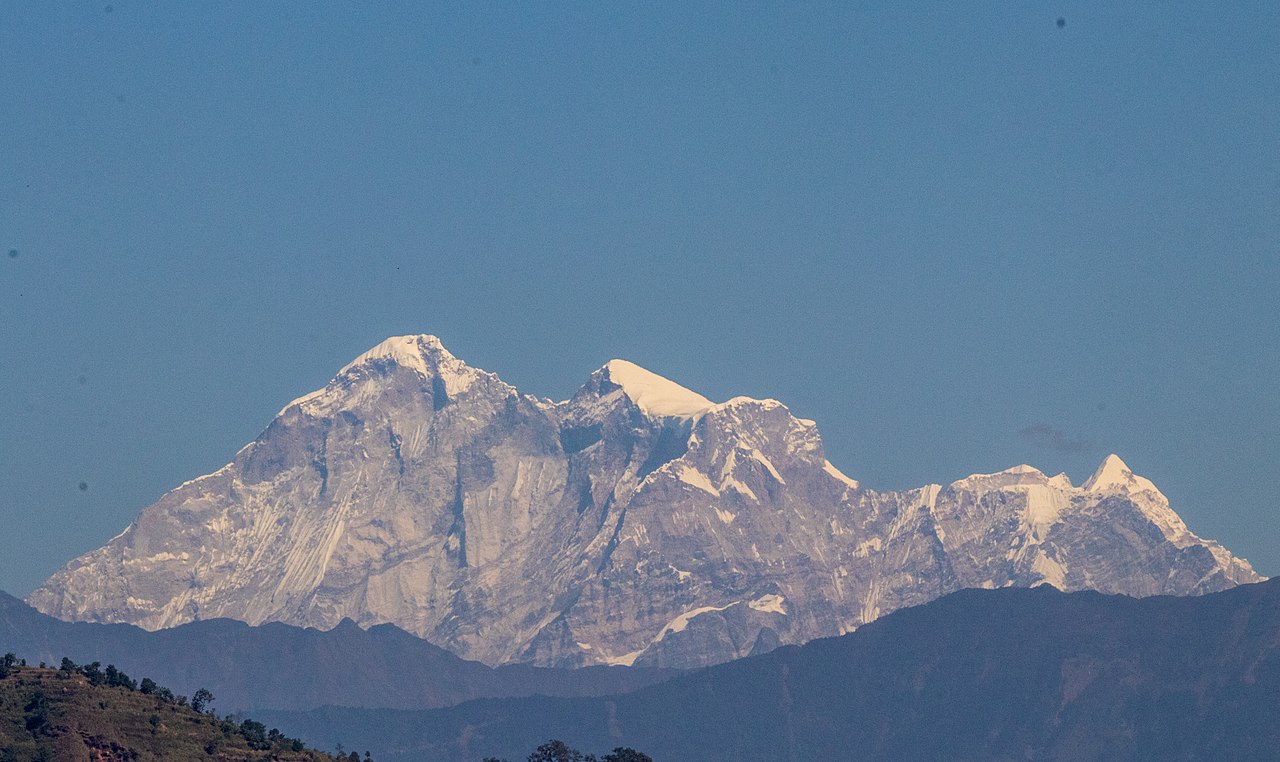
Nepal keeps its clocks at UTC+5:45, five hours and forty-five minutes ahead of Coordinated Universal Time, and it has done so since 1 January 1986. The odd quarter-hour comes from geography: Nepal Standard Time is the mean solar time of the meridian at 86°15′E, which passes through the peak of Gaurishankar, a 7,134 m Himalayan mountain about 100 km northeast of Kathmandu. That puts Nepal 15 minutes ahead of India (UTC+5:30), 15 minutes behind Bhutan and Bangladesh (UTC+6) and 2 hours 15 minutes behind China (UTC+8), and makes it one of only three places in the world on a 45-minute offset.
Why Nepal Set Its Clocks by Gaurishankar at 86°15′E
Every standard time zone is, at root, the local solar time of one chosen line of longitude. The Earth turns 15 degrees an hour, so each degree of longitude east of Greenwich adds four minutes to the clock. A meridian at 86.25°E therefore works out to exactly 5 hours 45 minutes ahead of Greenwich, and that is the line Nepal picked. It runs through Gaurishankar in the Rolwaling Himal, in Dolakha District, a mountain the Sherpa people call Jomo Tseringma and which is visible from Kathmandu on clear days. Its twin summits, Shankar to the north and Gauri to the south, are named after Shiva and Parvati, which gives the national clock an unusually sacred reference point.

The choice is not as arbitrary as it looks. Nepal is a long, narrow country, roughly 800 km from west to east and about 200 km from north to south, lying between about 80°E and 88°E. Gaurishankar sits towards the eastern side of that span, but most of Nepal's people live in the centre and east, in the Kathmandu Valley and along the Terai plains towards Biratnagar. Kathmandu itself lies at about 85°19′E, which gives it a local mean time of UTC+5:41:16. Rounding that to the nearest five minutes gives 5:40; rounding to the nearest quarter-hour gives 5:45. Nepal chose the quarter-hour, and the meridian that matches it happens to cross one of its best-known peaks.
From Kathmandu Mean Time to UTC+5:30 in 1920
Until 1920 Nepal had no national standard at all. Kathmandu, like most towns in South Asia, kept its own local solar time, UTC+5:41:16. Some references round this to UTC+5:40, which is why that figure still turns up in older almanacs and in many retellings of Nepal's time story, but 5:40 was never an official standard. It was simply an approximation of the capital's sun time.
In 1920 Nepal adopted Indian Standard Time, UTC+5:30. India had introduced IST on 1 January 1906, using a meridian at 82°30′E near Mirzapur in Uttar Pradesh, chosen to sit midway between western India (naturally about UTC+5) and the northeast (naturally about UTC+6). For Nepal the practical logic is easy to see. Its commerce faced south: Birgunj, which is joined to Raxaul in Bihar, still handles most of Nepal's trade with India and is known as the Gateway of Nepal. Sharing India's clock removed one more obstacle on that route. For the next 66 years the clocks in Kathmandu and Patna read the same.

The 15-Minute Jump of 1 January 1986
On 1 January 1986, which in Nepal's own Bikram Sambat calendar fell in the year 2042 BS, Nepal moved its clocks forward by 15 minutes, from UTC+5:30 to UTC+5:45. The change brought official time closer to the sun over the central and eastern hills, where under Indian time the sun had been reaching its highest point over Kathmandu at about 11:49, some 11 minutes before the clocks said 12:00. It also gave Nepal a time of its own rather than one borrowed from its southern neighbour.
Explanations for the move usually combine those two threads. The solar argument is straightforward and checks out against the arithmetic: 86°15′E is within a degree of Kathmandu and close to the population centre of the country. The national-identity argument is harder to pin to a document, but the result is plain on any world clock: Nepal is the only country in South Asia whose clocks differ from India's by a quarter-hour. Nepal does not use daylight saving time, so the offset has stayed fixed at 5:45 for four decades. Phones and computers take their rules from the IANA tz database, which lists the whole country as one zone, Asia/Kathmandu.
The new offset caused no great disruption at home, because the country only ever had one zone to change. The friction came at the edges. Anyone moving between Nepal and India now had to shift their watch by a quarter-hour, and anyone writing software or airline timetables had to accept that not every offset is a multiple of 30 minutes.
Nepal’s Clock Beside India, China, Bhutan and Bangladesh
Seen on a map of South Asia, Nepal sits in a staircase of offsets. Pakistan dropped from UTC+5:30 to UTC+5 in September 1951. India and Sri Lanka keep UTC+5:30. Nepal comes next at 5:45, then Bhutan and Bangladesh at UTC+6, Myanmar at UTC+6:30, and finally China, which keeps the whole country, including Tibet across the Himalaya from Nepal, on Beijing Time, UTC+8.
The two land borders make the contrast vivid. Crossing from Birgunj to Raxaul, or at any of the other crossings on the open border with India, a traveller sets the watch back 15 minutes. Crossing north into Tibet, the jump is 2 hours 15 minutes forward, because China's single zone stretches Beijing's time across more than 60 degrees of longitude. Bhutan and Bangladesh, which Nepal does not touch but which lie only a short distance east across India's Siliguri Corridor, run 15 minutes ahead of Kathmandu.
India's own unified zone is part of the reason Nepal's offset stands out. With more than 29 degrees of longitude between the Rann of Kutch and Arunachal Pradesh, India has repeatedly debated a second zone; tea gardens in Assam even keep an informal "Chaibagan" time one hour ahead of IST. Nepal, far narrower, never needed more than one zone, so it could tune that one to its own sun. The story of how a giant handles the same problem is told in our guide to why India keeps a single time zone.
One Clock from the Mahakali to the Mechi
A single zone across 800 km still leaves the sun out of step at the edges. Nepal's western border follows the Mahakali River, near 80°E, where the local mean time is about UTC+5:20. There, average solar noon falls at around 12:25 on Nepal's clocks. At the eastern border on the Mechi River, near 88°E, the local mean time is about UTC+5:52, so the sun reaches its highest point at roughly 11:53. In Kathmandu, at 85°19′E, mean solar noon comes at about 12:04. (The actual moment shifts by up to a quarter of an hour through the year because of the equation of time, but the gap between east and west stays at about half an hour.)
Those numbers show why 5:45 is a sensible fit. A UTC+5:30 clock put Kathmandu's solar noon at around 11:49 and the eastern districts' at about 11:38; a UTC+6 clock would have made the far west's noon fall at about 12:40. The quarter-hour split almost exactly balances the two ends of the country, with the capital close to the middle. That is a tighter fit than many larger countries achieve. China's single zone, by contrast, leaves solar noon in Kashgar at around 15:00 on the clock, a situation examined in our piece on China's single time zone.
Living With UTC+5:45: Calls, Television and Himalayan Crossings
Day to day, Nepalis rarely think about the offset. Everything inside the country runs on one time, and because there is no daylight saving, the gap to India is always exactly 15 minutes and the gap to China always 2 hours 15 minutes. The complications show up in international dealings.
- Calls and meetings abroad. When London is on GMT, Kathmandu is 5 hours 45 minutes ahead; when Britain moves to summer time, the gap narrows to 4 hours 45 minutes. New York is 10 hours 45 minutes behind in the northern winter and 9 hours 45 minutes behind in summer. Every meeting time ends in :15 or :45 on one side or the other.
- Cross-border television. Indian channels schedule programmes on IST, so a show listed for 9 pm in Delhi starts at 9:15 pm in Kathmandu.
- Software and timetables. Systems that assume whole-hour or half-hour offsets get Nepal wrong. The IANA database handles it correctly, but hand-built time pickers often omit 5:45 altogether.
- Treks and expeditions. Climbers moving between the Nepali and Tibetan sides of the Himalaya, for example around Everest, the 8,848.86 m summit on the Nepal–China border, cross a time jump of more than two hours without leaving the mountains.
The odd offset has also become a small point of national trivia. Nepal already has the world's only non-rectangular national flag; the quarter-hour clock is a second way in which the country quietly does things its own way.
Nepal, the Chathams and Eucla: The Other 45-Minute Offsets
Nepal is not entirely alone. Only three time zones in the world use a 45-minute offset. The second belongs to the Chatham Islands, lying some 800 km off the east coast of New Zealand's South Island, which keep UTC+12:45 and moves to UTC+13:45 in the southern summer. The third is Australian Central Western Time, UTC+8:45, which is not legally defined but is used by a handful of roadhouses and settlements on the Eyre Highway, including Eucla, Madura, Mundrabilla and Cocklebiddy in Western Australia and Border Village in South Australia. Road signs there tell drivers to adjust their watches by 45 minutes, and the practice dates back at least to 1935, when the Commonwealth Railways timetable used it on the Trans-Australian line.
Of the three, Nepal's is by far the largest by population, covering a country of 147,516 km² and 29.2 million people at the 2021 census, and it is the only one that serves an entire sovereign state. The Chathams have about 620 residents, and the Eucla strip is a string of roadhouse settlements whose largest, Eucla itself, had 53 residents at the 2016 Australian census. That makes UTC+5:45 the 45-minute offset that most people on Earth actually live by.
The underlying lesson is that time zones are political decisions anchored in astronomy. Nepal took the astronomy seriously, picking a meridian that splits its country almost evenly, and in doing so it ended up with a clock no neighbour shares. For the full list of places that keep half-hour and quarter-hour offsets, from Iran and Afghanistan to Newfoundland and South Australia, see our guide to half-hour and quarter-hour time zones.