
Few national emblems manage to say so much with so little. The flag of Peru is built from just two colors and three simple bands, yet it carries the weight of a hard-won independence, the memory of a continent reshaping itself in the early nineteenth century, and even a charming legend about a flock of birds. Adopted in 1825, this vertical triband of red and white is one of the most recognizable banners in South America, flown from the colonial balconies of Lima to the high Andean plazas of Cusco. In this guide we unpack what the colors mean, how the design came together, why it looks the way it does today, and how it stands apart from the many other flags that share its palette.
A Tricolor in Red and White
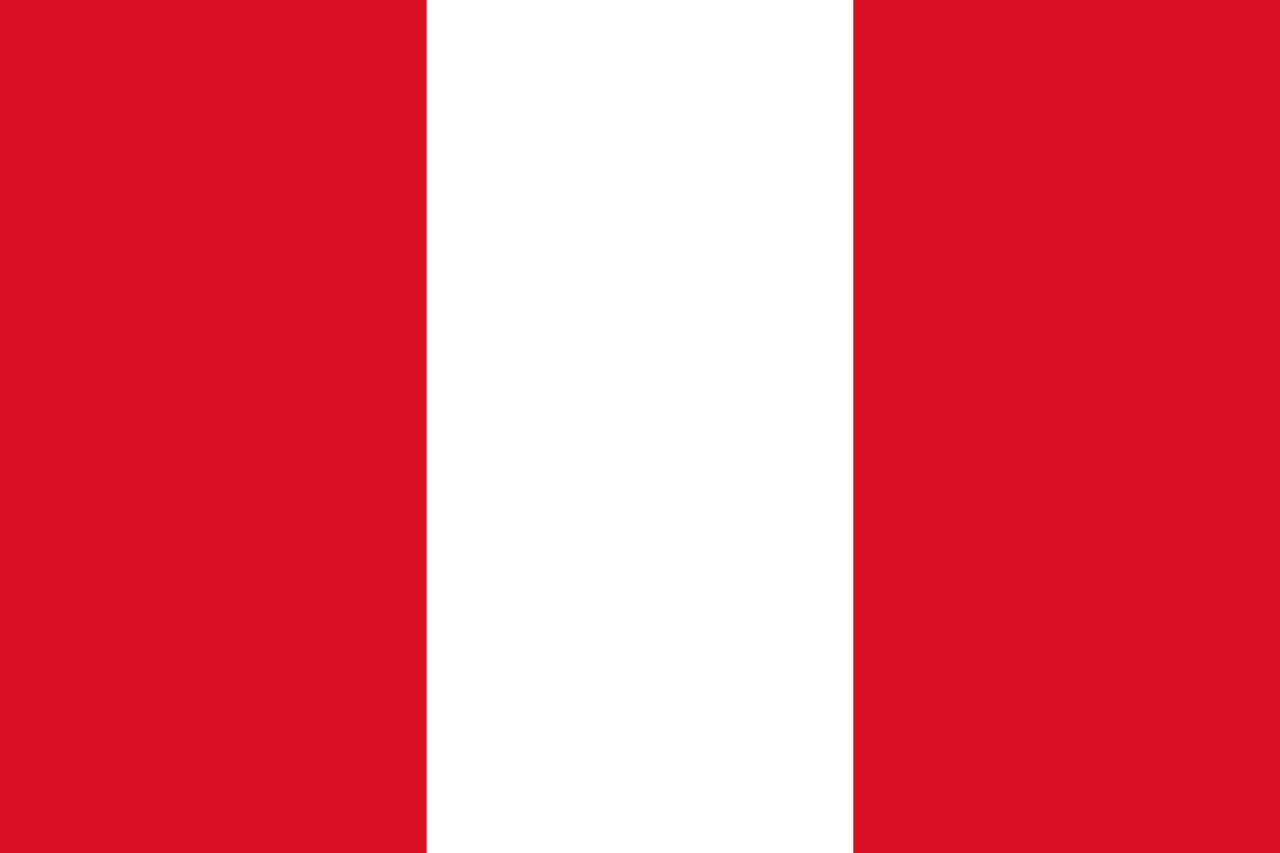
At its core, the Peruvian flag is a vertical tricolor: three equal vertical bands running top to bottom, with red on both outer edges and white in the center. That symmetry gives the flag a balanced, almost architectural feel, the white panel framed and protected on either side by red. The proportions are typically rendered in a 2:3 ratio, the same widescreen rectangle used by many national flags, and each of the three stripes occupies exactly one-third of the total width.
It is worth distinguishing the version most people picture from its official cousins. The plain red-white-red banner is the bandera nacional, the civil flag flown by ordinary citizens. The state and war flags add the national coat of arms to the central white band, while the national standard places a more elaborate emblem at the heart of the design. For everyday purposes, though, the clean two-color version is what Peruvians wave, and it is the form that has become shorthand for the country itself.
What the Colors Stand For
The symbolism of the Peruvian flag is rooted in the struggle that produced it. The red bands are traditionally read as the blood shed by those who fought and died for Peru's independence from Spain, a tribute to sacrifice and to the courage of the liberators. The white center stands for peace and purity, the calm and dignity that the new republic hoped to build once the fighting was over.
This pairing of red and white is deliberately stark. There is no blue for sky or sea, no green for forests or yellow for mineral wealth, the way you find on so many other Latin American flags. Instead the design distills national feeling into a single contrast: the cost of freedom set against the hope of harmony. That restraint is part of what gives the flag its quiet power, and it ensures the meaning never gets diluted by competing imagery.
How the Flag Took Shape
The flag was born in the turbulent years of the independence movement, when Peru was breaking away from Spanish rule alongside much of the rest of the continent. The earliest Peruvian banners went through several revisions as leaders experimented with layouts and emblems during the 1820s, a period when newly liberated nations were quite literally designing themselves from scratch. The version that endured, the simple vertical red-white-red triband, was settled in 1825, and it is that arrangement that Peru still flies today.
What is remarkable is how stable the basic concept has remained. While the official seals and coat of arms placed on the state versions have been refined over the generations, the underlying red-white-red structure has not budged. A Peruvian from the mid-1800s would instantly recognize the flag flying over Lima in the 2020s, a continuity that is rarer than it sounds among the world's national emblems.
The Flamingo Legend
One of the best-loved stories attached to the flag concerns its choice of colors. According to popular tradition, the liberating general who arrived to free Peru was inspired by a flock of flamingos, sometimes called parihuanas, taking flight along the coast. Their wings flashed white and crimson against the sky, and the general is said to have declared that those would be the colors of liberty for the new nation.
Historians generally treat this as a charming legend rather than documented fact, and the red-and-white scheme has plenty of practical and political explanations rooted in the era's revolutionary banners. Still, the flamingo tale has stuck precisely because it is so vivid, linking the flag to Peru's own natural world. Whether literally true or not, it captures something real about how the colors feel: bright, alive, and unmistakably local.
Telling It Apart From Similar Flags
Red and white is one of the most common color combinations in vexillology, so the Peruvian flag has plenty of relatives and a few easy-to-confuse look-alikes. The key to identifying it is the vertical arrangement and the red-outer, white-center order.
- Canada also uses a red-white-red vertical triband, but its central band is wider and carries the famous red maple leaf, so confusion rarely lasts long.
- Austria, Indonesia, Monaco, Poland and Singapore all pair red and white, but they use horizontal stripes rather than vertical bands, which immediately sets them apart.
- Bahrain and Qatar combine white and a reddish maroon, but with serrated edges and very different proportions.
Within South America, Peru's restrained two-color scheme is itself distinctive. Many neighbors lean on multi-color horizontal bands with prominent emblems, so the crisp vertical red-white-red reads as unmistakably Peruvian once you know what to look for.
The Flag in National Life
The flag is woven through Peruvian civic and cultural life. The country celebrates a dedicated Flag Day, and the banner is raised across schools, government buildings, and homes during the late-July independence celebrations of Fiestas Patrias. Sports are another stage where the colors come alive: fans drape themselves in red and white when the national football team plays, and Olympic and Pan-American athletes carry the tricolor into stadiums abroad.
For Peruvians at home and in the global diaspora, the flag functions as a portable piece of identity, a way to claim a heritage that stretches from Pacific beaches to Amazon rainforest to the snow-capped Andes. If you want to understand the country behind the banner, its regions, languages, and landmarks, the peru country guide is a good next step. Peru sits in western South America, and the flag travels everywhere its people do.
Quick Facts Worth Knowing
- The design is a vertical triband, red on the outer thirds and white in the center.
- The official colors are simply red and white, with red symbolizing blood shed for independence and white standing for peace and purity.
- The current form was adopted in 1825 during the independence era.
- Plain red-white-red is the civil flag; state and war versions add the national coat of arms.
- A popular legend credits the colors to a flock of flamingos seen taking flight.
- Peru is located on the continent of South America, along the Pacific coast.
Frequently Asked Questions
When was the flag of Peru adopted?
The modern vertical red-white-red triband was adopted in 1825, after several earlier revisions made during Peru's independence movement in the early 1820s. The basic two-color, three-band structure has remained in use ever since.
What do the colors of the Peruvian flag mean?
The two red bands represent the blood shed by those who fought for Peru's independence, while the white center band stands for peace and purity. The design deliberately keeps to just these two colors to express sacrifice and hope without additional imagery.
Who designed the flag of Peru?
The flag emerged from the independence movement rather than from a single named designer, evolving through a series of official revisions in the 1820s before the lasting version was settled in 1825. A well-known legend links the color choice to a general inspired by flamingos, though that story is treated as tradition rather than documented history.
What continent is Peru on, and how does its flag compare to similar ones?
Peru is in South America, on the Pacific side of the continent. Its red-white-red flag resembles Canada's vertical triband, but Peru's central band is narrower and carries no maple leaf. It is most easily distinguished from other red-and-white flags, such as those of Austria, Poland, or Indonesia, by its vertical rather than horizontal layout.