
South Korea is a unitary presidential republic in which the directly elected President serves as both head of state and chief executive, while a Prime Minister acts as head of government and a single-chamber National Assembly holds legislative power. This system, established under the 1987 constitution, balances a powerful presidency against an active legislature and an unusually assertive Constitutional Court.
The Type of Government
Officially the Republic of Korea, South Korea operates as a democratic presidential republic with a unitary structure, meaning power flows from a central government in the capital, Seoul, rather than being divided among autonomous states or provinces. The current framework dates to the Sixth Republic constitution, adopted in 1987 after the June Democracy Movement forced an end to decades of military-backed authoritarian rule. That constitution restored direct presidential elections and entrenched civil liberties, separation of powers, and judicial review.
Unlike parliamentary systems where the executive emerges from the legislature, South Korea's President is chosen independently by voters. The result is a hybrid arrangement: a strong, separately elected executive paired with a Prime Minister who supports day-to-day administration. For broader context on the nation, see our south korea country guide.
The Executive Branch
The President is the central figure in South Korean government, serving simultaneously as head of state, chief executive, and commander-in-chief of the armed forces. The President is directly elected by popular vote to a single five-year term and, crucially, cannot be re-elected. This single-term limit is a deliberate safeguard born of the country's history with leaders who clung to power, and it guarantees regular turnover at the top.
The President appoints the Prime Minister, who must be approved by the National Assembly. As head of government, the Prime Minister assists the President in directing the cabinet, known as the State Council, and can deputize for the President when needed. Cabinet ministers head the major government departments covering areas such as foreign affairs, finance, defense, and education. In 2022 the presidential office relocated to the Yongsan district, ending the long association of South Korean leadership with the historic Blue House (Cheong Wa Dae).
The Legislature: the National Assembly
Legislative authority rests with the National Assembly, a unicameral (single-chamber) body of 300 members. Lawmakers are chosen through a mixed electoral system: most seats are filled by direct election in local constituencies, while a smaller share is allocated by proportional representation based on each party's national vote share. Members serve four-year terms.
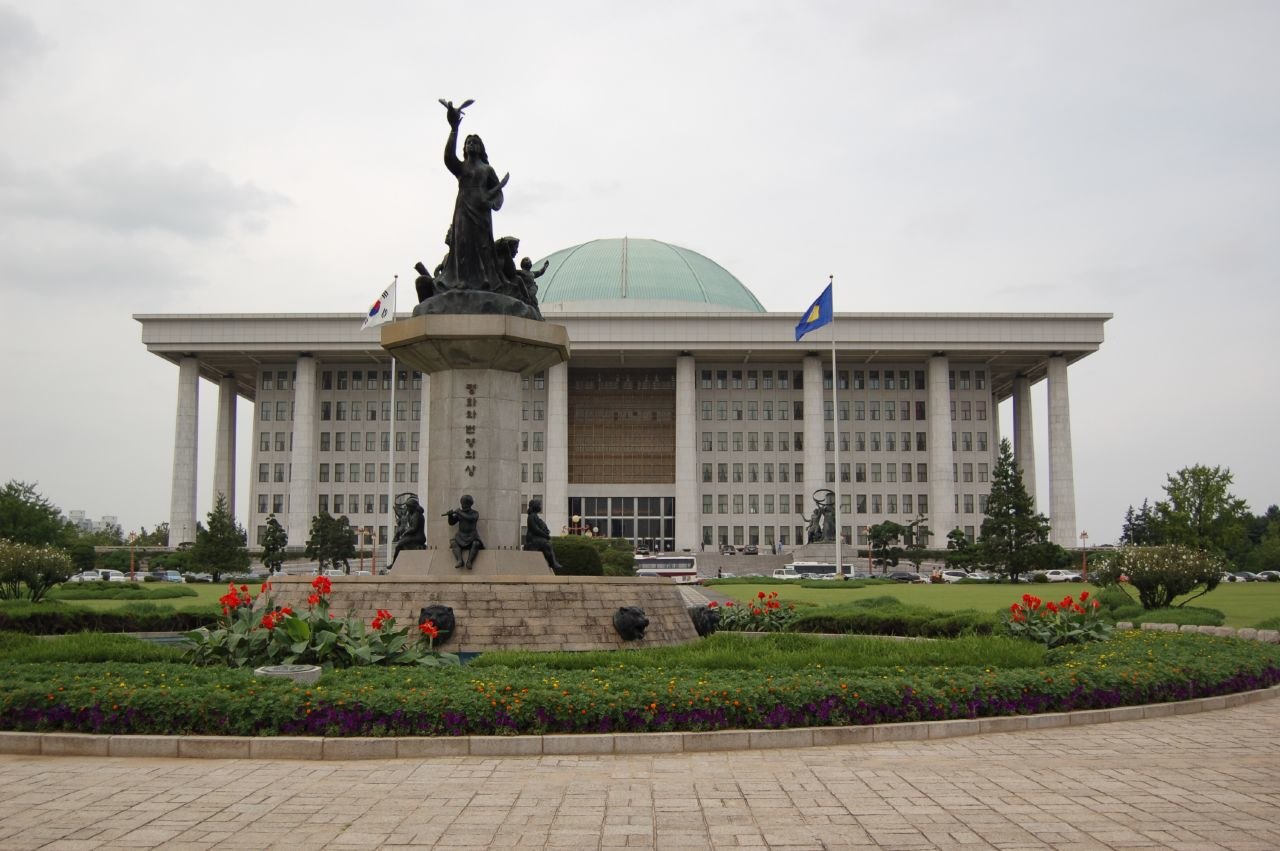
The Assembly writes and passes legislation, approves the national budget, ratifies treaties, and exercises oversight of the executive. It also holds the power to initiate impeachment proceedings against the President and other senior officials. Housed in a landmark building with a distinctive green dome on Yeouido island in the Han River, the Assembly is the arena where South Korea's vigorous multi-party politics plays out, often with intense competition between the major progressive and conservative blocs.
The Judiciary and Checks on Power
South Korea maintains an independent judiciary with two top courts that serve different roles. The Supreme Court is the highest court for ordinary civil and criminal cases, while the Constitutional Court rules specifically on constitutional questions. The Constitutional Court has become one of the most consequential institutions in the country, with authority to strike down laws that violate the constitution and to render the final verdict in presidential impeachment cases.
That power is far from theoretical. The court has removed sitting presidents from office after the National Assembly voted to impeach them, demonstrating that even the most powerful figure in the state is subject to constitutional limits. This robust system of checks and balances, combined with one of Asia's most politically engaged citizenries and a free press, has made South Korea a leading example of democratic accountability in the region.
Elections and Political Life
South Koreans go to the polls for presidential elections every five years and National Assembly elections every four years, alongside regular local elections. Voter turnout is generally high, and large public demonstrations are a recurring feature of political life, reflecting a tradition of citizen activism that traces back to the pro-democracy struggles of the 1980s. Power has changed hands peacefully and repeatedly between rival parties since democratization, even amid sharp polarization.
Frequently Asked Questions
What type of government does South Korea have?
South Korea is a unitary presidential republic. The President is directly elected as head of state and chief executive, a Prime Minister serves as head of government, and a unicameral National Assembly makes the laws.
Who is the head of state and head of government?
The President is the head of state, while the Prime Minister is the head of government. The President holds the dominant executive role, and the Prime Minister, appointed by the President and approved by the legislature, helps run the cabinet.
How long is a South Korean president's term?
The President serves a single five-year term and is constitutionally barred from running for re-election. This term limit was designed to prevent any leader from concentrating power over the long term.
What is South Korea's legislature called?
It is the National Assembly, a single-chamber body of 300 members elected for four-year terms through a mix of constituency seats and proportional representation.