

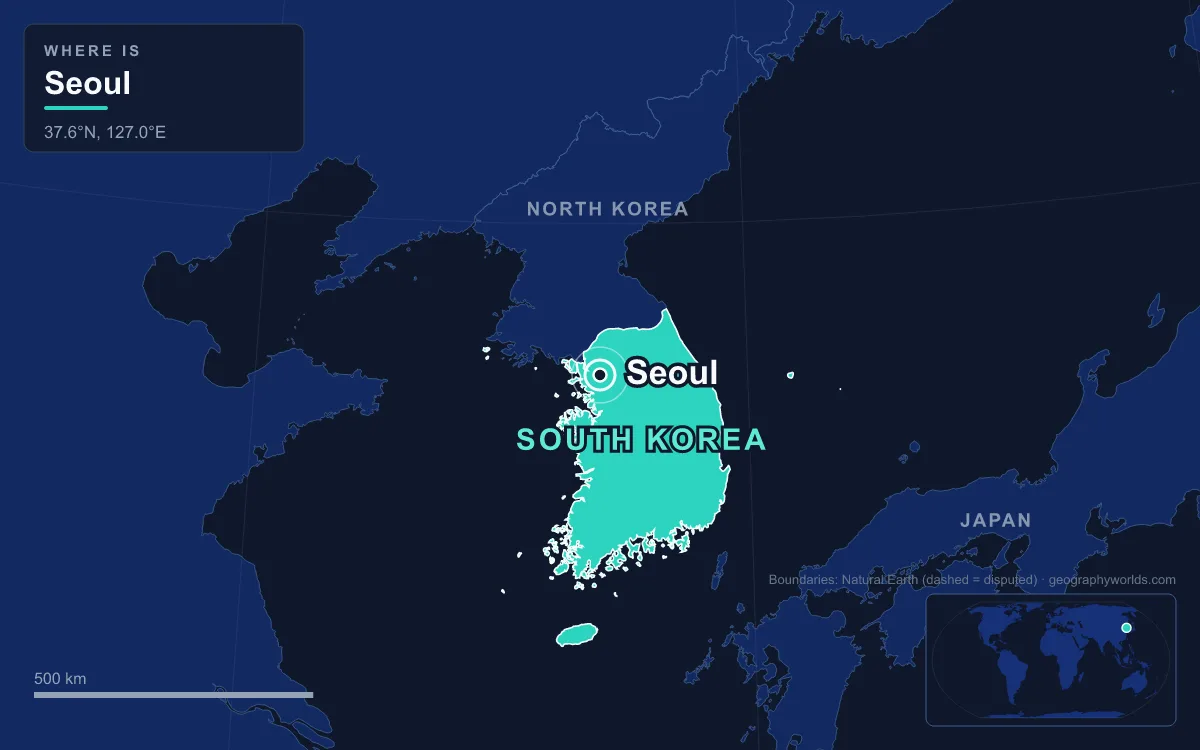
The capital of South Korea is Seoul, officially Seoul Special Metropolitan City. It lies in the north-west of the country on both banks of the Han River, a short distance south of the heavily fortified border with North Korea, and it had about 9.6 million residents in 2024. Its wider metropolitan area, which takes in Incheon and Gyeonggi Province, holds roughly half of the country’s population. Many ministries have moved to the planned city of Sejong since 2012, but in 2004 South Korea’s Constitutional Court ruled that Seoul must stay the capital unless a national referendum decides otherwise. Seoul has been a capital almost continuously since 1394, when the founder of the Joseon dynasty chose it, and that long history is still visible across the modern city.
Hanyang, Hanseong, Keijō: How a Word for “Capital” Became a Name
Seoul is an unusual name for a Korean city, because it is a native Korean word rather than a Sino-Korean one, and it has no matching Chinese characters. The word seoul simply meant “capital city”, and it is believed to come from Seorabeol, the old name of Gyeongju, the capital of the Silla kingdom. The place itself went by many official names. The Baekje kingdom, traditionally founded in 18 BC, had its early capital Wiryeseong somewhere within today’s city limits. Under Goryeo it was Namgyeong, the “southern capital”. Under Joseon it was officially Hanseong, and it was also called Hanyang. By the 17th century people were already calling it the seoul, the capital. French missionaries wrote this as Séoul, which is how the spelling reached other languages.
Yi Seong-gye, the general who founded the Joseon dynasty, chose Hanyang over a rival site at Muak in 1394. He laid it out as a Confucian capital between four inner mountains: Bugaksan, Inwangsan, Naksan and Namsan. A stone Fortress Wall, begun in 1395 and largely finished in 1396, ran along their ridges. Under Japanese rule from 1910 the city was renamed Keijō, meaning “capital”. In October 1946, under the US military government, a charter made “Seoul” the official name. The Korean War then passed over it four times. North Korean forces took it in June 1950, UN forces retook it that September, a combined Chinese and North Korean force captured it in January 1951, and UN forces recaptured it in spring 1951 in Operation Ripper. At least 191,000 buildings lay in ruins afterwards. Two annexations in 1963, including the farmland south of the river that became Gangnam, more than doubled the city from about 268 to 613 square kilometres. That set roughly its present size of 605 square kilometres, split into 25 districts, or gu.
Power: Gyeongbokgung, Cheong Wa Dae and the Assembly on Yeouido
The Joseon court’s power centre was Gyeongbokgung, the “Palace of Great Blessings”. Its first phase was completed in 1395. Under Sejong the Great, who reigned from 1418 to 1450, the palace housed a water clock, an observatory and the scholars who helped him create Hangul, the Korean alphabet. It burned down during the Imjin War in 1592 and lay in ruins for more than 250 years. Rebuilding began in 1865, early in King Gojong’s reign, and the royal family moved back in 1868. After Japan annexed Korea in 1910, the palace was taken apart on purpose. Almost all of its roughly 500 structures were sold off or removed, and only about 40 were left by 1945. From 1916 the Government-General of Chōsen building, the colonial headquarters, was built inside the palace grounds. South Korea demolished it in 1995 and 1996, and restoration plans running to 2045 have rebuilt dozens of halls since.

Modern executive power moved just behind the palace. Cheong Wa Dae, the Blue House, was built on the old royal back garden and served as the president’s office and residence from 1948. In 2022 President Yoon Suk Yeol took office in the Ministry of National Defense building in Yongsan District instead and opened Cheong Wa Dae to the public as a park. Yoon was impeached in December 2024 and later removed from office. His successor, Lee Jae Myung, moved back to Cheong Wa Dae on 29 December 2025. Legislative power sits across the river, on Yeouido, an island in the Han that held an airport before building began there in the late 1960s. The National Assembly building there was completed in 1975. Its plenary chamber has 400 seats, reportedly to leave room for new members if Korea were ever reunified. In December 2024, during the short-lived martial law declaration, soldiers were sent into the building, but they did not reach the chamber, and lawmakers voted the decree down.
Faith: Jongmyo’s Ancestor Rites, Jogyesa and the Bell Hill Cathedral
Joseon made Neo-Confucianism its state ideology, and the city’s most important religious building reflects that. Jongmyo, the royal ancestral shrine, was built in 1394, the year the capital was chosen. Invading Japanese forces burned it during the war of 1592–1598, and the complex that stands today dates from 1601. Its main hall, Jeongjeon, is a single long, low building. It grew eastward, niche by niche, until it had 19 chambers holding the spirit tablets of 19 kings and 30 queens. UNESCO listed it as a World Heritage Site in 1995, and descendants of the royal family still hold the Jongmyo Daejae ceremony there. A road that had separated the shrine from Changdeokgung palace since 1932 was put into a tunnel in 2019, reconnecting the two.

Buddhism was discouraged under Joseon but never removed from the capital. Jogyesa, near Insa-dong, traces its origins to 1395. The modern temple was founded in 1910 and became the chief temple of the Jogye Order in 1936. During the colonial period it became a centre of Buddhist resistance to Japanese control. Christianity arrived later and faced harsher treatment. French missionaries were persecuted, and the killings led to a French punitive expedition in 1866. After Korea signed a treaty with the United States in 1882, Bishop Marie-Jean-Gustave Blanc of the Paris Foreign Missions Society bought a vacant lot on Jonghyeon, “Bell Hill”. Its red-and-grey brick cathedral was consecrated in 1898 and was then the largest building in Seoul. In the 1970s and 1980s Myeongdong Cathedral became a sanctuary for pro-democracy protesters. In 1987 about 600 students held a hunger strike there after the student Park Jong-chol died under police torture.
The census numbers show a city unlike its Confucian past. In 2015 about 35 per cent of Seoul residents identified as Christian and about 11 per cent as Buddhist, while 53.6 per cent said they had no religion. Yoido Full Gospel Church, founded in 1958, is one of the largest congregations in the world, with somewhere between 830,000 and 870,000 members depending on the source. The Seoul Central Mosque opened in 1976. Our guide to religion in South Korea covers the national picture.
Trade: From Namdaemun Market to the Towers of Gangnam
Commerce in Seoul began at the city gates. Namdaemun, the Great South Gate, was completed in 1398 and rebuilt in 1447. It was long the oldest wooden structure in the city and was designated National Treasure No. 1 in 1962. An arsonist burned its wooden pavilion in 2008, and it reopened after restoration in May 2013. The market beside it opened in 1414 and is one of the oldest in Korea. After the Japan–Korea Treaty of 1876 forced Korea’s ports open, nearly half its merchants became Chinese or Japanese. It survived colonial attempts to close it, and after the Korean War it was occupied by refugees. In 2016 it had about 5,200 stores and 9,090 workers. The clothing district at the other old gate, Dongdaemun, gained Zaha Hadid’s curving Dongdaemun Design Plaza in 2014. The plaza helped Seoul win the title of World Design Capital 2010 while it was being built.
Modern money moved to newer ground. Yeouido became the city’s finance and media district, home to the Korea Exchange, the broadcaster KBS, LG’s headquarters and the 63 Building. South of the river, the Gangnam land annexed in 1963 became a technology and business district. In Songpa District, the 123-storey Lotte World Tower opened on 3 April 2017. At 555 metres it is the tallest building in South Korea and among the tallest in the world. Samsung, LG and Hyundai are among 15 Fortune Global 500 companies based in the Seoul Capital Area, which in 2022 ranked as the sixth-largest metropolitan economy in the world. See how Lotte World Tower compares with the city’s other skyscrapers in our list of the tallest buildings in Seoul.
Daily Life: Cheonggyecheon, Line 1 and the Han River Parks
For most of the 20th century, ordinary life in Seoul meant crowding. After the Korean War, refugees built shacks along Cheonggyecheon, a stream that Joseon kings had dredged as the city’s drain since 1406. From 1958 it was covered with concrete, and between 1969 and 1976 a 5.6-kilometre elevated expressway was built on top of it. In July 2003 Mayor Lee Myung-bak started a project to tear the road down. The restored stream opened in 2005, 10.9 kilometres long, at a cost of over 386 billion won. Water for it is pumped in from the Han River, its tributaries and groundwater. The project drew heavy criticism at first but has since become popular with residents and visitors alike.

Getting around means the subway. Line 1 opened in 1974, and by 2022 Seoul Metro’s lines 1 to 9 alone had 331.5 kilometres of track. The wider network now has 24 lines reaching well beyond the capital region, and in early 2024 Seoul Metro was carrying about 7 million passengers a day. On weekends people head for the riverside parks at Yeouido, Banpo, Ttukseom, Jamsil and Nanji, or for the green belt around the city. The river itself is no longer used for navigation. Its estuary lies on the line between the two Koreas, and civilians are barred from it, a reminder of how close the Korean Demilitarized Zone is.
Home life is expensive and getting smaller. Seoul is almost twice as dense as New York City, and high housing costs have pushed families out to satellite cities in Gyeonggi. The city’s population peaked above 10 million and has been falling since 2014. In 2023 its fertility rate was 0.55, below even the national rate of 0.72. About 404,000 foreign residents lived in Seoul in 2016, and in 2011 Chinese citizens of Korean descent were the largest group. The palaces, shrines, markets and stream that shape daily routines are all products of more than six centuries as a capital. For the country around it, from the Han basin to Jeju, continue with our South Korea country guide.
Quick Facts About Seoul
- Country: South Korea
- Continent: Asia (East Asia)
- Country population: approximately 51.6 million
- Capital city status: Seoul is the capital of South Korea, the seat of national government, and the location of foreign embassies, parliament, and the head of state's official residence.
Frequently Asked Questions
What is the capital of South Korea?
The capital of South Korea is Seoul. Seoul is the seat of national government, hosts most foreign embassies and consulates, and is typically where the head of state and parliament are located.
What continent is Seoul in?
Seoul, the capital of South Korea, is located in Asia, in the East Asia region. As South Korea's capital, Seoul serves as the country's primary connection to the broader Asian political, economic, and cultural sphere.
Why is Seoul the capital of South Korea?
Seoul was chosen as the capital of South Korea for reasons that typically combine geography, history, and politics. Capital city selections often reflect a desire for centrality (being accessible from across the country), historical importance (being a longstanding seat of government or culture), or neutrality (being acceptable to multiple regions or ethnic groups within the country). The specific reasons for Seoul's designation are detailed in the city's history above.
What is Seoul known for?
As the capital of South Korea, Seoul is best known for housing the country's central government institutions — parliament, presidential or royal residences, supreme court, and key ministries. It is also typically a major cultural and economic center within South Korea, hosting national museums, embassies, and signature monuments. The introduction and history sections above provide detailed coverage of the city's specific notable institutions and landmarks.
Related Pages
- South Korea Country Guide — full geography, climate, economy, and culture overview
- Flag of South Korea — meaning, history, and design of South Korea's national flag