
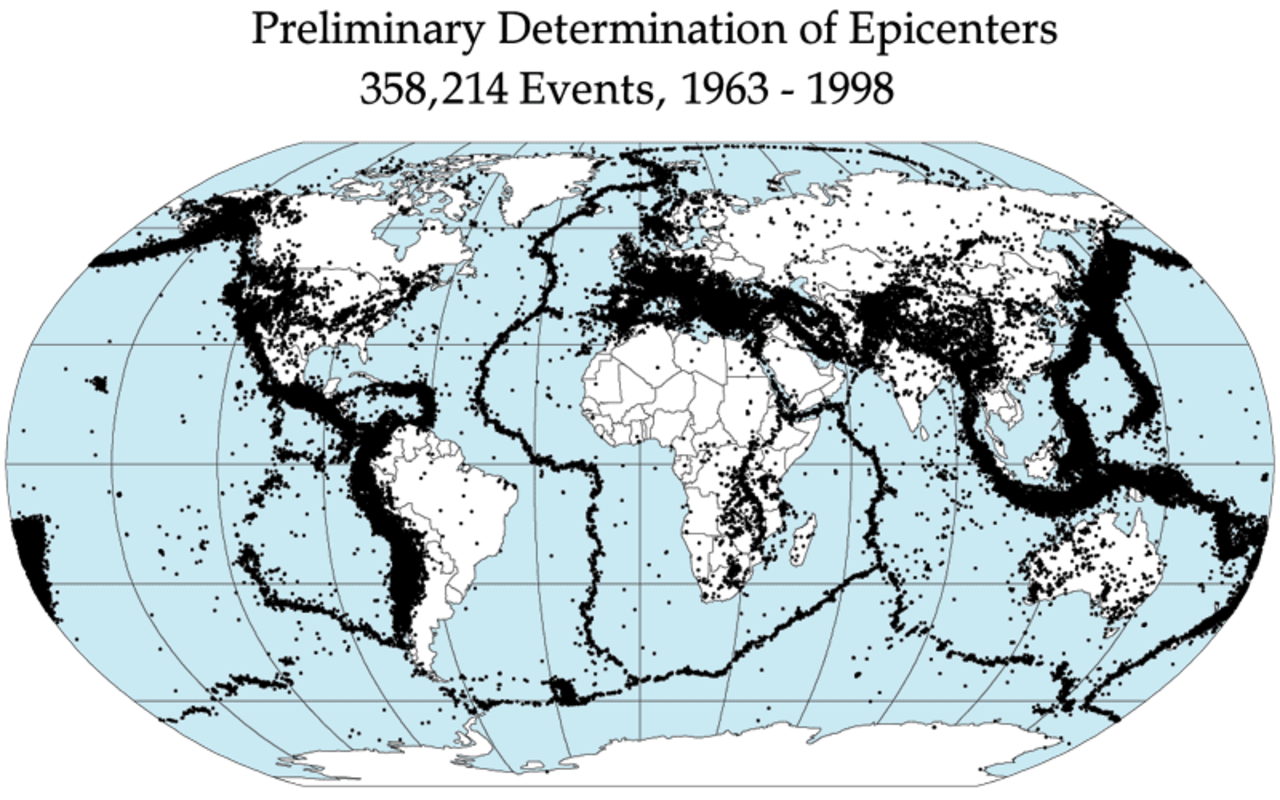
Earthquakes happen when rocks along a geological fault suddenly slip past each other, releasing energy that has built up from tectonic stress. This energy radiates outward as seismic waves, causing the ground to shake. Most earthquakes occur at tectonic plate boundaries, where plates collide, pull apart, or slide past each other.
Introduction
Earth experiences about 500,000 detectable earthquakes each year, though only about 100,000 can be felt by people, and roughly 100 cause significant damage. The most powerful earthquakes release energy equivalent to billions of tons of TNT and can reshape landscapes, trigger tsunamis, and devastate cities in seconds.

The Short Answer
- Primary Cause: Sudden release of stress along geological faults
- Where They Occur: Mostly at tectonic plate boundaries
- Frequency: ~500,000 detectable earthquakes per year worldwide
The Earth's tectonic plates are in constant, slow motion, driven by convection currents in the mantle. Where plates interact, friction locks them together temporarily, and stress builds up over years to centuries. When the accumulated stress exceeds the strength of the rocks, the fault ruptures and the plates lurch into new positions, releasing energy as an earthquake.
The point underground where the rupture begins is called the focus or hypocenter. The point on the surface directly above is the epicenter. Shallow earthquakes (less than 70 km deep) tend to cause the most damage because the seismic energy travels a shorter distance to the surface.
The Science Behind It
- Elastic Rebound: Rocks spring back to their original shape after faulting
- Seismic Waves: P-waves (compressional), S-waves (shear), surface waves
- Magnitude Scale: Each whole number = ~32x more energy released
The elastic rebound theory explains earthquake mechanics. As tectonic stress slowly deforms rocks on either side of a fault, they bend and store elastic energy like a compressed spring. When the fault finally slips, the rocks snap back to their original shape, releasing stored energy as seismic waves. The longer the time between earthquakes on a given fault, the more energy accumulates, and the larger the eventual earthquake.
Three types of seismic waves radiate from the rupture. P-waves (primary waves) are compressional waves that travel fastest and arrive first, moving through both solids and liquids. S-waves (secondary waves) are shear waves that move slower and only through solids. Surface waves travel along the ground surface and cause the most destructive shaking, producing rolling and side-to-side motions.
Types & Variations
- Tectonic Earthquakes: Plate boundary interactions (most common)
- Volcanic Earthquakes: Caused by magma movement beneath volcanoes
- Collapse Earthquakes: Triggered by cave or mine collapses
- Induced Earthquakes: Caused by human activities like fracking or reservoir filling
At convergent boundaries where plates collide, some of the world's most powerful earthquakes occur. The 2011 Tohoku earthquake (magnitude 9.1) in Japan happened where the Pacific Plate subducts beneath the North American Plate. At divergent boundaries where plates pull apart, earthquakes are generally smaller. Transform boundaries like the San Andreas Fault produce frequent moderate to large earthquakes.
Induced seismicity has become a growing concern. The injection of wastewater from oil and gas operations into deep wells has caused notable earthquake swarms in Oklahoma, which went from experiencing two magnitude-3+ earthquakes per year before 2009 to over 900 in 2015. Reservoir-induced seismicity occurs when the weight of water behind large dams stresses underlying faults.
Famous Examples
- 1960 Chile: Magnitude 9.5, strongest recorded earthquake
- 2011 Tohoku, Japan: Magnitude 9.1, triggered devastating tsunami
- 2004 Indian Ocean: Magnitude 9.1, tsunami killed ~230,000 people
- 1906 San Francisco: Magnitude 7.9, destroyed 80% of the city
The 1960 Valdivia earthquake in Chile remains the most powerful earthquake ever recorded at magnitude 9.5. It ruptured nearly 1,000 kilometers of fault, triggered massive landslides, and generated a tsunami that crossed the Pacific Ocean, causing deaths in Hawaii, Japan, and the Philippines. The earthquake permanently changed the local landscape, raising some coastal areas and sinking others.
The 2004 Indian Ocean earthquake and tsunami was one of the deadliest natural disasters in recorded history. A magnitude 9.1 earthquake off the coast of Sumatra ruptured a 1,300-kilometer section of the Sunda megathrust, displacing the seafloor by up to 15 meters and generating waves that reached heights of 30 meters in Aceh, Indonesia. The resulting tsunami killed approximately 230,000 people across 14 countries.
Why It Matters
- Building Codes: Engineering for earthquake resistance saves lives
- Early Warning: Seismic networks can provide seconds to minutes of warning
- Prediction Challenge: Exact earthquake prediction remains impossible
Earthquake engineering has advanced dramatically, and modern building codes in earthquake-prone regions require structures to withstand significant shaking. Japan, which experiences about 1,500 earthquakes per year, has some of the world's most advanced earthquake-resistant buildings, including skyscrapers with base isolation systems and pendulum dampers.
Despite decades of research, precise earthquake prediction (specifying the time, location, and magnitude of a future earthquake) remains impossible. However, earthquake early warning systems can detect P-waves from an earthquake and send alerts to nearby populations before the more destructive S-waves and surface waves arrive. Japan's system provided up to 80 seconds of warning during the 2011 Tohoku earthquake.
Key Facts
- The 1960 Chile earthquake (magnitude 9.5) is the most powerful ever recorded.
- About 500,000 detectable earthquakes occur each year, with roughly 100 causing significant damage.
- The San Andreas Fault in California is a transform plate boundary stretching over 1,200 km.
- Each whole number increase in earthquake magnitude represents about 32 times more energy.
- The 2004 Indian Ocean tsunami killed approximately 230,000 people across 14 countries.
Fun Facts
- Animals have been observed behaving strangely before earthquakes, though no reliable prediction method has been developed from this.
- The Pacific Ring of Fire accounts for approximately 90% of the world's earthquakes.
- Moonquakes occur on the Moon, but they are much weaker than earthquakes and last longer, sometimes for hours.
- Earthquakes can temporarily change the length of the day by redistributing Earth's mass.
Final Thoughts
Earthquakes are the sudden, violent expression of the slow but immense forces driving plate tectonics. While we cannot yet predict when they will strike, our understanding of how earthquakes happen has led to lifesaving advances in building design, early warning systems, and hazard assessment. In a world where billions of people live in seismically active regions, this knowledge is not merely academic but essential for survival.
Test Your Knowledge!
Curious about geography? Test what you've learned!
Play Geography Games →