
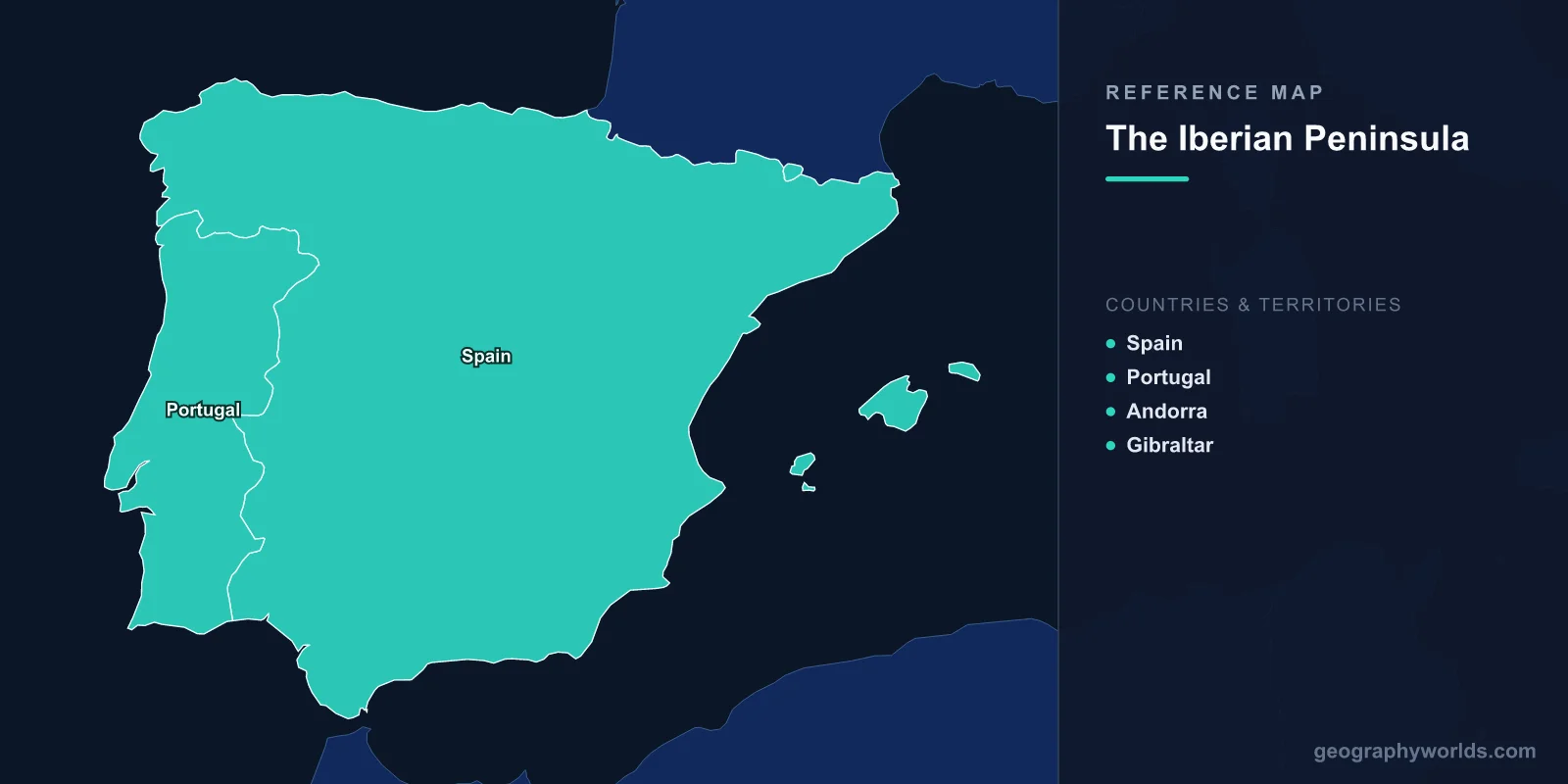
The Iberian Peninsula is a 583,000 km2 landmass in southwestern Europe, home to Spain, Portugal, Andorra, and Gibraltar. It is separated from France by the Pyrenees Mountains and from Africa by the 14.3 km wide Strait of Gibraltar. The peninsula features the Meseta Central plateau, Mediterranean and Atlantic coastlines, and climate zones ranging from oceanic in the north to semi-arid in the southeast.
Introduction
The Iberian Peninsula occupies the southwestern corner of Europe, covering approximately 583,000 square kilometers. Shared primarily by Spain and Portugal, with the micro-state of Andorra and the British territory of Gibraltar, it is separated from the rest of Europe by the Pyrenees Mountains and from Africa by the narrow Strait of Gibraltar. As Europe's second-largest peninsula after Scandinavia, Iberia contains five major mountain systems, six significant river basins, and a coastline of over 3,000 kilometers.
Iberia's position at the crossroads of the Atlantic and Mediterranean worlds has made it a meeting point of civilizations for thousands of years. Phoenicians, Romans, Visigoths, and Moors all left their mark, creating a rich cultural tapestry that is reflected in the peninsula's architecture, cuisine, and languages. The region is home to approximately 57 million people across its territories, supports six distinct languages (Spanish, Portuguese, Catalan, Basque, Galician, and Aranese), and contains over 50 UNESCO World Heritage Sites — more than almost any comparably sized area on Earth. From the launch of the Age of Exploration in the 15th century to the modern tourism economy that draws over 100 million visitors annually to Spain and Portugal combined, Iberia has shaped and been shaped by its unique geographic position.

Geography & Extent
- Area: 583,000 km²
- Countries: Spain, Portugal, Andorra, Gibraltar
- Highest Point: Mulhacen, 3,479 m (Sierra Nevada)
The Iberian Peninsula is roughly square-shaped, bounded by the Atlantic Ocean to the west and north, the Mediterranean Sea to the south and east, and the Pyrenees to the northeast. The interior is dominated by the Meseta Central, a vast elevated plateau averaging 600-700 meters in altitude that gives the peninsula much of its character.
Major river systems including the Ebro, Tagus, Guadalquivir, Duero, and Guadiana carve deep valleys through the landscape. The coastline stretches over 3,000 kilometers, ranging from the dramatic cliffs of the Algarve to the sandy beaches of the Costa del Sol and the rugged rias of Galicia.
Climate & Landscape
- Climate Zones: Mediterranean, oceanic, semi-arid, alpine
- Average Annual Temp: 13-18°C (varies widely)
- Driest Area: Almeria, ~200 mm/year
Iberia displays remarkable climatic diversity for its size. The northern coast receives heavy rainfall and has a cool oceanic climate similar to Britain, while the southeast around Almeria is Europe's driest region, receiving only about 200 millimeters of rain per year. The interior Meseta experiences hot, dry summers and cold winters with significant frost.
The peninsula contains diverse landscapes, from the snow-capped peaks of the Sierra Nevada and Pyrenees to the wetlands of Donana National Park, one of Europe's most important bird habitats. The dehesa ecosystem of western Iberia, with its scattered cork and holm oaks, is a unique man-made landscape that supports Iberian pigs and endangered species like the Iberian lynx.
Countries & Population
- Total Population: ~57 million
- Largest City: Madrid (~3.3 million)
- Languages: Spanish, Portuguese, Catalan, Basque, Galician
Spain occupies about 85 percent of the peninsula and is the larger and more populous of the two main nations, with roughly 47 million inhabitants. Portugal, stretching along the western coast with approximately 10 million people, has a distinct culture and language despite centuries of shared history with Spain. The Basque Country straddles the border with France and preserves Europe's oldest surviving language, Basque (Euskara), which is a language isolate unrelated to any other known language family and predates the arrival of Indo-European languages.
Urbanization has concentrated populations along the coasts and in major cities like Madrid (3.3 million), Barcelona (1.6 million), Lisbon (550,000 city, 2.9 million metro), and Porto. Rural depopulation of the interior — sometimes called la Espana vacia (empty Spain) — is one of the peninsula's most pressing demographic challenges. Entire provinces in central Spain have population densities below 10 people per square kilometer, comparable to parts of Scandinavia or Siberia. Andorra, nestled high in the Pyrenees, has a population of just 80,000 and relies on tourism and duty-free shopping for its economy, while Gibraltar's 33,000 residents live on a narrow 6.7 square kilometer territory dominated by its famous 426-meter limestone Rock.
Natural Resources
- Cork Production: ~50% of world supply (Portugal)
- Olive Oil: Spain is the world's largest producer
- Minerals: Mercury, copper, tin, tungsten
The Iberian Peninsula is the world's leading producer of cork, with Portugal alone supplying roughly half the global total from its montado cork oak forests. Spain dominates global olive oil production, accounting for nearly 45 percent of the world's supply. The peninsula's mineral wealth has been exploited since antiquity, with the Romans mining silver, gold, and copper extensively.
Renewable energy has become a major resource, with Spain and Portugal investing heavily in wind and solar power. Spain is one of the world's leading wind energy producers, and Portugal has achieved periods of running entirely on renewable electricity. The Alqueva reservoir in Portugal is one of the largest artificial lakes in Europe.
Cultural Significance
- UNESCO Sites: Over 50 combined (Spain and Portugal)
- Historical Influences: Roman, Moorish, Christian
- Cuisine: Mediterranean diet heartland
The Iberian Peninsula was under Moorish rule for nearly 800 years in some regions, and this Islamic heritage is visible in the Alhambra of Granada, the Great Mosque of Cordoba, and the Alfama district of Lisbon. The Reconquista, the Christian campaign to reclaim Iberia, shaped the political and religious identity of both Spain and Portugal for centuries.
Iberia launched the Age of Exploration in the 15th and 16th centuries. Portuguese and Spanish navigators like Vasco da Gama, Columbus, and Magellan departed from Iberian ports to establish global trading empires. The cultural and linguistic legacy of this era extends to Latin America, Africa, and Asia, where hundreds of millions speak Spanish and Portuguese today.
Key Facts
- The Iberian Peninsula is Europe's second-largest peninsula at 583,000 km².
- The Meseta Central, a vast interior plateau, covers much of the peninsula's interior.
- Portugal produces roughly 50% of the world's cork from its oak forests.
- The Strait of Gibraltar, only 14.3 km wide, separates Iberia from Africa.
- Basque, spoken in northern Iberia, is Europe's oldest surviving language with no known relatives.
Fun Facts
- The Iberian Peninsula is named after the ancient Iberians, though the origin of that name is debated.
- Spain has the second-highest number of UNESCO World Heritage Sites of any country in the world.
- The Algarve coast in Portugal has over 3,000 hours of sunshine per year, more than almost anywhere in Europe.
- Andorra, nestled in the Pyrenees, has no airport, no railway, and no military.
Final Thoughts
The Iberian Peninsula is a land where geography has shaped history and culture in profound ways. Its position between the Atlantic and Mediterranean, between Europe and Africa, has made it a crossroads of civilizations and a launchpad for global exploration. From Moorish palaces to Atlantic fishing villages, Iberia remains one of Europe's most diverse and fascinating regions.
Test Your Knowledge!
Think you know your world geography? Try our interactive quiz!
Play Geography Games →