
Introduction
Indonesia 🇮🇩 and the Philippines 🇵🇭 are the two great island nations of Southeast Asia, each made up of thousands of separate pieces of land scattered across tropical seas. They share a region, a maritime way of life, and a place along the volatile edge of the Pacific, but they differ widely in scale and in the histories that shaped them. This comparison sets them side by side across size, population, capitals, climate, and the features that define each.
Whether you are studying geography, planning a trip through the islands, or simply curious how these two archipelagic neighbors compare, here are the key facts and figures.
Size & Geography
| Feature | Indonesia 🇮🇩 | Philippines 🇵🇭 |
|---|---|---|
| Area | 1,904,569 km² | 300,000 km² |
| Continent | Asia | Asia |
| Region | Southeast Asia | Southeast Asia |
| Land Borders | Malaysia, Papua New Guinea, Timor-Leste | None (island nation) |
| Landscape | 17,000+ islands; mountains, rainforests, volcanic terrain | 7,641 islands; mountainous with narrow coastal lowlands |
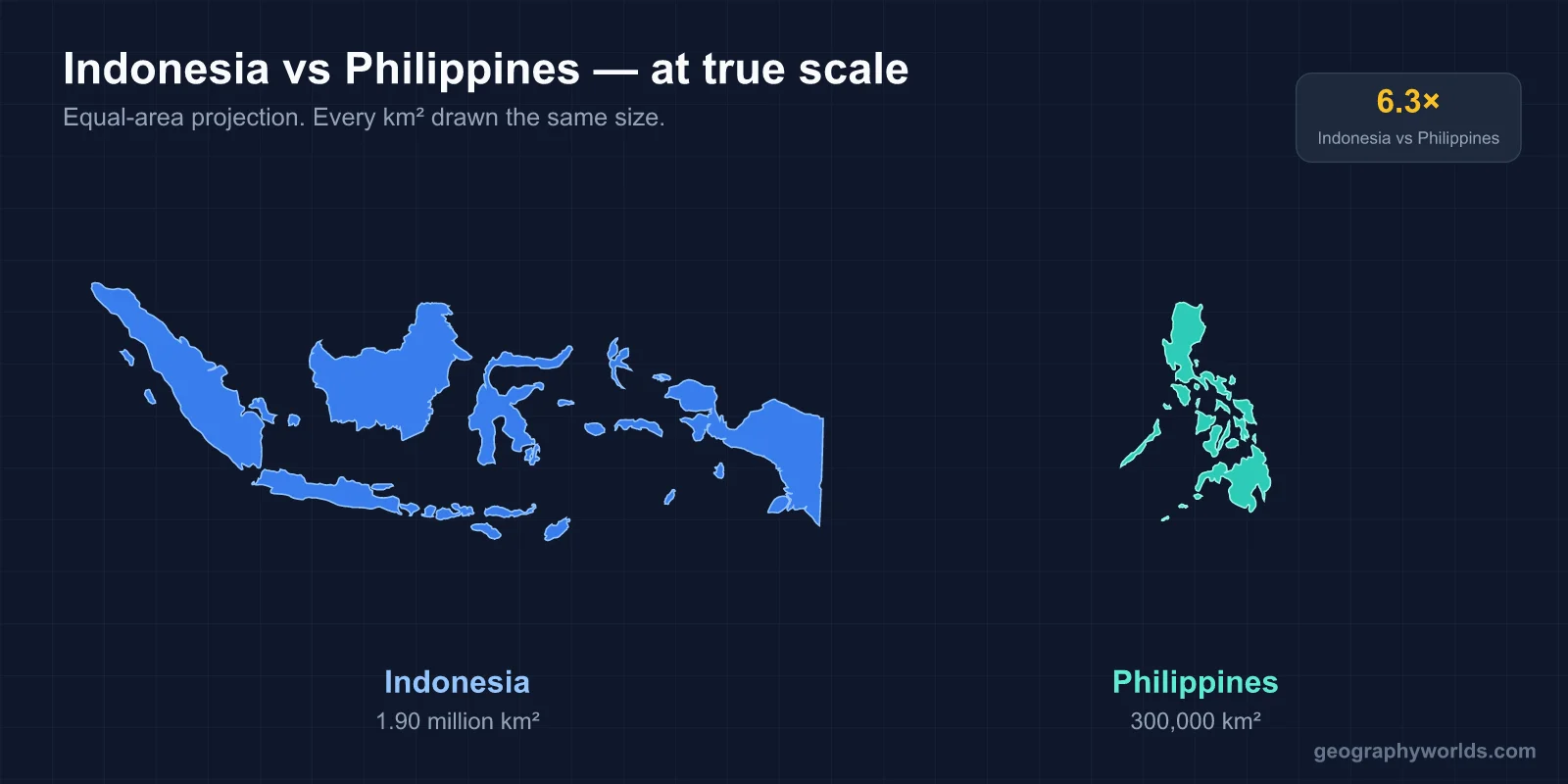
Indonesia is by far the larger country, covering 1,904,569 km² to the Philippines' 300,000 km² — roughly 6.3 times the land. Both are archipelagos, but the numbers behind that label differ sharply: Indonesia sprawls across more than 17,000 islands of mountains, rainforest, and volcanic terrain, while the Philippines is made up of 7,641 islands, mostly mountainous with narrow coastal lowlands. One telling distinction shows up in the borders column. Because parts of Indonesia share land frontiers with Malaysia, Papua New Guinea, and Timor-Leste, it has land borders at all, whereas the Philippines is a pure island nation with none.
Population & Demographics
| Metric | Indonesia 🇮🇩 | Philippines 🇵🇭 |
|---|---|---|
| Population | 287.9 million | 117.7 million |
| Population Density | 151.2 per km² | 392.4 per km² |
Indonesia is also the more populous nation, with 287.9 million people to the Philippines' 117.7 million — about 2.4 times as many, and enough to rank Indonesia among the most populous countries in the world. But spread that population over a much larger territory and Indonesia ends up far less crowded on average. Its density of 151.2 people per km² is dwarfed by the Philippines' 392.4, a gap of roughly 241.3 people per km². In other words, the smaller country feels considerably more packed, a pattern common to compact, heavily settled island nations.
Capital Cities
Jakarta is the capital of Indonesia, while Manila serves as the capital of the Philippines. Both are sprawling, densely populated capitals set within the Southeast Asia region of the Asian continent, and both rank among the largest urban areas in the world — fitting anchors for two of the region's most populous nations.
Language, Currency & Culture
| Aspect | Indonesia 🇮🇩 | Philippines 🇵🇭 |
|---|---|---|
| Languages | Indonesian (Bahasa Indonesia, official), plus over 700 regional languages | Filipino (Tagalog) and English (both official) |
| Currency | Indonesian Rupiah (IDR) | Philippine Peso (PHP) |
Both nations juggle remarkable linguistic diversity, but they resolved it differently. Indonesia adopted Indonesian, or Bahasa Indonesia, as a unifying official language atop more than 700 regional tongues. The Philippines recognizes two official languages, Filipino (based on Tagalog) and English, the latter a legacy of its period under American administration. Their money differs too — the Indonesian rupiah and the Philippine peso. These contrasts trace back to very different colonial pasts, Dutch in Indonesia and Spanish then American in the Philippines, layered over deep indigenous roots.
Climate & Natural Features
| Aspect | Indonesia 🇮🇩 | Philippines 🇵🇭 |
|---|---|---|
| Climate | tropical; hot and humid | tropical marine; monsoons |
| Key Features | Borneo, Sumatra, Java, Bali, Ring of Fire volcanoes | Chocolate Hills, Mayon Volcano, Palawan, rice terraces |
| Economy | commodities, manufacturing, palm oil, mining | services (BPO), remittances, agriculture, electronics |
Both countries are thoroughly tropical and both straddle the seismically active Ring of Fire, which gives each its volcanoes. Indonesia's climate is simply hot and humid year-round, with signature landmarks like Borneo, Sumatra, Java, and Bali. The Philippines has a tropical marine climate driven by monsoons, and is famous for the Chocolate Hills, the near-perfect cone of Mayon Volcano, the islands of Palawan, and its mountain rice terraces. Their economies sit in different lanes: Indonesia is anchored in commodities, manufacturing, palm oil, and mining, while the Philippines is powered by services — especially business process outsourcing — along with remittances, agriculture, and electronics.
What Makes Each Country Unique
Indonesia is internationally renowned for Bali, the Komodo dragons, and extraordinary biodiversity. As the world's largest archipelago, it has more than 17,000 islands — the most of any country — yet only about 6,000 of them are inhabited.
The Philippines is celebrated for its stunning island beaches, the Chocolate Hills of Bohol, its colorful jeepney culture, and the warmth of its people. It is also known for the longest Christmas season in the world, with festivities beginning in September and stretching into January.
Key Differences at a Glance
- Area: Indonesia (1,904,569 km²) vs Philippines (300,000 km²) — Indonesia is 6.3x larger
- Population: Indonesia (287.9 million) vs Philippines (117.7 million) — Indonesia is 2.4x more populous
- Capitals: Jakarta vs Manila
- Currency: Indonesian Rupiah (IDR) vs Philippine Peso (PHP)
- Continents: Asia vs Asia
- Density: Philippines is more densely populated (difference of ~241.3 people per km²)
- Languages: Indonesian (Bahasa Indonesia) vs Filipino (Tagalog) and English (both official)
Verdict
Indonesia and the Philippines are the two island giants of Southeast Asia, and on the headline measures Indonesia leads across the board — 6.3 times the land area and 2.4 times the population. Yet the more revealing figure is density, where the smaller Philippines comes out far ahead, a reminder that a bigger population does not always mean a more crowded country.
Beyond the numbers, each has its own feel. Indonesia is the hot, humid sprawl of Borneo, Java, and Bali, its economy rooted in commodities; the Philippines is the monsoon-swept land of the Chocolate Hills and Mayon Volcano, its growth driven by services and outsourcing. Their different colonial histories echo through their languages and culture to this day.
Side by side, they show how two neighbors that look superficially alike — tropical, archipelagic, populous — can still be remarkably distinct once you look closely at the map and the figures behind it.
Test Your Knowledge!
Think you know your countries? Try our interactive geography quiz!
Play Geography Games →