
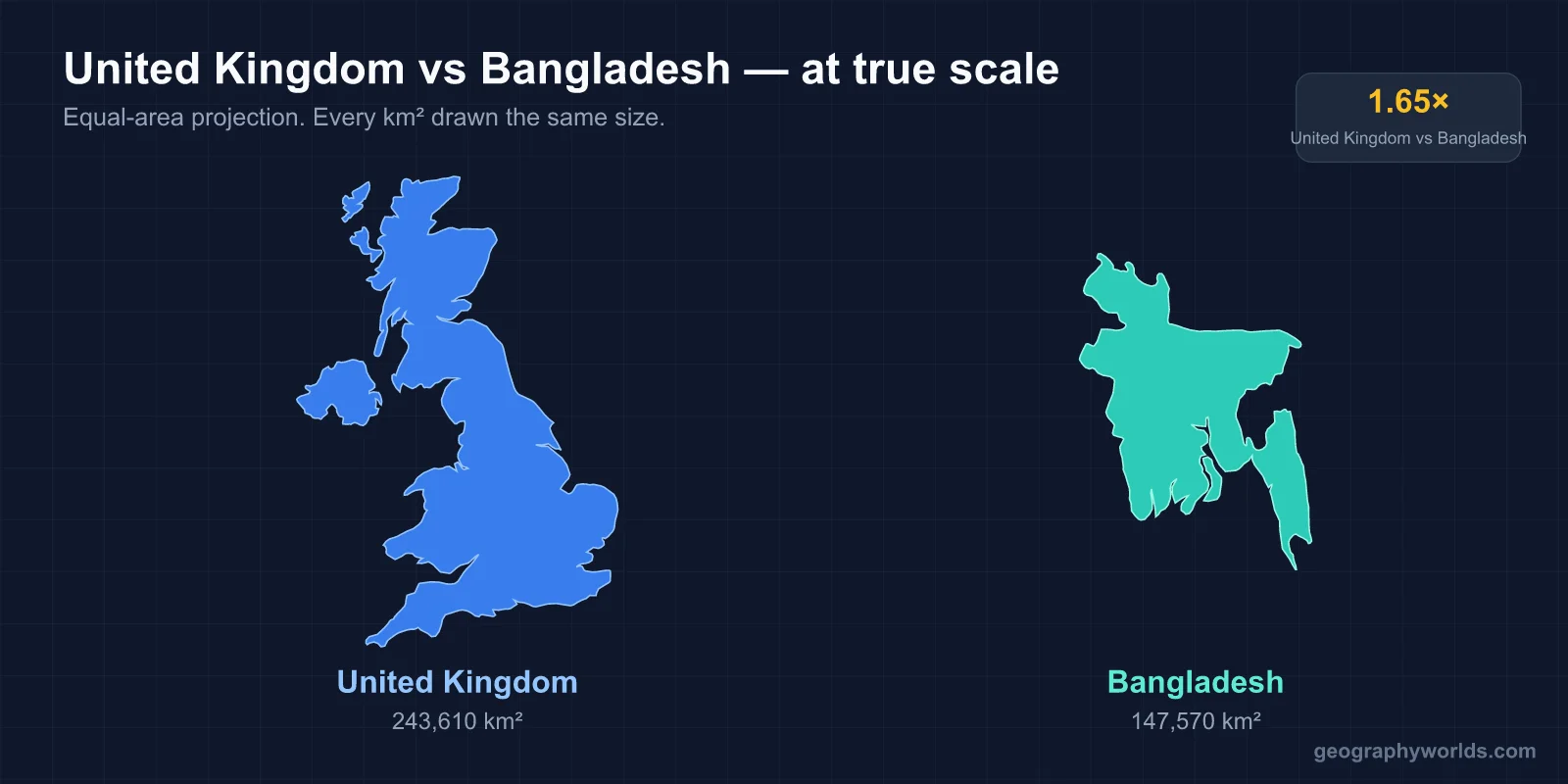
Bangladesh and the United Kingdom are an unusual pairing — a densely packed South Asian delta nation and a North Atlantic island state. They're often compared because their populations are surprisingly close, but their physical sizes differ significantly. So which is bigger by area?
The Short Answer
No, the UK is bigger than Bangladesh. The UK covers 243,610 km². Bangladesh covers 147,570 km². The UK is approximately 65% larger than Bangladesh. But Bangladesh's population is more than 2.5 times the UK's — it is one of the most densely populated countries on Earth.
Side-by-Side Numbers
- Bangladesh area: 147,570 km² (56,977 sq mi)
- UK area: 243,610 km² (94,058 sq mi)
- Difference: UK is ~96,000 km² larger
- Ratio: UK is ~1.65× the size of Bangladesh
- Bangladesh population: ~173 million
- UK population: ~67 million
Bangladesh
Bangladesh is in South Asia, bordered almost entirely by India, with a short border with Myanmar in the southeast and the Bay of Bengal to the south. The country is overwhelmingly dominated by the Ganges-Brahmaputra-Meghna river delta — one of the largest and most productive deltas in the world. About 80% of Bangladesh is alluvial floodplain, and most of the country sits less than 12 m above sea level, making it extraordinarily vulnerable to sea-level rise, flooding, and cyclones.
Bangladesh is the world's 8th most populous country with about 173 million people. The capital, Dhaka, is one of the largest metropolitan areas in the world with over 22 million people, and one of the most densely populated cities on Earth. Other major cities include Chittagong (the main port), Khulna, Rajshahi, and Sylhet. Bangladesh gained independence from Pakistan in 1971 after a war of liberation. Today the country is among the world's fastest-growing economies.
The United Kingdom
The United Kingdom comprises four constituent countries: England (the largest and most populous), Scotland, Wales, and Northern Ireland. England, Scotland, and Wales share the island of Great Britain; Northern Ireland sits on the island of Ireland alongside the Republic of Ireland. The UK has about 12,500 km of coastline and includes numerous smaller islands.
The UK has about 67 million people, with London (about 9 million in the city, 14 million in the metro area) as the dominant city. England is highly urbanized; Scotland and Wales have more mountainous and rural terrain. The country is one of the world's six largest economies and a permanent UN Security Council member. It left the European Union in 2020.
Population Density
The population density contrast is staggering. Bangladesh has about 1,173 people per km² — one of the highest densities of any major country on Earth (only city-states like Singapore, Monaco, and Vatican City are more densely populated). The UK has about 281 people per km², high for Europe but only about a quarter of Bangladesh's density. Dhaka's metro area alone has about 47,400 people per km² in some areas — among the densest cities in the world.
Climate
Bangladesh has a tropical monsoon climate. Summers (April–September) are hot and extremely humid, with the southwest monsoon bringing heavy rainfall — Sylhet receives over 5,500 mm of rain per year. Cyclones from the Bay of Bengal regularly hit the coast, sometimes catastrophically. The 1970 Bhola cyclone killed over 500,000 people, the deadliest tropical cyclone in recorded history. Winters are mild and dry.
The UK has a temperate maritime climate moderated by the Gulf Stream. Summers are mild (typical July highs of 20–22°C), winters are cool but rarely severe (typical January lows of 1–5°C). Rainfall is moderate but consistent — Britain's reputation for rain comes more from frequency than total amount. Snow is occasional except in the Scottish Highlands and the Pennines.
Economy
The UK has the world's 6th largest economy at roughly $3.3 trillion. Major industries include financial services (London is one of the world's leading financial centers alongside New York), professional services, aerospace, pharmaceuticals, the creative industries (film, TV, music, publishing), and education. Bangladesh has the 35th largest economy at about $460 billion, growing rapidly. Major industries include textiles and ready-made garments (Bangladesh is the world's 2nd-largest exporter of clothing after China), agriculture (especially rice and jute), shipbuilding, leather, pharmaceuticals, and increasingly IT services. Bangladesh has been one of the fastest-growing economies in Asia for over a decade.
Climate Change Vulnerability
Bangladesh is one of the most climate-vulnerable countries in the world. With about 80% of the country in a low-lying delta and roughly 1.5 million km² of the Bay of Bengal's waters bordering it, the country is exceptionally exposed to sea-level rise, coastal erosion, salinity intrusion (which is making land unsuitable for traditional agriculture), and increasingly severe cyclones. Estimates suggest tens of millions of Bangladeshis could be displaced by climate change in coming decades. The UK is also climate-vulnerable — sea-level rise threatens the Thames Barrier and coastal cities like Hull and parts of East Anglia; heatwaves are becoming more severe — but the country has far greater resources to adapt than Bangladesh.
Religion and Culture
Bangladesh is the world's 4th most populous Muslim country, with about 91% of the population identifying as Muslim (mostly Sunni). About 8% are Hindu, with smaller Christian and Buddhist communities. Bengali culture is rich and distinctive — the country's language (Bangla/Bengali) is the 7th most-spoken in the world and was at the center of the 1952 Language Movement that ultimately led to Bangladesh's independence. The UK is religiously diverse. About 46% identify as Christian (largely Church of England), with significant Muslim (about 6%), Hindu (about 2%), Sikh, Jewish, and Buddhist communities. About 37% identify as having no religion in recent censuses.
History
Bangladesh's territory was part of various Indian empires (Maurya, Gupta, Pala, Sena, Mughal) for centuries before becoming part of British Bengal in 1858. The 1947 Partition of India created East Pakistan (predominantly Muslim Bangladesh) and West Pakistan (modern Pakistan), separated by 1,600 km of India. After decades of cultural, political, and economic discrimination, Bangladesh fought a brutal war of independence in 1971, with Indian military support, becoming the People's Republic of Bangladesh on December 16, 1971.
The UK has shaped global history more than nearly any other nation. The British Empire became the largest in history at its 1922 peak, covering nearly a quarter of the world's land and population. The 20th century saw the empire dismantled, with most colonies gaining independence between 1947 and 1980. The UK's legacy includes the English language (now the world's lingua franca), parliamentary democracy, common law, and significant influence on global cultural exports.
Diaspora Links
Bangladesh and the UK are connected by significant diaspora populations. About 650,000 people of Bangladeshi origin live in the UK, with the largest community in London's East End. The UK is one of the top destinations for Bangladeshi students, professionals, and family migrants. Remittances from Bangladeshis abroad (including in the UK, the Gulf states, and Malaysia) totaled about $22 billion in 2023 — about 5% of Bangladesh's GDP. These connections create real economic, cultural, and political ties between the two nations.
Food and Culture
Both countries have rich food cultures with global influence. Bengali cuisine is famous for its mix of rice, fish, lentils, and spices — biryani, hilsa fish curry, panta bhat (fermented rice), and sweets like rasgulla and sandesh are widely loved. The "Indian" restaurants that proliferated in the UK after WWII are overwhelmingly run by Bangladeshis (especially from Sylhet), introducing curry as essentially a British national dish. The UK has shaped global food culture less directly but profoundly — afternoon tea, fish and chips, the full English breakfast, Sunday roast, and increasingly modern British cuisine led by chefs like Heston Blumenthal and Yotam Ottolenghi.
Key Facts
- The UK is about 65% larger than Bangladesh by area.
- Bangladesh has about 2.6× more people than the UK.
- Bangladesh is one of the most densely populated countries on Earth.
- Bangladesh is at the front line of climate change vulnerability.
- About 650,000 people of Bangladeshi origin live in the UK.
Fun Facts
- Bangladesh has more people than Russia despite being much smaller geographically.
- The UK's longest river (the Severn) is shorter than Bangladesh's smallest major river.
- Dhaka has more rickshaws than any city in the world.
- Bengali tigers are Bangladesh's national animal; the Sundarbans mangrove forest hosts the world's largest tiger population.
- Both nations have rich cricket traditions and have produced top international players.
The Bottom Line
The UK is bigger than Bangladesh by area — about 65% larger. But Bangladesh has 2.6 times the UK's population packed into less than two-thirds the land area. The two countries are inverted in nearly every demographic and geographic dimension. Both have outsized influence in their regions and globally, both face significant climate challenges, and both are linked by colonial history, diaspora populations, and growing economic ties.
Quiz World Nations!
Test your knowledge of Bangladesh, the UK, and great nations of the world.
Play Geography Games →