
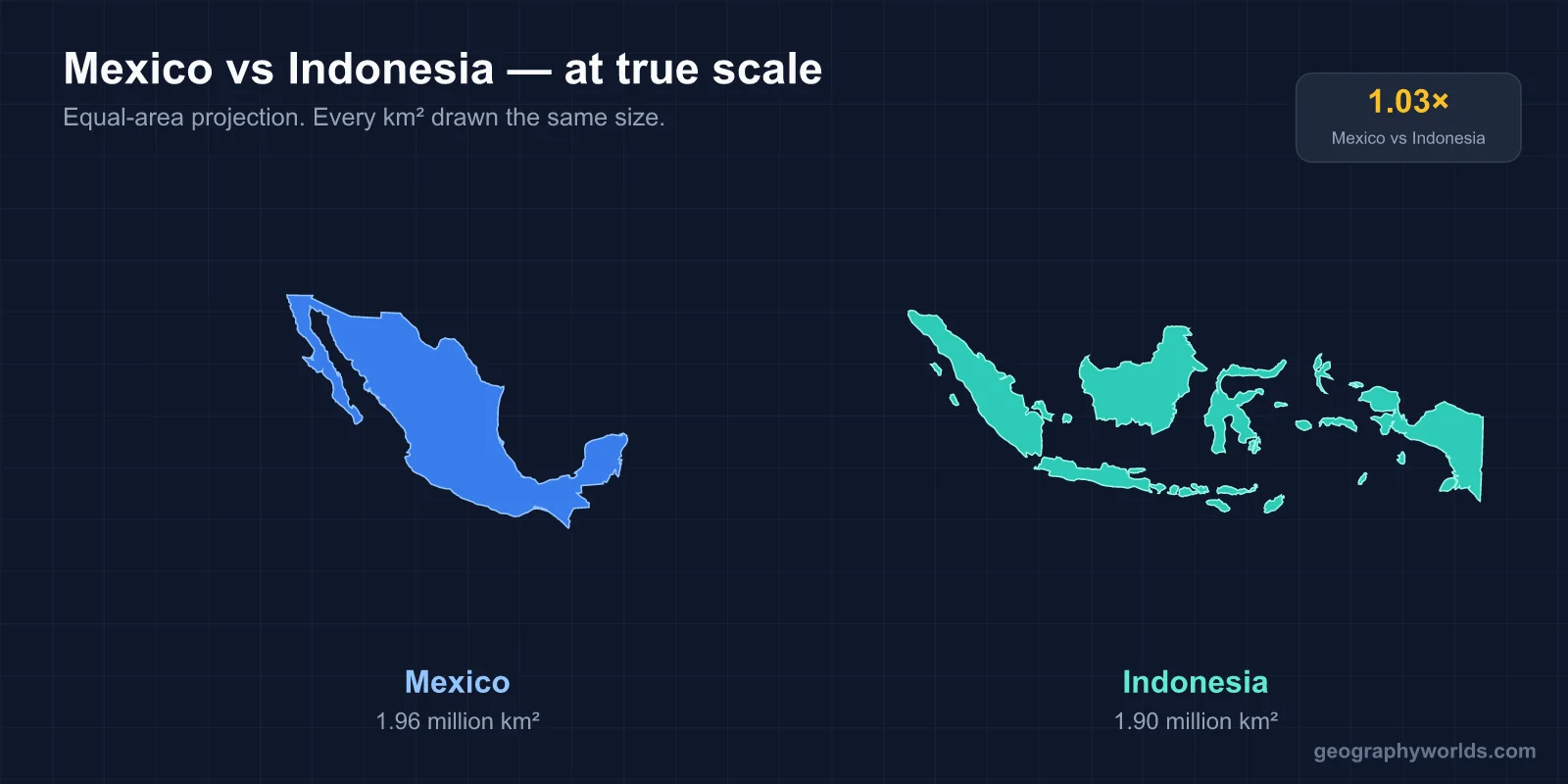
No, just barely. Mexico is slightly larger than Indonesia. Mexico covers 1,964,375 km², while Indonesia covers 1,904,569 km². Mexico is about 1.03 times the size of Indonesia — larger by 59,806 km², which is about the size of Croatia or Latvia. But Indonesia has more than twice the population (280 million vs 130 million Mexicans).
The Short Answer
Mexico and Indonesia are both among the world's most populous and economically important developing countries. Mexico is the 10th-most populous country with 130 million people; Indonesia is the 4th-most populous with 280 million. By area, they're nearly tied — Mexico in the 13th spot globally, Indonesia in 14th. The gap between them (60,000 km²) is small enough that they're essentially the same scale.
Despite similar areas, the two countries are profoundly different. Mexico is mostly mainland with one peninsular extension (Baja California) and the Yucatán. Indonesia is an archipelago of over 17,000 islands stretching across 5,000 km of equatorial seas — making it the world's largest archipelagic state.

The Real Numbers
- Mexico total area: 1,964,375 km² (758,449 sq mi)
- Indonesia total area: 1,904,569 km² (735,358 sq mi)
- Difference: 59,806 km² — about the size of Croatia
- Ratio: Mexico is about 1.03× the size of Indonesia
Mexico is land-mostly with a long coastline (9,330 km) on the Pacific, Gulf of Mexico, and Caribbean. Indonesia is islands — but with massive total coastline (about 54,716 km, the second-longest in the world after Canada). The two have very different geographic structures despite their similar total areas.
Population
Indonesia has more than double the population:
- Indonesia population: ~280,000,000
- Mexico population: ~130,000,000
- Indonesia density: ~147 people per km²
- Mexico density: ~66 people per km²
Indonesia has 2.15× more people than Mexico, packed into 3% less land. Indonesia's population density is more than 2× Mexico's. The reason: Java, Indonesia's most populous island, contains about 145 million people on just 132,000 km² — one of the most densely populated large areas in the world (density of about 1,100 people/km², comparable to Bangladesh).
Geography
Indonesia is the largest archipelagic country in the world, with major islands including:
- Java: Most populous, home to Jakarta
- Sumatra: 6th-largest island in the world
- Borneo (shared with Malaysia and Brunei): 3rd-largest island in the world
- Sulawesi: Unique K-shaped island
- New Guinea (shared with Papua New Guinea): 2nd-largest island in the world
- Bali: Famous tourist destination
Mexico is mostly mainland with two peninsulas (Baja California and Yucatán). Major regions include the Sierra Madre mountain ranges, the Mexican Plateau, the Sonoran and Chihuahuan deserts in the north, tropical southern regions, the Mexican Pacific coast, and the Yucatán Peninsula. Pico de Orizaba (5,636 m) is Mexico's highest peak.
Climate
Indonesia has tropical climate dominant throughout — Indonesia straddles the equator. The climate is hot and humid year-round, with monsoon-influenced wet and dry seasons. Indonesia is one of the wettest places on Earth in some regions, especially Sumatra and Borneo.
Mexico has more climate variety. Northern Mexico is largely desert or semi-arid. Central Mexico is temperate at high elevations. Southern Mexico is tropical. The Pacific coast is hot. The Yucatán is tropical wet-and-dry. Hurricane season affects the Atlantic, Caribbean, and Pacific coasts.
Economy
Mexico has the larger economy in absolute terms:
- Mexico GDP: ~$1.79 trillion
- Indonesia GDP: ~$1.32 trillion
- Mexico per capita GDP: ~$13,800
- Indonesia per capita GDP: ~$4,700
Mexico's economy is about 36% larger than Indonesia's in absolute terms, and Mexico is about 3× richer per capita. But Indonesia has been growing faster (5-6% annual GDP growth vs Mexico's 2-3%) and is projected to overtake Mexico's economy in the 2030s. Mexico is a major manufacturer for North America; Indonesia is a major commodity exporter (palm oil, coal, nickel, rubber, coffee).
Languages and Religion
Indonesia is the world's largest Muslim-majority country — about 87% Muslim. Indonesia is also incredibly linguistically diverse with over 700 living languages. Indonesian (Bahasa Indonesia) is the official language and is widely spoken as a second language. Regional languages include Javanese, Sundanese, Madurese, and many others.
Mexico is overwhelmingly Catholic — about 78% identify as Roman Catholic, with smaller Protestant and indigenous religious traditions. Spanish is the dominant language (about 99% speakers), with 68 recognized indigenous languages including Nahuatl, Maya, Mixtec, and Zapotec.
Key Facts
- Mexico is about 1.03× the size of Indonesia.
- Indonesia has 2.15× more people than Mexico.
- Indonesia is the world's largest archipelagic state.
- Mexico is the world's 10th-most populous country.
- Indonesia is the world's 4th-most populous country.
Fun Facts
- Indonesia has more volcanoes (about 130 active) than any country in the world.
- Mexico has the most UNESCO World Heritage Sites in the Americas (35), beating both the US and Brazil.
- Java in Indonesia alone has more people than Mexico — about 145 million vs Mexico's 130 million.
- Mexico City sits at 2,240 m elevation; Jakarta is at sea level.
- Indonesia has 6 official religions: Islam, Protestantism, Catholicism, Hinduism, Buddhism, and Confucianism.
- Mexico has 5 of the world's 25 megacities (cities with 10+ million people): Mexico City. Indonesia has Jakarta.
Trade and Economy
Both countries have growing manufacturing sectors and significant export economies. Mexico is heavily integrated with the US economy through USMCA — about 80% of Mexican exports go to the US. Major Mexican exports include cars, electronics, oil, fruits and vegetables, beer, and tequila. Mexico is now the largest manufacturer of cars in North America.
Indonesia's economy is more diversified geographically — its largest trading partners include China, the US, Japan, Singapore, and ASEAN neighbors. Indonesia is the world's largest exporter of palm oil and a major producer of coal, rubber, coffee, tin, and tropical fruits. The country is increasingly important in global supply chains for electronics and textiles.
Natural Disasters
Both face significant natural disaster risks. Indonesia is one of the most seismically active countries in the world, with frequent earthquakes, tsunamis, and volcanic eruptions. The 2004 Indian Ocean tsunami killed over 200,000 Indonesians. The Anak Krakatau volcano (offspring of the famous 1883 Krakatoa eruption) remains active.
Mexico also has earthquakes (especially in the south), hurricanes on its coasts, and active volcanoes including Popocatépetl, which periodically erupts and threatens Mexico City. The 1985 Mexico City earthquake killed about 10,000 people.
The Bottom Line
Mexico is barely bigger than Indonesia — about 3% larger by area. Indonesia has more than double the population. Both are major regional powers — Mexico in North America, Indonesia in Southeast Asia. Both are emerging economies with rapid growth, large youth populations, and important roles in their respective regions. The two countries are practically equivalent in size but very different in everything else — religion, language, geography, history, and culture.
Cultural Exports
Indonesia's cultural exports include gamelan music, batik textiles, wayang shadow puppetry, and an ancient Hindu-Buddhist heritage visible in temples like Borobudur (the world's largest Buddhist temple) and Prambanan. Indonesian cuisine — nasi goreng, rendang, satay — is increasingly popular globally. Bali has become a global symbol of paradise tourism.
Mexican cultural exports include Día de los Muertos (Day of the Dead), mariachi music, Aztec and Maya heritage sites, telenovelas, lucha libre wrestling, and an extraordinary cuisine (tacos, mole, guacamole, tequila, mezcal). Mexican cinema and literature continue to influence world culture, and the Mexican diaspora has spread these traditions globally.
Demographics
Both countries have young populations relative to developed nations. Indonesia's median age is about 30; Mexico's is about 29. Both are growing — Indonesia at about 1% annually, Mexico at about 1%. Both will need to continue building infrastructure, education, and employment to absorb their large young populations.
Tourism Industries
Indonesia is a major tourism destination, receiving about 17 million international visitors annually (pre-pandemic). Bali alone attracts about 6 million tourists per year. Other major destinations include Yogyakarta (cultural heart), Jakarta, Komodo Island, Borobudur temple, and Raja Ampat (diving). Tourism contributes about 5% of Indonesian GDP.
Mexico is the 6th most-visited country in the world (about 45 million tourists annually). Major destinations include Cancún, Playa del Carmen, Cabo San Lucas, Puerto Vallarta, Mexico City, Oaxaca, and pre-Columbian archaeological sites (Chichén Itzá, Teotihuacán). Tourism contributes about 9% of Mexican GDP. Despite very different cultures and locations, both countries see tourism as a critical growth sector and major contributor to their economies. Both also benefit from significant indigenous and pre-Columbian/pre-colonial heritage that attracts cultural tourists worldwide. Mexico has Maya, Aztec, and Olmec heritage; Indonesia has Hindu-Buddhist heritage visible in Borobudur and Prambanan, along with diverse indigenous cultures across thousands of islands.