
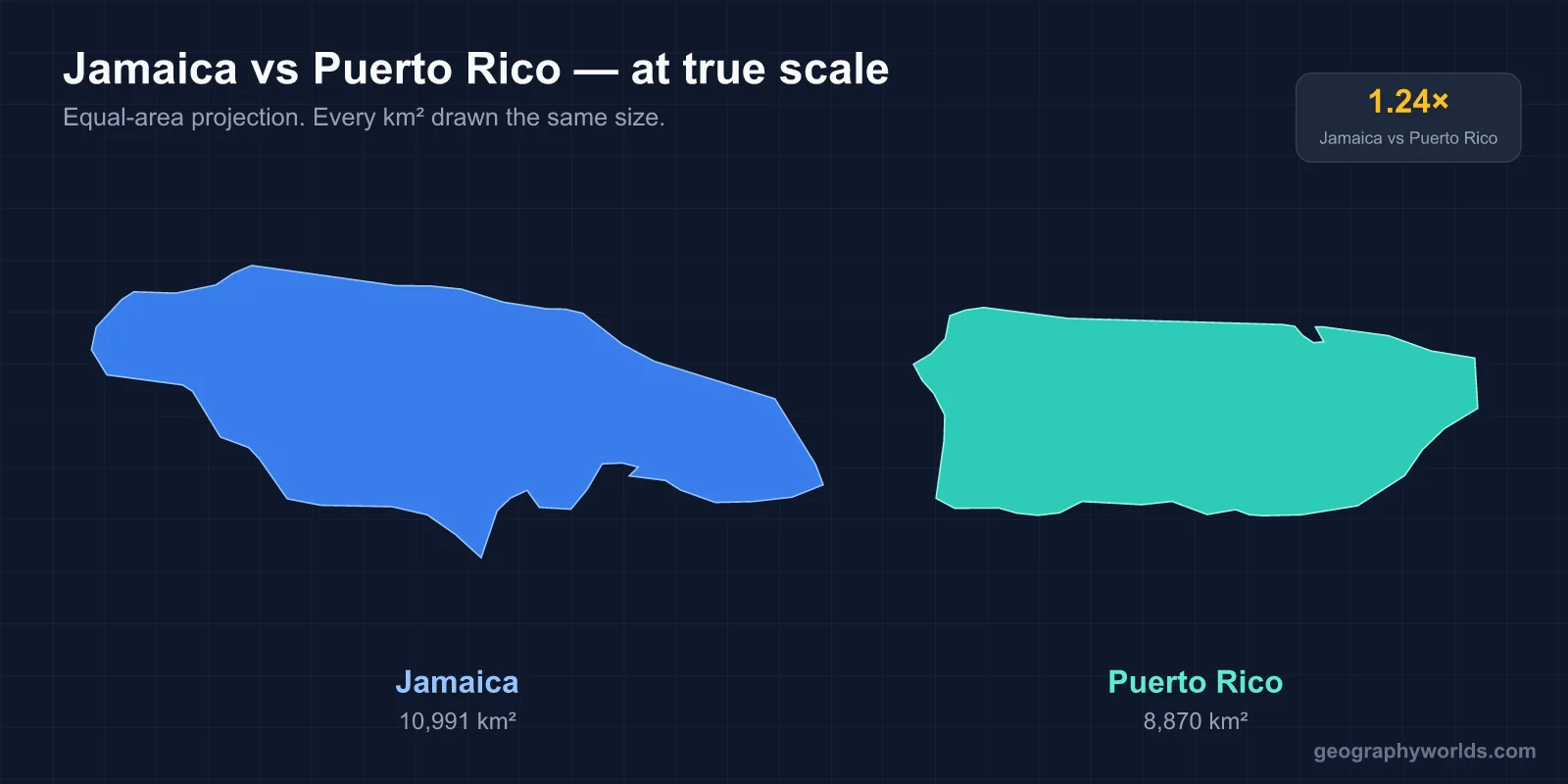
Jamaica and Puerto Rico are two of the most famous Caribbean islands — cultural powerhouses with global reach, complex colonial histories, and vibrant musical traditions. So which one is actually bigger?
The Short Answer
Yes, Jamaica is bigger than Puerto Rico. Jamaica covers 10,991 km². Puerto Rico covers 8,870 km². Jamaica is approximately 24% larger than Puerto Rico.
Side-by-Side Numbers
- Jamaica area: 10,991 km² (4,244 sq mi)
- Puerto Rico area: 8,870 km² (3,425 sq mi)
- Difference: Jamaica is ~2,121 km² larger
- Ratio: Jamaica is ~1.24× the size of Puerto Rico
- Jamaica population: ~2.8 million
- Puerto Rico population: ~3.2 million
Jamaica
Jamaica is an independent island nation in the Caribbean, the third-largest island in the Greater Antilles after Cuba and Hispaniola. The country is located south of Cuba, west of Hispaniola, and about 600 km south of Florida. Kingston, the capital, has about 1.2 million people in its metro area. Other major cities include Montego Bay, Spanish Town, and Portmore.
Jamaica's geography is varied for an island of its size — the Blue Mountains in the east include peaks over 2,200 m, while the rest of the island has rolling hills, coastal plains, and famous beaches. The island has been independent since 1962, though Queen Elizabeth II remained head of state until her death, and discussions about becoming a republic continue. Jamaica has had outsized global cultural influence through music (reggae, dancehall, ska), sports (especially track and field — Usain Bolt and Shelly-Ann Fraser-Pryce dominated global sprinting for over a decade), and food.
Puerto Rico
Puerto Rico is an unincorporated US territory in the Caribbean, east of the Dominican Republic and west of the US Virgin Islands. The island is the smallest and easternmost of the Greater Antilles. San Juan, the capital and largest city, has about 318,000 people in the city and 2.2 million in the metro area. Other major cities include Bayamón, Carolina, and Ponce.
Puerto Rico's geography is mountainous — the central spine includes peaks over 1,300 m and El Yunque National Forest (the only tropical rainforest in the US National Forest System). Coastal plains surround the central mountains. The island was a Spanish colony from 1493 until 1898, when it was ceded to the US after the Spanish-American War. Puerto Ricans have been US citizens since 1917 but cannot vote in presidential elections and have only non-voting representation in Congress. The territory has held multiple referendums on statehood, independence, and continued territorial status with mixed results.
Climate
Both islands have tropical climates with similar conditions. Average temperatures stay between 25–30°C year-round. Both are vulnerable to hurricanes from the Atlantic — the 2017 hurricane season was particularly devastating, with Hurricane Maria causing massive damage to Puerto Rico (thousands of deaths and a year+ of widespread power outages). Hurricanes Irma and Matthew affected Jamaica less severely but still caused significant damage. Climate change is making Caribbean hurricanes stronger and more frequent.
Economy
Both islands have economies shaped by their political status. Puerto Rico has a much larger economy — GDP of about $115 billion, despite the island's ongoing economic crisis (declared in 2016) and the devastating effects of Hurricane Maria. Major industries include manufacturing (especially pharmaceuticals, accounting for about a third of GDP), tourism, finance, and government services. Jamaica's economy is smaller at about $16 billion. Major industries include tourism (Jamaica welcomes about 4 million visitors per year), mining (bauxite/alumina), agriculture (sugar, coffee — Blue Mountain coffee is one of the world's most expensive), and increasingly business process outsourcing and entertainment.
Cultural Influence
Both islands have had outsized global cultural influence. Jamaica gave the world reggae music — Bob Marley remains one of the most globally recognized musicians of the 20th century, and reggae has shaped genres from punk to hip-hop to electronic music. Jamaican dancehall culture, Patois language, Rastafari religion, and food culture (jerk chicken, ackee and saltfish, curry goat) have spread worldwide. Puerto Rican culture has shaped global Latin music — Salsa, reggaeton (which originated in Puerto Rico in the 1990s and is now one of the world's top music genres), bachata, and merengue (shared with the Dominican Republic). Major artists like Bad Bunny, Daddy Yankee, Marc Anthony, and Ricky Martin have brought Puerto Rican music to global audiences.
Sport
Jamaica is famous in athletics — particularly track and field. Usain Bolt holds world records in the 100m and 200m sprints; Shelly-Ann Fraser-Pryce, Elaine Thompson-Herah, and other Jamaican sprinters have dominated women's sprinting. The country also has a strong cricket tradition (part of the West Indies team) and significant achievement in football. Puerto Rico is a baseball-dominated nation — many MLB stars have come from Puerto Rico, including Roberto Clemente, Carlos Beltrán, Yadier Molina, and Francisco Lindor. Puerto Rico has also competed strongly in basketball and boxing.
Language
Jamaica's official language is English, with Jamaican Patois (a creole language) widely spoken in informal contexts. English is used in government, business, and formal media; Patois is used in daily speech, music, and informal communication. Puerto Rico has two official languages: Spanish and English. Spanish is the dominant everyday language, though English is widely understood, especially in business and government. The bilingual culture reflects the island's Spanish colonial heritage and a century of US administration.
Tourism
Both islands are major Caribbean tourism destinations. Jamaica welcomes about 4 million international visitors per year. Top destinations include Montego Bay, Negril, Ocho Rios, and Port Antonio, plus the cultural attractions of Kingston. Puerto Rico welcomes about 3.5 million visitors per year. Top attractions include Old San Juan (a UNESCO World Heritage Site), El Yunque National Forest, the beaches of Vieques and Culebra, and the Bioluminescent Bay in Mosquito Bay.
Diaspora
Both have large diasporas in the US. About 3 million Jamaicans live abroad, mostly in the US, UK, and Canada, with major communities in New York, Florida, and Toronto. Remittances from the diaspora contribute about 15% of Jamaica's GDP. The Puerto Rican diaspora in the mainland US is now larger than the population of Puerto Rico itself — about 5.7 million Puerto Ricans in the US vs 3.2 million on the island. Major Puerto Rican communities exist in New York, Florida, Pennsylvania, and Massachusetts. This diaspora has had enormous influence on US politics, culture, and music.
Cuisine
Both islands have distinctive culinary traditions. Jamaican cuisine is one of the most internationally recognized Caribbean cuisines — jerk chicken, ackee and saltfish (the national dish), curry goat, oxtail stew, callaloo, and patties have spread globally through the Jamaican diaspora and reggae-era cultural exports. The country is also famous for Blue Mountain coffee and Appleton rum. Puerto Rican cuisine blends Spanish, African, and Taíno indigenous influences. Major dishes include mofongo (mashed plantains), arroz con gandules (rice with pigeon peas — the national dish), lechón (whole roasted pig), pasteles, and tostones. Puerto Rican coffee is also highly regarded.
Natural Disasters
Both islands face severe hurricane risk. Hurricane Maria devastated Puerto Rico in September 2017, killing an estimated 3,000 people (mostly indirectly through power outages, medical access disruptions, and infrastructure collapse) and leaving much of the island without electricity for nearly a year. The slow federal response was widely criticized and prompted significant political reform efforts. Jamaica has been hit by major hurricanes including Hurricane Gilbert (1988), Hurricane Ivan (2004), and most recently Hurricane Beryl (2024). Both islands are at the front line of climate change-driven hurricane intensification.
Key Facts
- Jamaica is about 24% larger than Puerto Rico by area.
- Puerto Rico has about 14% more people than Jamaica.
- Both are Caribbean islands with massive global cultural influence.
- Jamaica is independent; Puerto Rico is a US territory.
- The Puerto Rican diaspora in the US is larger than the island's population.
Fun Facts
- Jamaica's Usain Bolt is the fastest human ever recorded.
- Puerto Rico is the birthplace of reggaeton.
- Jamaica is home to Blue Mountain coffee, one of the world's most expensive.
- Old San Juan in Puerto Rico is a UNESCO World Heritage Site.
- Both islands are at risk from climate change and rising sea levels.
- Jamaican reggae music was inscribed on UNESCO's Intangible Cultural Heritage list in 2018.
- Puerto Rico's Arecibo Observatory (collapsed 2020) was one of the world's most famous radio telescopes.
- Both islands produce major coffee — Blue Mountain coffee from Jamaica is among the world's priciest.
The Bottom Line
Jamaica is bigger than Puerto Rico — by about 24%. Both are Caribbean islands with outsized cultural influence and complex political histories. Jamaica is independent and has shaped global music through reggae; Puerto Rico is a US territory and has driven Latin music's global rise. Both have major diasporas in the US that continue to shape mainland American culture.
Quiz Caribbean!
Test your knowledge of Jamaica, Puerto Rico, and the Caribbean.
Play Geography Games →