
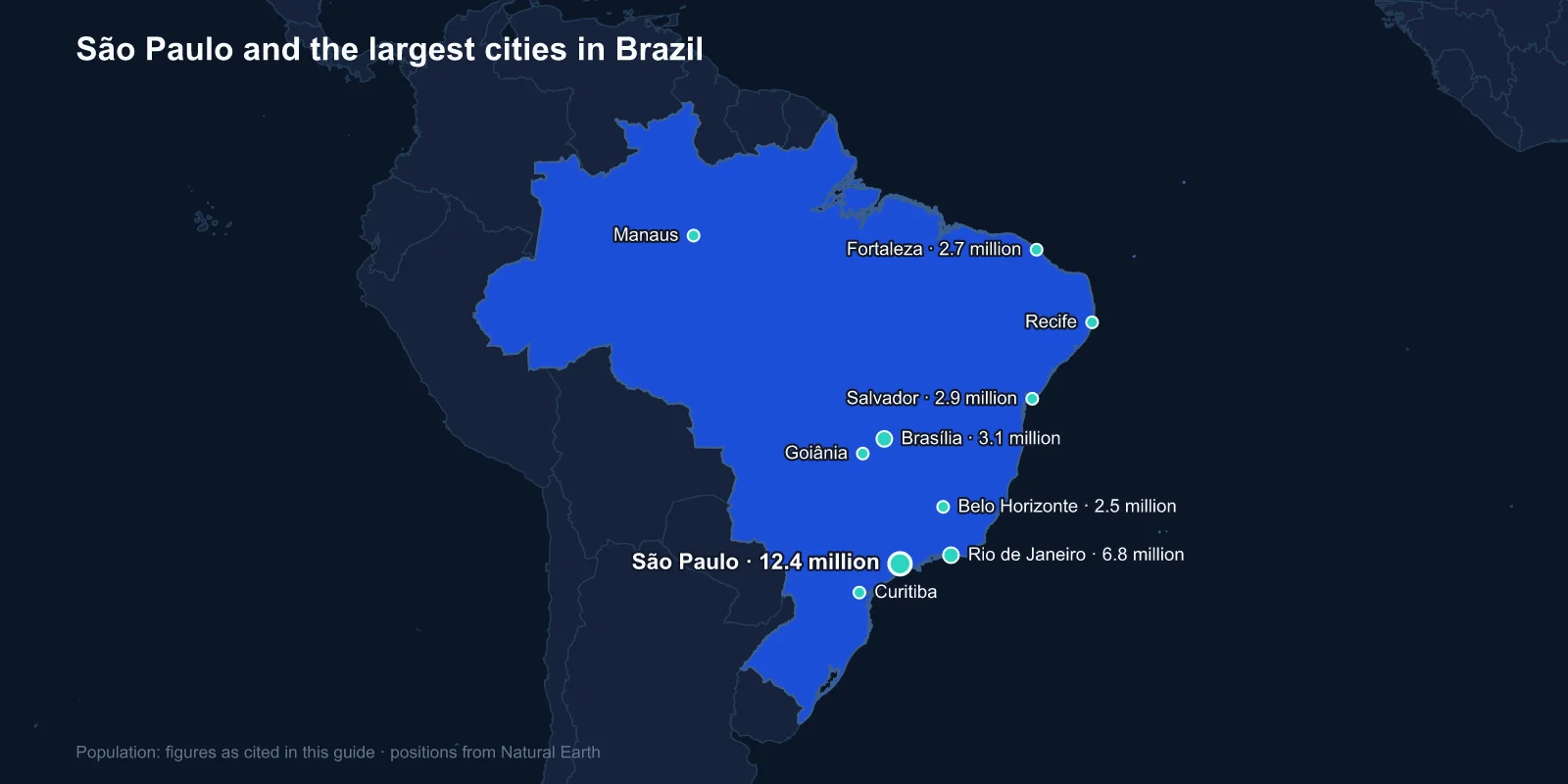
The largest city in Brazil is São Paulo, with a city-proper population of about 12.4 million, followed by Rio de Janeiro (6.8 million), Brasília (3.1 million), Salvador (2.9 million), Fortaleza (2.7 million), Belo Horizonte (2.5 million), Manaus (2.2 million), Curitiba (1.9 million), Recife (1.7 million), and Goiânia (1.5 million). Together these ten cities anchor a country that is both the largest in South America and one of the most heavily urbanized nations on Earth, with more than 85% of Brazilians living in towns and cities.
The top ten ranked by population
These figures come from Brazil's national statistics agency, the IBGE (Instituto Brasileiro de Geografia e Estatística), and refer to the municipality rather than the wider metropolitan area:
- 1. São Paulo — 12.4 million (São Paulo state, Southeast)
- 2. Rio de Janeiro — 6.8 million (Rio de Janeiro state, Southeast)
- 3. Brasília — 3.1 million (Federal District, Center-West)
- 4. Salvador — 2.9 million (Bahia, Northeast)
- 5. Fortaleza — 2.7 million (Ceará, Northeast)
- 6. Belo Horizonte — 2.5 million (Minas Gerais, Southeast)
- 7. Manaus — 2.2 million (Amazonas, North)
- 8. Curitiba — 1.9 million (Paraná, South)
- 9. Recife — 1.7 million (Pernambuco, Northeast)
- 10. Goiânia — 1.5 million (Goiás, Center-West)
The gap between first and second place is striking: São Paulo alone holds nearly twice the population of Rio de Janeiro, and it is the largest city not just in Brazil but in the entire Southern Hemisphere.
São Paulo and Rio: the two giants
São Paulo is the financial and industrial engine of Latin America. Founded by Jesuit missionaries in 1554, it grew explosively during the coffee boom and twentieth-century industrialization, drawing waves of Italian, Japanese, Lebanese and internal Brazilian migrants. Today it hosts the largest Japanese community outside Japan and a famously dense skyline. Rio de Janeiro, founded in 1565, served as Brazil's capital from 1763 to 1960 and remains the country's tourism icon, framed by Sugarloaf Mountain, Copacabana and Ipanema beaches, and the Christ the Redeemer statue. In 2012 UNESCO recognized Rio's dramatic blend of mountains, forest and sea — the "carioca landscape" — as a World Heritage Site.
Planned capitals and historic ports
Three of the ten cities were deliberately designed on paper before being built. Brasília, inaugurated in 1960, was raised from empty savanna in just 41 months to move the capital inland; its modernist plan by Lúcio Costa and Oscar Niemeyer made it the first twentieth-century city named a UNESCO World Heritage Site. Goiânia (1933) and Belo Horizonte (1897) were similarly planned grid cities created to replace older colonial capitals. At the other extreme, Salvador was Brazil's first capital (1549–1763) and the heart of Afro-Brazilian culture, while Recife, briefly the seat of Dutch Brazil, earned the nickname "Venice of Brazil" for its rivers, canals and dozens of bridges.
The Amazon and the regional spread
Manaus is the surprise on the list — a city of more than two million people in the middle of the Amazon rainforest, roughly 1,500 km up-river from the Atlantic. It boomed during the rubber era around 1900, leaving behind the ornate Teatro Amazonas opera house, and today thrives as a federal free-trade zone where much of Brazil's electronics manufacturing takes place. The full ranking touches all five official regions: the wealthy Southeast supplies three cities, the fast-growing Northeast another three, the Center-West frontier two, with the Amazonian North and the European-flavored South each contributing one. This spread reflects how urban population in Brazil is no longer concentrated solely on the historic southeastern coast.
City versus metropolitan rankings
The order shifts when you count metropolitan regions instead of municipalities, because surrounding suburbs are counted in. Greater São Paulo exceeds 22 million people across dozens of municipalities, ranking among the world's ten largest urban areas. Greater Rio de Janeiro holds about 13.5 million, and Greater Belo Horizonte roughly 6 million — large enough to overtake Brasília's metro. Greater Recife's metro of about 4 million also pulls ahead of Salvador's on a metropolitan basis. Whenever you compare lists of Brazilian cities, it is worth checking whether the numbers describe the city proper or the wider metro area, as the two can differ by millions.
The Coast Holds Almost Everyone
Brazil is the fifth-largest country in the world, and the overwhelming majority of its population lives within a few hundred kilometres of the Atlantic. The pattern was set by four centuries of colonial economics: sugar in the north-east, then gold in Minas Gerais, then coffee in Sao Paulo, all of it exported through coastal ports.
The interior was left to cattle, rubber and, for most of the twentieth century, very little. Manaus, deep in the Amazon and roughly 1,500 kilometres from the sea, is the striking exception and reaches the top ten despite having no road connection to the rest of the country that functions year-round.
Manaus exists in its modern form because of a 1967 free-trade zone that gave tax exemptions to manufacturers, which is why a city in the middle of the rainforest assembles televisions and motorcycles. Before that it had the rubber boom, which paid for an opera house, the Teatro Amazonas, built in 1896 with Italian marble and French glass.
A Capital Built From Nothing in Forty-One Months
Brasilia does not appear high on this list, but it is the most deliberate city in Brazil. The constitution of 1891 had called for a capital in the interior, and Juscelino Kubitschek finally built it, inaugurating the city in April 1960 after less than four years of construction.
Lucio Costa laid out the plan and Oscar Niemeyer designed the buildings, and the result is the only city built in the twentieth century to be inscribed as a UNESCO World Heritage Site. The plan is famously read as an aeroplane or a bird, with ministries along a monumental axis and residential superblocks along the wings.
It was designed for a population far smaller than the Federal District now holds, and the satellite cities that grew up around the planned core house most of the people who actually work there. The critique that Brasilia was built for cars rather than pedestrians has been made continuously since it opened.
Sao Paulo Was Built by Coffee and Immigration
Sao Paulo is the largest city in the southern hemisphere, and its growth was financed by coffee. The plateau behind Santos proved ideal for it in the nineteenth century, the railway to the port made export viable, and the profits built the city.
Labour came from abroad on an enormous scale after the abolition of slavery in 1888. Italians arrived in such numbers that they became a majority of the city's population for a period; Japanese immigration from 1908 produced the largest Japanese community outside Japan, concentrated in the Liberdade district; Lebanese, Syrian, Portuguese, Spanish and German communities all followed.
The result is a city whose food, surnames and neighbourhoods record a migration history closer to New York or Buenos Aires than to the rest of Brazil.
Rio Lost the Capital and Kept the Image
Rio de Janeiro was the capital of Brazil from 1763 until 1960, and between 1808 and 1821 it was the seat of the entire Portuguese Empire, after the royal court fled Napoleon and crossed the Atlantic. No other European empire has been governed from the Americas.
The city's setting, granite peaks dropping straight into the bay, is the reason for its shape: development runs in strips along the shore and up the hillsides, and the favelas occupy the steep ground that formal building avoided. The Tijuca forest behind the city is one of the largest urban forests in the world, replanted deliberately in the 1860s after coffee clearance had wrecked the water supply.
Losing the capital to Brasilia removed the federal payroll but not the symbolism, and Rio remains the city the country and the world picture first.
The North-East Cities Are Older Than the Southern Ones
Salvador, Recife and Fortaleza anchor a region that was the economic centre of Brazil long before the south. Salvador was the colonial capital from 1549 to 1763 and the main port of the Atlantic slave trade in the Americas, receiving more enslaved Africans than any other single arrival point in the hemisphere.
That history is the reason Salvador is the most visibly African city in Brazil, in its food, its Candomble religious practice, its capoeira and its music. The Pelourinho, the UNESCO-listed colonial centre, is named for the whipping post that stood there.
Recife, built across islands and channels, is called the Brazilian Venice and was held by the Dutch between 1630 and 1654, the only substantial non-Portuguese colonial episode in Brazilian history. Fortaleza has grown fastest of the three, on tourism and light industry, and the north-east as a whole remains poorer than the south despite holding a substantial share of the population. The regional divide is covered further in our Brazil country guide.
Common Questions About Brazilian Cities
What is the largest city in Brazil?
São Paulo, with about 12.4 million residents in the city proper and over 22 million in its metropolitan region. It is the largest city in the Southern Hemisphere and the wider Western Hemisphere.
What is the second-largest city in Brazil?
Rio de Janeiro, with roughly 6.8 million people in the city proper and about 13.5 million across Greater Rio.
Is São Paulo the capital of Brazil?
No. Brasília has been the national capital since 1960. São Paulo is the largest city and financial center, while Rio de Janeiro served as capital from 1763 to 1960 and Salvador before that.
What is the largest city in the Amazon?
Manaus, with about 2.2 million people. It is one of the most isolated million-plus cities in the world, reachable from the rest of Brazil mainly by boat or plane. You can test your knowledge of world cities with our interactive geography games.
Why is Brasilia not among the largest cities?
Because it is young and was planned to a fixed size. The city proper was designed for around half a million people; the wider Federal District holds close to three million, most of them in satellite cities outside the planned core, which are frequently counted separately.