
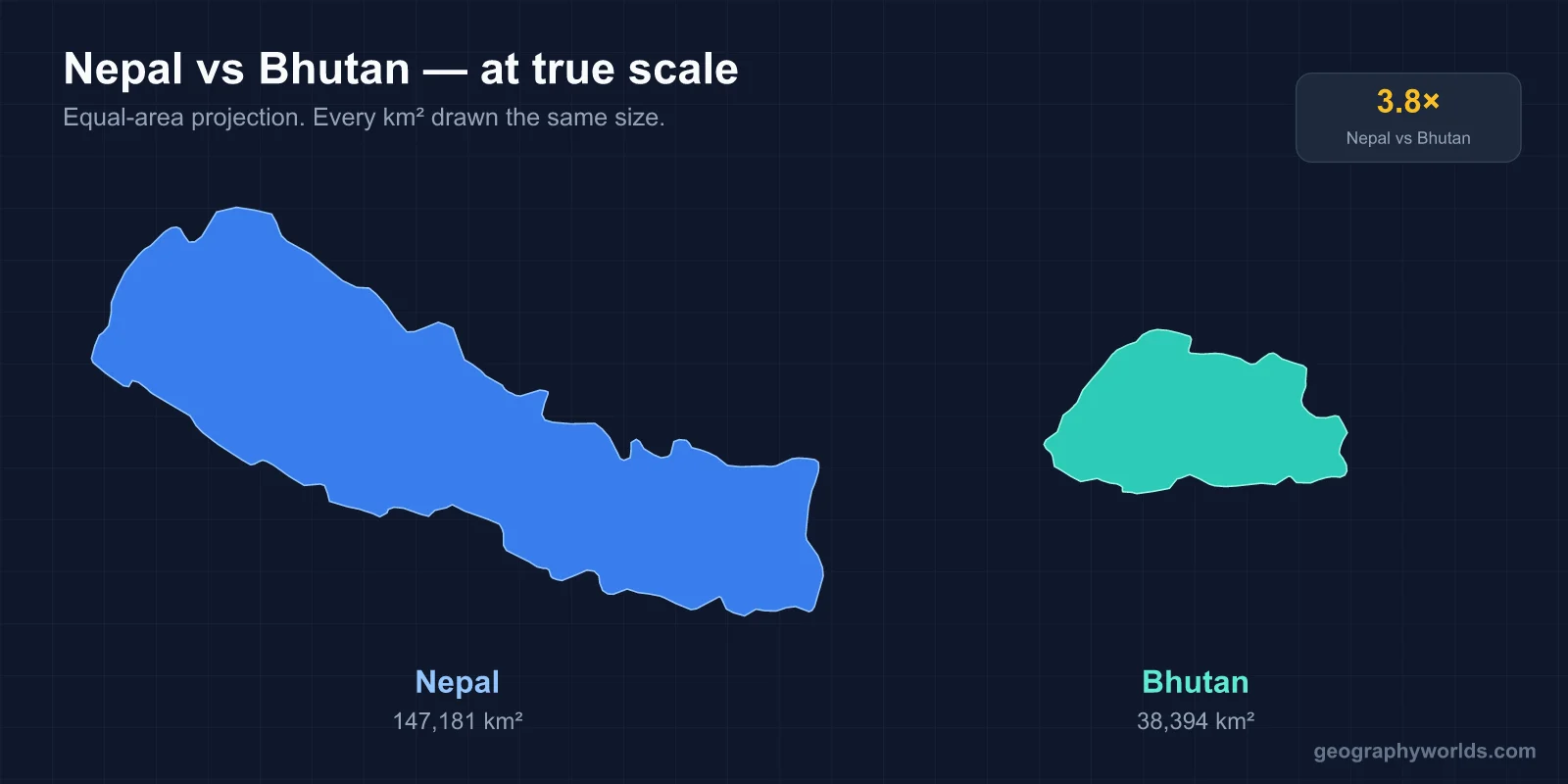
Nepal is about 3.8 times the size of Bhutan — 147,181 km² against 38,394 km² — and has roughly 37 times as many people, some 29.6 million to Bhutan's 800,000. Both are landlocked between China and India, and both rise from subtropical lowland to permanent snow within about 200 kilometres. The sharpest difference is not physical: Nepal built an economy on selling access to its mountains, and Bhutan made climbing them illegal.
The numbers, side by side
| Measure | Nepal 🇳🇵 | Bhutan 🇧🇹 |
|---|---|---|
| Area | 147,181 km² | 38,394 km² |
| Population | ~29.6 million | ~800,000 |
| Density | ~201 per km² | ~21 per km² |
| Capital | Kathmandu | Thimphu |
| Government | Federal republic (monarchy abolished 2008) | Constitutional monarchy (democracy from 2008) |
| Official language | Nepali, plus 120+ others | Dzongkha |
| Currency | Nepalese rupee (pegged 1.6 : 1 INR) | Ngultrum (pegged 1 : 1 INR) |
| Highest point | Mount Everest, 8,849 m | Gangkhar Puensum, 7,570 m |
| Forest cover | ~45% | ~72% (60% constitutional floor) |
Read down that table and the two countries look like versions of the same idea at different scales. Read the last three rows and they stop looking similar at all.
Their flags make the same point. Nepal flies the only non-rectangular national flag in the world — two stacked pennants, a survival of the older South Asian banner form rather than a modern design choice, carrying a moon and a sun. Bhutan's shows Druk, the thunder dragon, gripping jewels against a diagonal split of saffron and orange, and gives the country its own name for itself: Druk Yul, the land of the thunder dragon. One flag is unique in shape, the other in subject, and both were kept rather than modernised.
Same corridor, different shape
Both sit in the same structural position: a strip of Himalaya pinned between the Tibetan Plateau to the north and the Gangetic plain to the south, with no coastline and only two neighbours.
Nepal is the wider of the two, running roughly 800 kilometres east to west but only 150 to 250 kilometres north to south. That narrowness is why its terrain is usually described in three horizontal belts rather than as a jumble: the subtropical Terai plains along the Indian border, the middle hills where most of the population lives, and the high Himalaya along the Tibetan frontier. You cross all three in a day's drive.
Bhutan is more compact and more uniformly steep. It has a southern foothill strip and a band of savanna along the Indian border, but the country is dominated by deep north-south valleys separated by ridges, each historically its own world. That valley-by-valley isolation is a large part of why Bhutan's dialects, dress and architecture vary so much across such a small area, and why the dzong — the fortress-monastery that administers a valley — became the organising unit of the state.
Why one has 29.6 million people and the other has 800,000
The population gap is far wider than the area gap: 3.8 times the land, but 37 times the people. Density tells the story — roughly 201 people per km² in Nepal against about 21 in Bhutan.
Most of Nepal's population is not in the mountains at all. The Terai, which is flat, fertile and malarial until it was cleared in the mid-twentieth century, now holds more than half the country's people. The Kathmandu Valley adds a dense urban core. Bhutan has no equivalent lowland breadbasket and no city remotely the size of Kathmandu; Thimphu, the capital, has well under 150,000 residents and is one of the few national capitals in the world with no traffic lights.
One country sells its mountains; the other closed them
This is the divergence that matters most, and it is a policy choice rather than an accident of geology.
Nepal holds eight of the world's ten highest peaks and has built an industry on them. Permits, guiding, portering and the trekking economy that surrounds Mount Everest and the Annapurna circuit are a significant earner and employ a large seasonal workforce.
Bhutan went the other way. In Bhutanese Vajrayana Buddhism and older local belief, high peaks are the residences of deities and protective spirits, and climbing them is an intrusion. Bhutan restricted climbing above 6,000 metres from the mid-1990s and banned mountaineering outright in 2003. The consequence is that Gangkhar Puensum, at 7,570 metres, is the highest unclimbed mountain on Earth — and will stay that way, because the ban is not a permit backlog but a settled position. Its name in Dzongkha is usually rendered as "White Peak of the Three Spiritual Brothers."
Two tourism models, priced deliberately differently
The climbing rules are part of a wider split in how each country handles visitors.
Nepal's model is high-volume and relatively open: trekking permits and park fees are modest, and independent travel is straightforward. Bhutan's is the opposite — a deliberate low-volume, high-value policy. Every visitor pays a Sustainable Development Fee on top of all travel costs, currently 100 US dollars per person per night, reduced from 200 dollars in September 2023 after visitor numbers fell, and set at that level through August 2027.
The fee is not a visa charge; it funds conservation, free healthcare and education. Whether or not it works as economics, it is an unusually explicit statement that a country would rather have fewer visitors paying more.
Forests, rivers and what each country exports
Both are steep, wet and full of falling water, so both built their export strategy on hydropower sold to India. Bhutan has gone furthest: hydropower is the backbone of its economy and its largest export by value.
Bhutan's forests are the other half of that picture. Its constitution requires that at least 60% of the country stay under forest cover in perpetuity, and actual cover runs around 72%. Because those forests absorb several times the carbon the economy emits, Bhutan is routinely described as the world's only carbon-negative country. Nepal's forest cover, at roughly 45%, is substantial and has been recovering under community forestry, but there is no constitutional floor.
Nepal's economy is more diversified and more dependent on people leaving: remittances from Nepalis working abroad are a very large share of GDP, alongside agriculture and tourism.
Two monarchies that ended in the same year, in opposite ways
Both countries stopped being absolute monarchies in 2008. Almost nothing else about the two transitions is alike.
Nepal's was forced and violent. A Maoist insurgency ran from 1996 to 2006 and killed something in the order of 17,000 people. The 2001 palace massacre, in which most of the royal family died, badly damaged the monarchy's standing. A mass movement in 2006 stripped the king of executive power, and the constituent assembly abolished the monarchy outright in 2008, making Nepal a federal democratic republic. A new constitution followed in 2015 after years of deadlock.
Bhutan's was granted from the throne. The fourth king, Jigme Singye Wangchuck, spent two decades preparing a transfer of power that essentially nobody was demanding, abdicated in 2006 in favour of his son, and saw the country hold its first parliamentary elections in 2008 under a written constitution. Bhutan kept its monarchy as a constitutional one; the Druk Gyalpo, the Dragon King, remains head of state.
That contrast — a monarchy overthrown after a civil war, and a monarchy that legislated away its own power on schedule — is the clearest illustration of how differently the two states have handled change.
Gross National Happiness, and what it actually is
Bhutan's best-known export is a phrase. Coined in the 1970s under the fourth king, Gross National Happiness was set against GDP as the measure the state should optimise, and it has since been formalised into an index with nine domains — including health, education, ecological diversity, cultural resilience, good governance and time use — surveyed periodically across the population.
It is easy to treat as a slogan, but it has teeth in policy: the constitutional forest-cover floor, the tourism fee and the mountaineering ban are all defensible under it and difficult to defend under a growth-maximising framework. It also has costs the framing tends to obscure, including the expulsion and displacement of a large part of the ethnic Nepali Lhotshampa population from southern Bhutan around 1990, many of whom spent two decades in refugee camps in eastern Nepal — a direct and uncomfortable link between the two countries.
Nepal has no equivalent organising doctrine. Its politics since 2008 have been coalition-heavy and turnover-prone, and its development strategy is conventional: infrastructure, hydropower, tourism and the management of large-scale labour migration.
Two currencies, one anchor
Both keep their own currency and both peg it to the Indian rupee — the ngultrum at par, the Nepalese rupee at 1.6 to 1. In Bhutan the Indian rupee circulates alongside the ngultrum as legal tender.
That shared anchor is a fair summary of the wider relationship. Both countries are landlocked, both route most trade through India, and both have monetary policy shaped by a neighbour they do not control. What they have done with the room that leaves them is where they part company: Nepal opened up and monetised access, Bhutan restricted it and monetised scarcity.
For the full picture of each, see our Nepal country guide and the Bhutan country guide; Nepal's own vertical range is covered in Nepal geography.
