
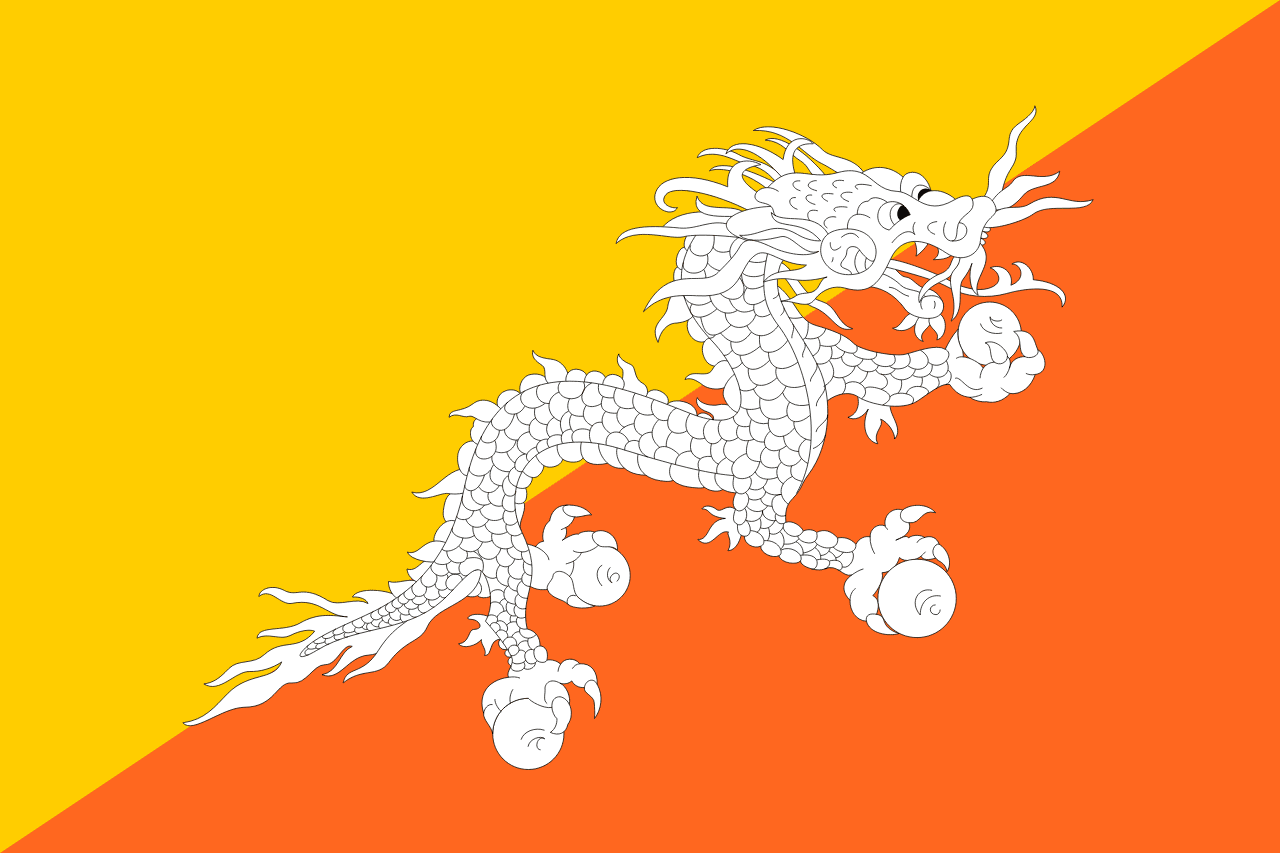

Few national flags capture a country's character as completely as Bhutan's does. Split diagonally from the lower hoist to the upper fly, the flag of this small Himalayan kingdom carries a great white dragon clutching jewels in its claws, set against fields of saffron orange and deep golden yellow. It is at once a heraldic emblem, a religious statement, and a portrait of how Bhutan understands itself. The name Bhutanese people use for their homeland, Druk Yul, literally means "Land of the Thunder Dragon," and the flag is the visual translation of that name. Adopted in its modern form in 1969, it remains one of the most distinctive and instantly recognizable banners flown anywhere in the world.
A Banner Built Around Two Colors
The Bhutanese flag uses three colors in total, but its background is dominated by two diagonal fields. The upper triangle, anchored at the hoist, is a rich orange, while the lower triangle, reaching toward the fly, is a warm yellow. The two meet along a diagonal line that runs corner to corner, and along that seam strides the dragon, rendered entirely in white.
Each color speaks to a different pillar of Bhutanese society. The orange field represents the country's Buddhist spiritual tradition, the monastic communities and religious practice that have shaped Bhutanese life for centuries. The yellow field stands for secular authority, the civil power embodied historically by the monarchy and the institutions of the state. Placing these two halves on a single cloth is a deliberate statement: in Bhutan, spiritual and temporal power are meant to coexist in balance rather than compete. The white of the dragon, neutral and luminous against both fields, signals purity and the loyalty that binds the kingdom's many ethnic and cultural groups together.
The Dragon at the Heart of the Design
The flag's centerpiece is unmistakable. The white dragon, known in the Dzongkha language as the Druk, stretches across the diagonal divide with its body curving from the lower hoist toward the upper fly. Its head turns back toward the orange field, and in each of its four claws it grips a jewel. According to the flag's own symbolism, the dragon represents thunder, the rolling sound that echoes through the Himalayan valleys and gives the Land of the Thunder Dragon its name. The jewels clenched in its claws stand for the wealth and prosperity of the nation and its people.
What makes the design unusual is that the dragon is depicted in a naturalistic, almost calligraphic style rather than a simplified geometric one. Its scales, whiskers, flaming mane, and snarling expression are all carefully drawn, which is part of why the Bhutanese flag is so visually rich compared with the clean stripes and stars of most national banners. The dragon is shown white rather than the green or gold of some East Asian dragon traditions, reinforcing the themes of purity and the equal standing of the kingdom's communities.
How the Flag Took Shape
The dragon was a Bhutanese emblem long before there was a single official national flag. Druk, the thunder dragon, has been associated with Bhutanese identity and the Drukpa school of Buddhism for centuries, and it appears throughout the country's monasteries, dzongs, and traditional art. When Bhutan moved to formalize a state flag in the twentieth century, it was natural to build the design around this deeply rooted symbol.
Early versions of the flag were created in the mid-twentieth century, but the proportions, the exact placement of the dragon, and the precise shades of the background were refined over time. The flag reached its current standardized form in 1969. Among the adjustments made during this period was the decision to render the dragon facing away from the hoist and to fix the diagonal so the design read clearly whether the flag hung limp or flew fully extended in the wind. The result is a banner that feels both ancient in its imagery and modern in its careful, codified construction.
How It Compares to Other Flags
Bhutan's flag is genuinely hard to confuse with any other, which is rare in vexillology. Many national flags share palettes or layouts, but the combination of a diagonal split and a large, detailed dragon is unique to Bhutan. The closest conceptual cousin is the flag of Wales, which also features a prominent dragon, though the Welsh red dragon sits on a green-and-white field and belongs to a country rather than a sovereign state. Sri Lanka's flag is another that places a detailed animal, a lion, front and center, sharing Bhutan's taste for ornate central figures over geometric abstraction.
On the color side, the orange-and-yellow warmth of Bhutan's flag echoes the saffron tones found in other Buddhist and South Asian contexts, but no other national flag pairs those two shades diagonally. If you want to understand how this banner fits into the broader story of the kingdom, its geography, and its culture, the bhutan country guide offers a fuller picture. What ultimately distinguishes Bhutan's flag is its refusal to simplify: where most modern flags trend toward minimalism, Bhutan kept a complex, expressive dragon and turned that complexity into a strength.
A Mirror of National Identity
For Bhutanese people, the flag is inseparable from the idea of Druk Yul itself. The dragon is not a decorative mascot but a living symbol of the nation's name, its faith, and its sense of destiny. The balance between the orange spiritual field and the yellow secular field reflects a worldview in which religion and governance are partners, an arrangement that has shaped Bhutan's distinctive path, including its famous emphasis on Gross National Happiness as a measure of national success.
Because the dragon is shown white, no single ethnic or regional group can claim it as theirs alone. In a country with notable cultural diversity across its valleys, that neutrality matters. The flag therefore functions as a unifying image, asking citizens of different backgrounds to see themselves as parts of one kingdom gathered under one thunder dragon.
The Flag in Everyday and Modern Life
Today the flag flies over government buildings, dzongs, and schools across Bhutan, and it appears at national celebrations such as the country's National Day in December, which marks the establishment of the monarchy. It is carried by Bhutanese athletes at international events, including the Olympic Games, where the striking dragon makes the small delegation immediately identifiable in any parade of nations. The flag also appears on official documents, at diplomatic missions abroad, and increasingly in tourism imagery, where the dragon has become a friendly ambassador for a country that markets itself as a pristine Himalayan destination.
Here are a few interesting facts that capture what makes this flag special:
- The flag's design is a direct illustration of the country's own name, Druk Yul, the Land of the Thunder Dragon.
- The white dragon clutches jewels in its claws, symbolizing the wealth and prosperity of Bhutan and its people.
- The diagonal division between orange and yellow represents the balance of spiritual and secular authority within the kingdom.
- The dragon's white coloring is meant to convey purity and the loyalty that unites Bhutan's diverse communities.
- The flag reached its current standardized form in 1969, refining earlier mid-century versions.
Frequently Asked Questions
When was the flag of Bhutan adopted?
Bhutan's flag was standardized into its current form in 1969. The dragon emblem itself is far older, having served as a symbol of Bhutanese identity for centuries, but the modern proportions, colors, and placement of the dragon were codified in the late 1960s.
What do the colors of the Bhutanese flag mean?
The flag uses orange, yellow, and white. The orange field represents Bhutan's Buddhist spiritual tradition, the yellow field stands for secular authority such as the monarchy and civil government, and the white dragon symbolizes purity. The dragon itself represents thunder, while the jewels in its claws represent national wealth.
Who designed the flag of Bhutan?
The flag was developed and refined by Bhutanese authorities over the mid-twentieth century rather than credited to a single famous designer. It draws on the long-established Druk dragon emblem and reached its standardized form in 1969, the version flown today.
What continent is Bhutan on, and which flags is it similar to?
Bhutan is a landlocked kingdom in the eastern Himalayas, located in Asia between India and China. Its flag is unusually distinctive, but it shares the rare trait of featuring a prominent dragon with the flag of Wales, and its love of a detailed central animal recalls the lion on the flag of Sri Lanka. No other national flag, however, combines a diagonal orange-and-yellow split with a white thunder dragon.