

Newgrange is a monumental passage tomb in the Boyne Valley of County Meath, Ireland, constructed around 3200 BCE during the Neolithic period. Predating both Stonehenge and the Great Pyramids of Giza, it is one of the oldest and most significant prehistoric structures in the world. The tomb's most celebrated feature is its precise astronomical alignment: at dawn on the winter solstice, a narrow beam of sunlight penetrates a specially constructed roof box above the entrance and illuminates the inner chamber for approximately 17 minutes.
Introduction
The mound is part of the Bru na Boinne complex, a UNESCO World Heritage Site that also includes the passage tombs of Knowth and Dowth, along with dozens of smaller monuments. Together they form one of the most important concentrations of prehistoric megalithic art and funerary architecture in Europe.
Geographic Setting
- Location: Boyne Valley, County Meath, Ireland
- Elevation: Approximately 60 meters above sea level
- River: Overlooking a bend in the River Boyne
- Climate: Temperate oceanic, 800mm annual rainfall
Newgrange sits on a ridge overlooking a wide bend in the River Boyne, about 8 kilometers west of the town of Drogheda. The gently rolling landscape of the Boyne Valley is among the richest agricultural land in Ireland, and this fertility likely supported the large Neolithic population that constructed the monument. The tomb's elevated position gives it commanding views across the river valley.
The River Boyne was a major artery of communication in prehistoric Ireland, connecting the interior to the Irish Sea coast. The concentration of major passage tombs along its banks suggests the river played a central role in the ritual and economic life of Neolithic communities. The mild, moist climate of the region supported dense deciduous forest in prehistory, which the tomb builders cleared for farming and construction.
Architecture & Engineering
- Diameter: 85 meters
- Height: 13.5 meters
- Passage Length: 19 meters leading to cruciform chamber
- Construction: 200,000 tonnes of stone and earth
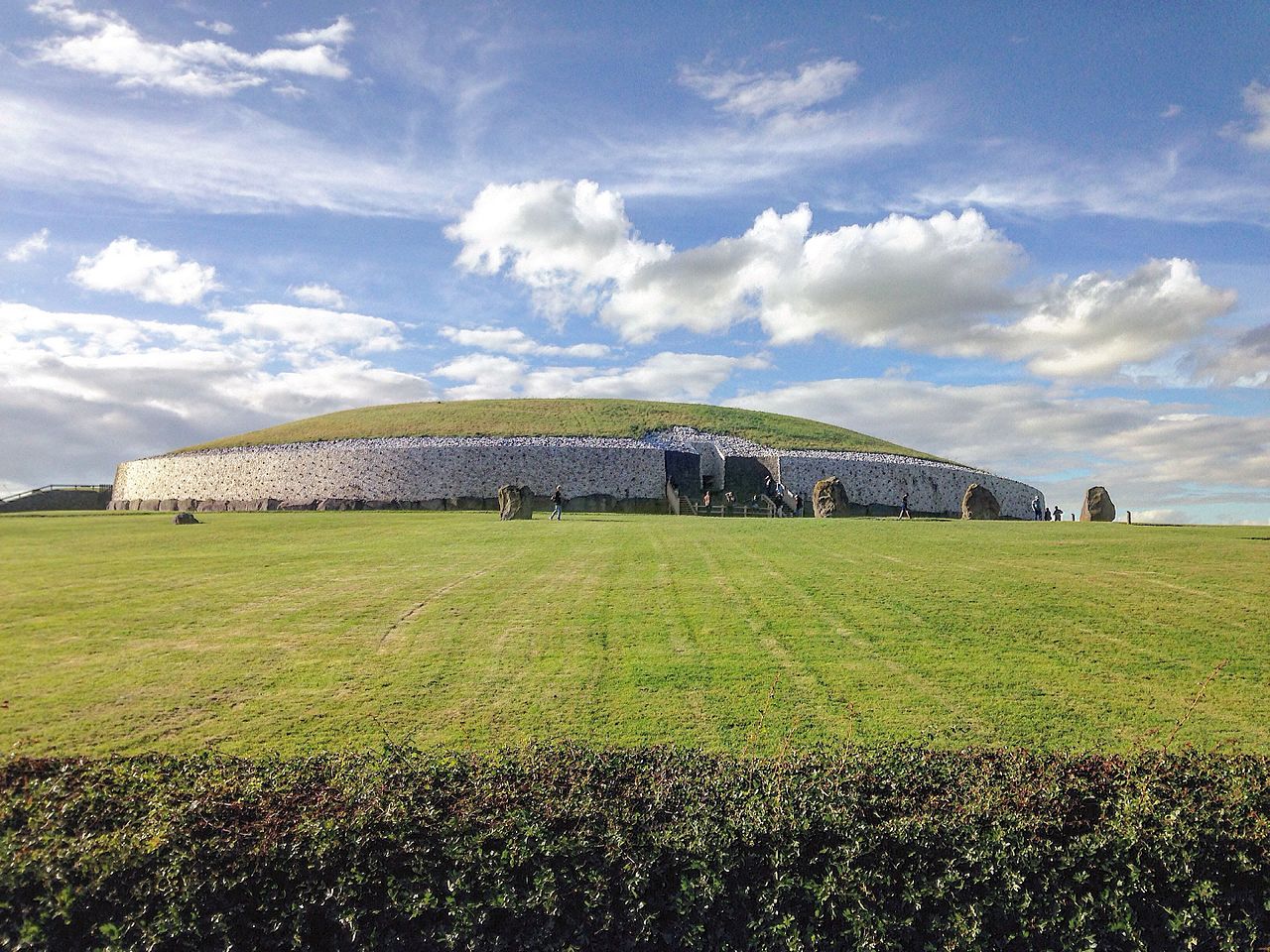
Newgrange is a kidney-shaped mound approximately 85 meters in diameter and 13.5 meters high, covering about one acre. The mound is retained by 97 large kerbstones, many decorated with elaborate spiral and geometric carvings — among the finest examples of Neolithic megalithic art in Europe. The entrance stone, with its famous triple-spiral motif, is one of the most iconic objects in Irish archaeology.
A 19-meter-long passage leads from the entrance to a cruciform chamber with three recesses, each containing a large stone basin that once held cremated human remains. The corbelled roof of the chamber, built by carefully overlapping flat stones in ever-tighter circles, has remained waterproof for over 5,000 years without any maintenance. The roof box above the entrance is a unique architectural feature, a deliberately constructed opening that admits the solstice light along the precise angle needed to reach the inner chamber.
Historical Significance
- Built: c. 3200 BCE
- Older Than: Stonehenge (by ~500 years) and the Great Pyramids (by ~600 years)
- Rediscovered: 1699 by road workers quarrying stone
- UNESCO Status: World Heritage Site since 1993
Newgrange was constructed by a sophisticated Neolithic farming community that possessed advanced knowledge of astronomy, engineering, and art. The labor required — estimated at 300 workers over 20 years — indicates a well-organized society with surplus food production and strong communal purpose. The tomb's solstice alignment reveals a precise understanding of the solar cycle that would not be matched in the region for millennia.
After centuries of use as a burial site and ritual center, Newgrange was sealed and gradually became overgrown, disappearing into the landscape. It was rediscovered in 1699 when laborers quarrying stone for road building broke into the passage. Archaeological excavations between 1962 and 1975, led by Professor Michael J. O'Kelly, revealed the roof box and confirmed the winter solstice alignment — a discovery that transformed understanding of Neolithic astronomical knowledge.
Conservation & Tourism
- Annual Visitors: ~200,000
- Solstice Access: Lottery for 50 places to witness the sunrise
- Management: Office of Public Works, Ireland
- Access: Via Bru na Boinne Visitor Centre
Access to Newgrange is managed through the Bru na Boinne Visitor Centre, which controls the number of people entering the passage tomb to protect its delicate carvings and corbelled roof. Each year, approximately 50 people are selected by lottery to stand inside the chamber during the winter solstice sunrise — one of the most sought-after archaeological experiences in the world. In recent years, the event has also been livestreamed globally.
The white quartz facade visible today is a reconstruction from the 1970s excavations. Professor O'Kelly found large quantities of white quartz cobbles at the base of the mound and interpreted them as a collapsed facade, which he rebuilt. This reconstruction has been debated by some archaeologists who believe the quartz may have been placed as a platform rather than a wall, but it has become an iconic part of the monument's appearance.
Key Facts
- Newgrange was built around 3200 BCE, predating both Stonehenge and the pyramids of Giza.
- The mound is 85 meters in diameter and contains over 200,000 tonnes of stone and earth.
- A roof box channels sunlight into the inner chamber for 17 minutes at the winter solstice.
- The corbelled roof has remained waterproof for over 5,000 years.
- It became a UNESCO World Heritage Site as part of Bru na Boinne in 1993.
Fun Facts
- Only about 50 lottery winners each year get to witness the solstice sunrise inside the chamber.
- The triple-spiral carving on the entrance stone has become one of Ireland's most recognized national symbols.
- Newgrange was already over 1,000 years old before construction began at Stonehenge.
Final Thoughts
Newgrange stands as one of the greatest achievements of Neolithic Europe, a 5,000-year-old monument that demonstrates remarkable astronomical knowledge, engineering skill, and artistic expression. Its winter solstice alignment — still functioning perfectly after five millennia — connects the modern visitor to the profound relationship between Ireland's earliest farmers and the cycles of the natural world.
Test Your Knowledge!
Think you know the world's ancient ruins and archaeological sites? Try our geography quiz games!
Play Geography Games →