
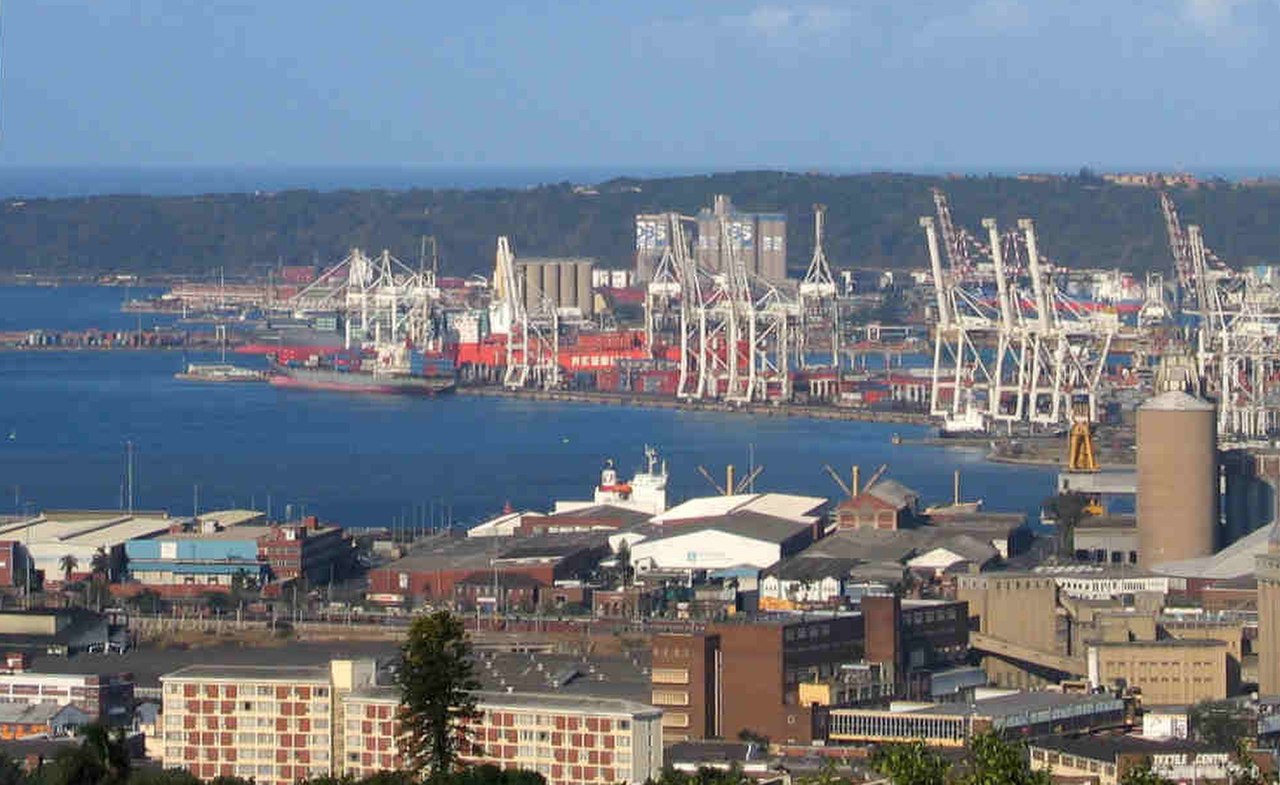
The Port of Durban is sub-Saharan Africa's largest and busiest container port, handling approximately 60% of South Africa's container throughput. Located on a natural lagoon bay on the Indian Ocean coast of KwaZulu-Natal Province, it serves not only South Africa but also the landlocked nations of southern Africa that depend on its facilities for international trade.
Introduction
Durban's natural harbor, formed by a drowned river valley, provides the finest sheltered deep-water anchorage on Africa's eastern seaboard. The port has been the commercial heart of KwaZulu-Natal since the colonial era and remains the essential maritime infrastructure for the entire southern African economic region.

Geographic Location
- Location: Indian Ocean coast, KwaZulu-Natal, eastern South Africa
- Coordinates: 29.87°S, 31.03°E
- Water Depth: 12.8 meters in main container channel
Durban's harbor is a natural bay formed by the flooded estuary of the Umgeni and other rivers, creating a large enclosed water body protected from Indian Ocean swells by a narrow sand spit called "the Bluff." This geographic formation provides excellent natural shelter, though the narrow harbor entrance requires careful navigation.
The port sits on Africa's southeastern coast, along the major shipping route that rounds the Cape of Good Hope connecting the Atlantic and Indian Oceans. This positions Durban on the alternative route between Europe and Asia used when the Suez Canal is disrupted, and on the direct route serving trade between southern Africa and Asia.
Port Infrastructure
- Container Terminals: Durban Container Terminal (DCT) Pier 1 and Pier 2
- Berths: 57 berths across all terminal types
- Capacity: 3.8 million TEU annual container capacity
The Durban Container Terminal operates across two pier complexes: Pier 1 handles containers using straddle carriers, while the newer Pier 2 uses rubber-tyred gantry cranes. Together, they provide approximately 3.8 million TEU of annual capacity, though actual throughput has been lower due to operational challenges.
Beyond containers, the port operates extensive multipurpose, car terminal, dry bulk, and liquid bulk facilities. The Bayhead area handles break-bulk and project cargo, while the Island View complex processes petroleum products and chemicals. Durban is also South Africa's primary vehicle import and export port.
Trade & Shipping
- Container Volume: 2.7+ million TEU
- National Share: ~60% of South Africa's container trade
- Key Exports: Automobiles, manganese, chrome, sugar, fruit
Durban handles a wide range of South African exports including automobiles (Toyota, BMW, and Mercedes-Benz have assembly plants in the region), minerals (manganese and chrome ore), agricultural products (sugar, citrus, and subtropical fruits), and manufactured goods. Imports include machinery, consumer goods, petroleum products, and food.
The port also serves as the primary import-export gateway for landlocked countries in the southern African region, including Botswana, Lesotho, Eswatini, Zimbabwe, and Zambia. Goods destined for these nations travel by road and rail from Durban, creating long-distance overland corridors that are among the most important trade routes in Africa.
Economic & Strategic Impact
- Employment: 200,000+ direct and indirect port-related jobs
- Landlocked Countries: Gateway for Botswana, Zimbabwe, Zambia, Lesotho, Eswatini
- Industrial Zone: Durban-Pietermaritzburg corridor—major manufacturing belt
The port is the single largest employer in KwaZulu-Natal and supports approximately 200,000 direct and indirect jobs in the broader Durban metropolitan area. The manufacturing corridor stretching from Durban to Pietermaritzburg hosts automotive, chemical, and food processing industries that depend on port connectivity.
Durban has faced persistent operational challenges including crane breakdowns, labor disputes, and congestion that have constrained throughput below theoretical capacity. The South African government has initiated reforms including private sector participation in terminal operations to address these issues and improve the port's competitiveness relative to alternative routes through Mozambique and Namibia.
Key Facts
- Durban is sub-Saharan Africa's busiest container port
- It handles approximately 60% of South Africa's container trade
- The natural bay harbor is protected by a sandbar called "the Bluff"
- Landlocked nations across southern Africa depend on Durban for trade access
- Over 200,000 jobs depend on port-related activities
Fun Facts
- Durban's harbor entrance is nicknamed "the bottleneck" because it is just 120 meters wide despite the large inner harbor
- The port was named by Portuguese explorer Vasco da Gama, who sheltered in the bay on Christmas Day 1497, naming it "Rio de Natal"
- Durban is one of the few major ports in the Southern Hemisphere that lies in a subtropical climate zone with warm winters
Final Thoughts
The Port of Durban highlights both the potential and the challenges of African port development. Its superb natural harbor and strategic location make it the indispensable gateway for southern Africa, but operational improvements are needed to fully realize its capacity. As Africa's economies grow, Durban's performance will increasingly affect not just South Africa but the entire southern half of the continent.
Test Your Knowledge!
Think you know the world's great harbors and ports? Try our geography quiz games!
Play Geography Games →