
Cuba has been a secular state since a July 1992 constitutional amendment replaced its earlier atheist definition, and Christianity remains its largest religion: a 2020 estimate puts Cubans of Catholic background at about 53.7% and Protestants at about 2.68%, while the Catholic Church itself claims around 60%. Practice is far thinner than affiliation. A 2022 survey by Observa Cuba found that 49% of Cubans professed a religion, and a 2015 Univision survey found 44% saying they were not religious. Alongside the churches stand the Afro-Cuban religions, chiefly Santería, Palo Monte and the Abakuá brotherhood, which by some estimates cited by the US State Department are consulted by as many as 80% of Cubans. The smaller minorities include about 96,000 active Jehovah's Witnesses (2016), roughly 1,500 Jews (2007), about 10,000 Muslims (Pew, 2011), and Hindus and followers of Chinese folk religion at about 0.2% each, while 18.0% describe themselves as agnostic and 5.1% as atheist.
From Atheist State to Secular State: the 1976 and 1992 Constitutions
The legal position of religion in Cuba has changed more than once since the revolution of January 1959. For its first sixteen years the revolutionary government ruled without a constitution at all. The Constitution of 1976, modelled on the Soviet constitution of 1936, was approved in a referendum on 15 February 1976 and took effect on 24 February. It defined Cuba as an atheist state, in line with the Marxist-Leninist position of the Communist Party, which since 1962 had barred Church personnel from membership and, in practice, kept religious believers out of its ranks.
The shift came with the collapse of the Soviet Union and the economic crisis Cubans call the Special Period. In November 1991 the Communist Party began admitting religious believers. In July 1992 the constitution was amended so that Cuba became a secular state rather than an atheist one, and added an article prohibiting discrimination on grounds of religious belief. Small home-based worship centres were again permitted. The change did not separate religion from politics entirely: the government still regulates religious groups through its Office of Religious Affairs, and even the Catholic Church faces limits on written and electronic communication and may accept donations only from state-approved sources.
A new constitution replaced the 1976 text in 2019. Drafted after a popular consultation that ran from 13 August to 15 November 2018, it was approved in a referendum on 24 February 2019 and proclaimed on 10 April 2019. The consultation itself became a religious flashpoint, because the first draft would have opened the way to same-sex marriage, and in June 2018 five Christian denominations publicly campaigned against it. That clause was dropped from the final text on 18 December 2018. The same question returned three years later in the Family Code, discussed below.
How Many Cubans Are Religious? The 2015, 2020 and 2022 Figures
Religious figures for Cuba come from churches and independent surveys, and they measure different things. Church membership estimates count people baptised or raised in a tradition; opinion surveys ask whether people consider themselves religious. Weekly attendance was put at about 250,000 people, roughly 2% of the population, in the early 1990s, split evenly between Catholics and Protestants. The Catholic Church has estimated that only about 5% of its claimed members attend Mass regularly, and independent sources put regular Mass-goers at as little as 1.5% of all Cubans.
Afro-Cuban religion is the hardest to count, because many practitioners also identify as Catholic. Among the Protestants, the largest denominations are Pentecostal and Baptist; the Seventh-day Adventists, with more than 34,041 members in 328 congregations in 2016, are reported as another of the largest, alongside smaller Methodist, Presbyterian, Anglican, Quaker and Lutheran churches.
The Catholic Church in Cuba: 1512 to the Papal Visits of 1998, 2012 and 2015
Catholicism arrived with the Spanish conquest. Dominican friars came in 1512, a year after Diego Velázquez de Cuéllar began the systematic colonisation of the island, and Pope Leo X created the Diocese of Baracoa, renamed the Diocese of Santiago de Cuba in 1522. The conquest destroyed Cuba's Indigenous population. Catholicism was the only religion the Spanish colonial government legally permitted; Protestant worship was tolerated only for foreigners until 1886, and full legal equality for all faiths came with the US intervention of 1898.
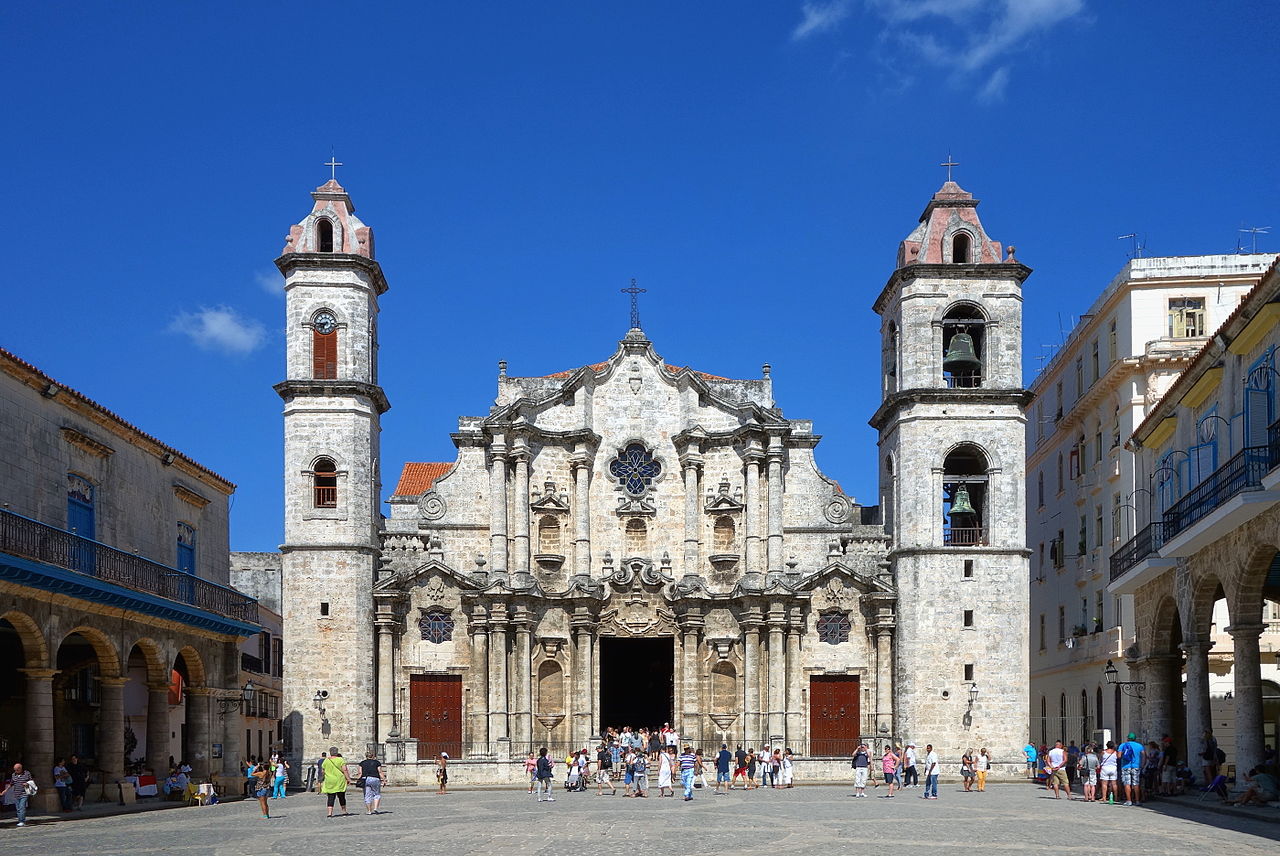
The seat of the Archdiocese of Havana is Havana Cathedral, begun by the Jesuits in 1748, completed in 1777 and consecrated in 1782, on the Plaza de la Catedral in what is now the Old Havana World Heritage Site. Today the Church in Cuba has three archdioceses (Havana, Camagüey and Santiago de Cuba) and eleven dioceses in all.
The revolution brought open conflict. In August 1960 several bishops signed a pastoral letter declaring communism incompatible with Catholicism; Fidel Castro answered with a four-hour speech attacking Spanish-born priests. Between 1959 and 1961 about 80% of Cuba's priests and ministers left for the United States, and in 1961 all property held by religious organisations was confiscated without compensation. The Archdiocese of Havana recorded only 7,000 baptisms in 1971. Recovery began in the late 1980s: baptisms reached 27,609 in 1989 and 33,569 in 1991. In 1985 the Council of State published Fidel y la Religión, Castro's interviews with the Brazilian friar Frei Betto, in which he conceded the revolution had made mistakes towards believers.
The turning point was Pope John Paul II's visit in January 1998, made at the invitation of both the government and the Cuban bishops; he said large open-air Masses and visas were issued for nineteen foreign priests. Pope Benedict XVI visited in March 2012 and Pope Francis in September 2015, after helping to broker the 2014 thaw between Cuba and the United States. In October 2008 Raúl Castro attended the opening of a Russian Orthodox cathedral in Havana, described by the Cuban press as the first of its kind in Latin America.
Santería, Palo Monte and Abakuá: Religions Born in Slavery
Cuba's Afro-Cuban religions grew out of the Atlantic slave trade between the sixteenth and nineteenth centuries. Santería, also called Regla de Ocha or Lucumí, took shape in the late nineteenth century from the traditional religion of the Yoruba of West Africa, Catholicism and Spiritism. Its believers honour a creator, Olodumare, and the oricha spirits, each paired with a Catholic saint, at altars in homes or in an ilé, a house-temple run by a santero or santera. The central ceremony, the toque de santo, uses drumming, song and dance so that an oricha may possess a participant. Palo, often called Palo Monte after one of its main branches, is a separate tradition with roots in the Kongo religion of Central Africa; its ceremonies use Palo Kikongo, a creole speech based on Kikongo and Spanish, just as Santería keeps Lucumí as its ritual language.

Abakuá is older as an institution. It was founded in 1836 in Regla, across the harbour from Havana, by Africans from West Africa's Cross River region, among them enslaved Efik members of the Ékpè society, on which Abakuá is largely modelled. It is an initiatory brotherhood open only to men, whose members swear to keep its teachings secret; by the 1860s it admitted men of other backgrounds, and it became powerful among the stevedores of Cuba's ports. During the republic after 1902, Afro-Cuban religious practitioners, especially those linked to Santería, were criminalised and marginalised, and after 1959 Abakuá faced continued persecution until the reforms of the 1990s, when it became part of the tourist economy.
8 September and 6 January: Cuba's Religious Calendar
One of the most important religious festivals in Cuba is the feast of the Virgin of Charity of El Cobre, on 8 September. The small statue venerated at El Cobre, a copper-mining village near Santiago de Cuba, is about 16 inches tall and is affectionately called La Cachita. On 19 May 1801 King Charles IV of Spain decreed the freeing of the enslaved workers of the El Cobre mines, and the story became bound up with the Virgin. Independence fighters adopted her as "La Virgen Mambisa", and at the written request of veterans of the War of Independence, Pope Benedict XV declared her Patroness of Cuba on 10 May 1916. Pope Pius XI granted the image a canonical coronation at a Eucharistic Congress in Santiago de Cuba on 20 December 1936, Paul VI made her sanctuary a minor basilica on 22 December 1977, and John Paul II crowned the image again on 24 January 1998. In Santería she is identified with Ochún, and yellow, the colour associated with the Virgin of Charity, fills her shrines with flowers.

The Day of the Three Kings, 6 January, is the other date when Afro-Cuban religion becomes public: Abakuá members parade dressed as íremes, masked spirits of the dead. Christmas had a more difficult path: after 1959 Fidel Castro's government imposed restrictions on religious activities, Christmas celebrations among them, and they eased only as the wider policy towards religion softened in the 1990s.
Tensions from the 1974 Witness Ban to the 2022 Family Code
Several groups have had harder relations with the state than the Catholic Church. Jehovah's Witnesses, who grew from about 100 in 1938 to around 30,000 by 1989, were banned in 1974, and members were imprisoned for refusing military service; about 3,000 left during the Mariel boatlift of 1980. Restrictions eased in 1994, when they were allowed to meet in groups of up to 150. Cuba's Jewish community, more than 24,000 strong in 1924, lost about 94% of its members to emigration after 1959; the roughly 1,500 who remained in 2007 centre on Havana's Beth Shalom Temple. Most of Cuba's estimated 10,000 Muslims in 2011 were converts, and in 2015 a Turkish foundation opened the first prayer room for them.
Afro-Cuban groups that refuse state oversight face pressure too. The Association of Free Yorubas of Cuba declined to register with the Office of Religious Affairs, and its leaders have reported harassment and arbitrary arrests. Human Rights Watch says the government still "maintains tight control" over religious institutions, and in 2022 Freedom House scored Cuba's religious freedom at 3 out of 4, noting improvement over the previous decade.
The sharpest recent dispute ran in the other direction, with churches opposing the government. In June 2018 five Christian denominations declared same-sex marriage "contrary to the spirit of the communist revolution", and church posters against it appeared during the constitutional consultation. When the new Family Code, which recognises same-sex marriage and adoption, went to a referendum on 25 September 2022, progressive Christian groups backed it and conservative churches opposed it; the code passed. How these religious debates fit into Cuba's one-party system is explained in our guide to the government of Cuba, and the island's syncretic traditions have close parallels in Vodou, covered in our article on religion in Haiti.