
Introduction
Romania 🇷🇴 and Hungary 🇭🇺 sit beside one another in Eastern Europe, sharing a long border and a tangled history that runs through the old Austro-Hungarian and Habsburg orbit. The Carpathian arc and the Danube River thread through both, yet the two countries feel quite different on the ground — one shaped by mountains and basins, the other by one of Europe's great plains.
What follows is a practical, side-by-side look at how Romania and Hungary compare in size, population, capitals, language, and landscape, useful whether you are revising for an exam or mapping out a trip through the region.
Size & Geography
| Feature | Romania 🇷🇴 | Hungary 🇭🇺 |
|---|---|---|
| Area | 238,391 km² | 93,028 km² |
| Continent | Europe | Europe |
| Region | Eastern Europe | Eastern Europe |
| Land Borders | Hungary, Serbia, Bulgaria, Ukraine, Moldova | Austria, Slovakia, Ukraine, Romania, Serbia, Croatia, Slovenia |
| Landscape | central Transylvanian Basin; Carpathian Mountains arc | mostly flat Great Hungarian Plain; hills in west |
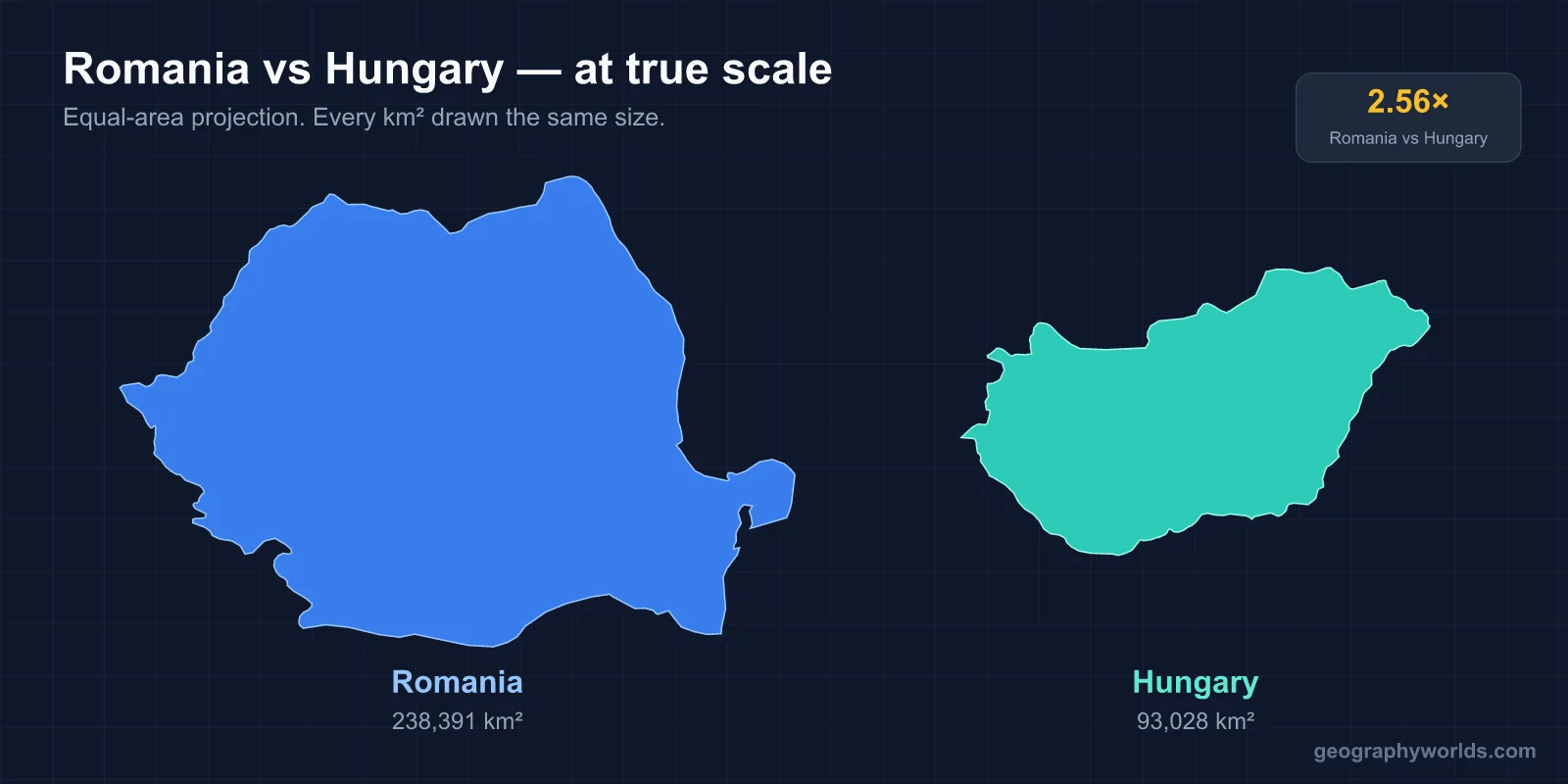
Romania is the larger country by a clear margin — its 238,391 km² is about 2.6 times Hungary's 93,028 km². The two also have very different terrain. Romania's interior is built around the Transylvanian Basin, ringed by the sweeping arc of the Carpathian Mountains, while Hungary is overwhelmingly flat, dominated by the Great Hungarian Plain with only modest hills toward the west. Hungary is the more landlocked of the pair, touching seven neighbors, whereas Romania borders five and also reaches the Black Sea on its eastern edge.
Population & Demographics
| Metric | Romania 🇷🇴 | Hungary 🇭🇺 |
|---|---|---|
| Population | 18.8 million | 9.6 million |
| Population Density | 78.9 per km² | 103.0 per km² |
With 18.8 million residents to Hungary's 9.6 million, Romania has almost exactly double the population. But because that population is spread across far more land, Romania is the less densely settled country, at 78.9 people per km² versus Hungary's 103.0 — a gap of about 24.2 people per km². Hungary's flat, accessible terrain and its concentration of people in and around Budapest help explain why the smaller country feels more tightly packed.
Capital Cities
Bucharest is the capital of Romania and Budapest is the capital of Hungary — two cities so similar in name that they are routinely confused, despite lying in different countries. Both are Eastern European capitals and both are by far the largest cities of their respective nations, with Budapest famously straddling the Danube.
Language, Currency & Culture
| Aspect | Romania 🇷🇴 | Hungary 🇭🇺 |
|---|---|---|
| Languages | Romanian (official) | Hungarian/Magyar (official) |
| Currency | Romanian Leu (RON) | Hungarian Forint (HUF) |
Language is the sharpest dividing line between these neighbors. Romanian, the official language of Romania, is a Romance language descended from Latin and is unusual in that part of Europe for being closely related to Italian, Spanish, and French. Hungarian, or Magyar, belongs to an entirely different family altogether and is unrelated to the languages around it. Each country also keeps its own money: Romania uses the Romanian Leu (RON), Hungary the Hungarian Forint (HUF), as neither has adopted the euro.
Climate & Natural Features
| Aspect | Romania 🇷🇴 | Hungary 🇭🇺 |
|---|---|---|
| Climate | temperate continental; cold winters, warm summers | temperate continental; cold winters, warm summers |
| Key Features | Carpathian Mountains, Transylvania, Danube Delta | Lake Balaton, Danube River, Great Plain (Puszta) |
| Economy | automotive, IT, agriculture, energy | automotive, electronics, agriculture, tourism |
Both countries share a temperate continental climate, with cold winters and warm summers, a natural consequence of sitting in interior Europe well away from the moderating ocean. Their landscapes, though, play to their geography. Romania's headline features are mountainous and watery at once — the Carpathian Mountains, the historic region of Transylvania, and the vast Danube Delta where the river empties into the Black Sea. Hungary's standouts are the gentler Lake Balaton, the Danube as it crosses the country, and the open grasslands of the Great Plain, known locally as the Puszta. The two economies overlap heavily, both built on automotive manufacturing and agriculture, with Romania adding a strong IT and energy sector and Hungary leaning on electronics and tourism.
What Makes Each Country Unique
Romania is internationally renowned for Transylvania and Dracula's Castle, painted monasteries of Bucovina, Carpathian Mountains, and the Danube Delta. Romania's Palace of the Parliament in Bucharest is the heaviest building in the world and the second-largest administrative building after the Pentagon.
Hungary is best known for thermal baths of Budapest, goulash, the Danube River, and ruin bars. Hungarian (Magyar) is one of the most difficult languages for English speakers — it is unrelated to any neighboring language and has 18 grammatical cases.
Key Differences at a Glance
- Area: Romania (238,391 km²) vs Hungary (93,028 km²) — Romania is 2.6x larger
- Population: Romania (18.8 million) vs Hungary (9.6 million) — Romania is 2.0x more populous
- Capitals: Bucharest vs Budapest
- Currency: Romanian Leu (RON) vs Hungarian Forint (HUF)
- Continents: Europe vs Europe
- Density: Hungary is more densely populated (difference of ~24.2 people per km²)
- Languages: Romanian (official) vs Hungarian/Magyar (official)
Verdict
Romania and Hungary are close neighbors that reward a closer look. Romania is the larger and more populous of the two — 2.6 times the area and double the population — yet its mountains and basins leave it less densely settled than Hungary, whose flat plains and Budapest-centered population push its density well above Romania's.
The mountains-versus-plains contrast runs through everything. Romania is the country of the Carpathians, Transylvania, and the Danube Delta, while Hungary is the country of Lake Balaton, the open Puszta, and the Danube flowing through Budapest. Their economies move in step, both anchored by automotive plants and farming, even as their languages could hardly be more different.
Set side by side, the two make a vivid case study in how the same corner of Europe can produce strikingly different countries. Comparing them is a quick way to see how terrain, language, and settlement patterns shape national identity.
Test Your Knowledge!
Think you know your countries? Try our interactive geography quiz!
Play Geography Games →