
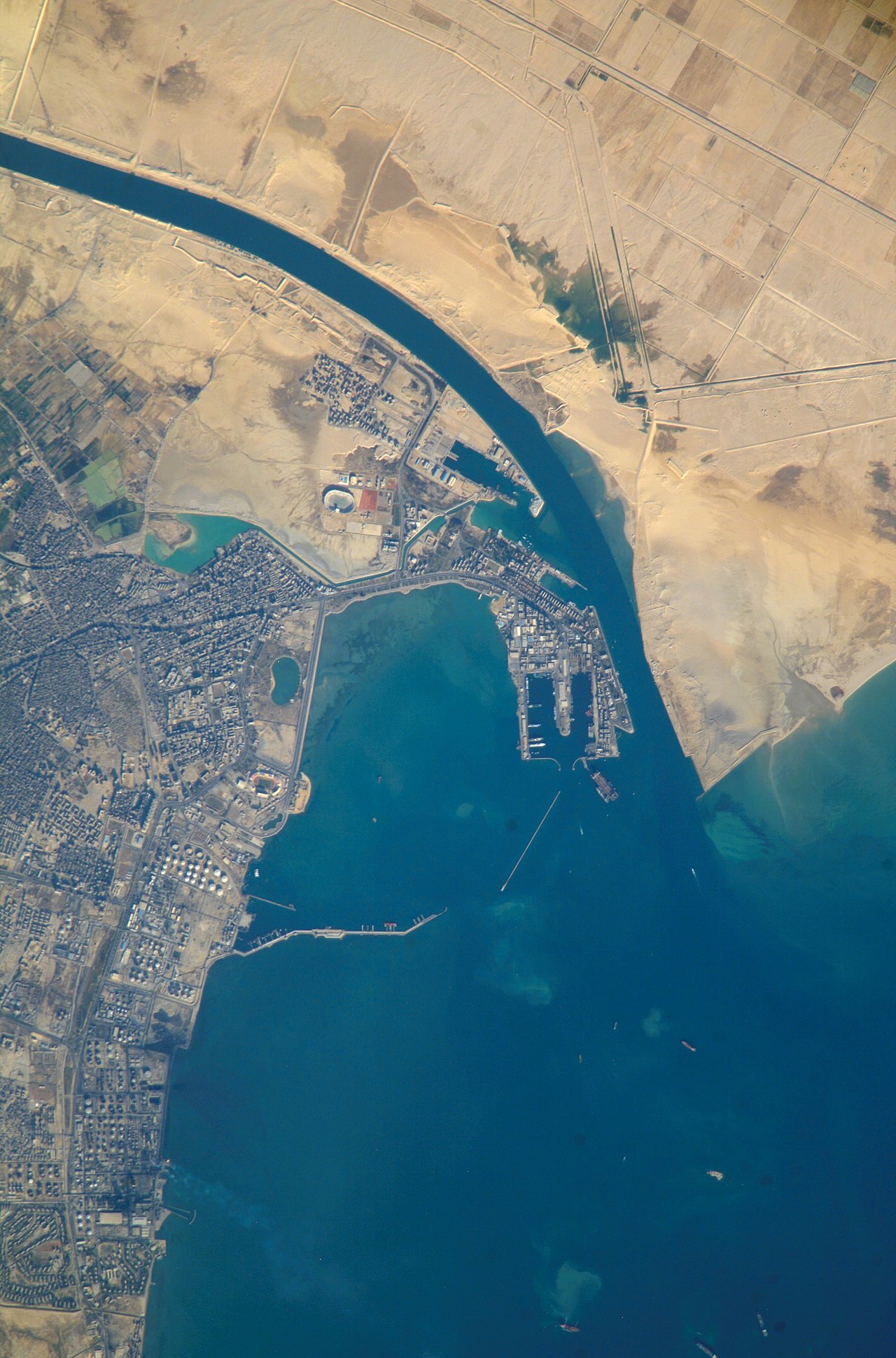
Stand on the western bank of the Suez Canal at Ismailia and you can watch a parade of supertankers and container ships pass by at walking speed, their hulls rising 20 metres above the narrow waterway. The ships are moving from Asia to Europe or back at roughly 8 knots. A single ship may carry 20,000 standard containers — the contents of perhaps two thousand suburban garage sales, or the iPhones for a continent. Roughly 50 ships a day make the transit. Together they account for around 12 percent of global trade by value. The canal was dug across the Isthmus of Suez between 1859 and 1869 by a French-led company using mostly Egyptian forced labour. It remains one of the few large pieces of 19th-century infrastructure still performing its original function on the original alignment.
The Geography of the Cut
The Isthmus of Suez is a 120-kilometre-wide strip of low desert separating the Mediterranean from the Red Sea. The terrain is broadly flat and at sea level or near it. The original surveys identified that the difference in elevation between the two seas was small enough that the canal could be built without locks — a tide-driven sea-level passage that allowed ships to sail through. The canal runs roughly north-south from Port Said on the Mediterranean to Suez on the Red Sea, passing through three natural lakes (Lake Manzala, Lake Timsah, the Bitter Lakes) that simplify the engineering by providing wider stretches for ships to manoeuvre and pass each other. The total length is 193 kilometres. The original canal was 8 metres deep and 52 metres wide at the surface. After multiple expansions over 160 years, it is now 24 metres deep and 205-225 metres wide. The 2015 New Suez Canal project added a 35-kilometre parallel channel for part of the route, allowing two-way traffic in that section.
How It Got Built
The idea of a canal between the Mediterranean and the Red Sea goes back at least to the Pharaonic period — there was an earlier "Canal of the Pharaohs" connecting the Nile to the Red Sea, maintained intermittently from around 600 BCE until silting up in the 8th century CE. The modern canal originated with the Frenchman Ferdinand de Lesseps, a former diplomat who obtained a concession from the Egyptian Khedive Sa'id Pasha in 1854 to form a company to build and operate a sea-level canal. The Suez Canal Company was a privately held French-British-Egyptian joint venture. Construction began in April 1859 with the breaking of ground at Port Said, and continued for ten years. The labour force at its peak exceeded 30,000 workers, drawn primarily from the Egyptian fellahin and conscripted through the corvée system of forced unpaid labour. Working conditions were brutal: malaria and cholera epidemics swept through the labour camps, and contemporaneous estimates of worker deaths during construction ran into the thousands. The canal opened on 17 November 1869 with a lavish ceremony attended by European royalty.
How the Tolls Work
The Suez Canal Authority charges transit fees calculated on the Suez Canal Net Tonnage of each vessel — a slightly modified measurement of capacity that has been used by the canal since 1873. The exact fee depends on ship type, cargo, direction of transit, time of year, and whether the ship is using the parallel two-way section. Container ships and tankers pay among the highest tolls; a large container ship typically pays $400,000 to $700,000 per transit, while a Suezmax tanker (the largest size that can fit fully laden) pays around $500,000 to $800,000. Specialised vessels (cruise ships, LNG carriers) have their own schedules. The fees are negotiated periodically and have generally trended upward; in 2023 the Authority introduced significant increases over a single fiscal year that drew complaints from shipping lines but produced no meaningful redirection of traffic.
Port Said and Suez
The two cities at either end of the canal were created largely to serve it. Port Said, at the Mediterranean end, was founded in 1859 as the construction headquarters of the canal project and grew into a free-zone port of around 750,000 people. The Suez Canal Authority's main administrative buildings sit on its waterfront. Suez itself, at the southern end, is an older Egyptian city that predates the canal but was reorganised around it in the late 19th century; today it has around 750,000 residents and serves as the headquarters of Egypt's petroleum industry. The Sinai Peninsula east of the canal — across the water — has a complicated political history, having been occupied by Israel from 1967 to 1982 and then returned to Egypt under the Camp David Accords. The Sinai today is heavily securitised by the Egyptian military, partly to protect the canal and partly because of an ongoing low-level Islamist insurgency in the northern peninsula.
The Crisis of 1956
Britain acquired a controlling share in the Suez Canal Company in 1875, when the bankrupt Khedive Ismail sold his shares to the British government for £4 million. The company continued to operate the canal under French and British management for 80 years, with substantial profits flowing to European investors and minimal benefit to Egypt. In July 1956 the Egyptian president Gamal Abdel Nasser nationalised the canal in retaliation for the Western refusal to fund the Aswan High Dam project. Britain and France, in secret coordination with Israel, launched a military invasion of the canal zone in October 1956 to seize it back. The military operation was successful — Anglo-French paratroopers captured Port Said within days. But the political response was catastrophic for the European powers. US President Eisenhower, furious at having been excluded from the planning, used American financial leverage to force Britain and France to withdraw within weeks. The Suez Crisis is conventionally identified as the moment when the European powers ceased to operate as great powers in the Middle East and the US and the Soviet Union became the primary external actors in the region. Egypt retained the canal.
Closure and Reopening
The canal was closed twice in the late 20th century. The first closure, from 1956 to 1957, was a brief consequence of the Suez Crisis. The second, from June 1967 to June 1975, followed the Six-Day War between Israel and its Arab neighbours; the canal became the front line between Israeli forces in Sinai and Egyptian forces on the western bank, and was blocked by sunken ships and unexploded ordnance. During the eight-year closure, world shipping rerouted around the Cape of Good Hope at the southern tip of Africa, adding several thousand miles and substantial time to the journey between Asia and Europe. The economic effects were absorbed but real: the closure accelerated the shipbuilding industry's shift toward supertankers and reshaped global trade patterns in ways that took decades to fully reverse after the canal reopened.
The Ever Given Incident
In March 2021 the 400-metre container ship Ever Given ran aground in the southern reach of the canal during a sandstorm, wedging itself diagonally across the channel and blocking all traffic. The ship was eventually refloated after six days of intensive dredging and tug-boat work, but by that time hundreds of ships had backed up at either end of the canal, and the global shipping schedule had been disrupted for weeks. The incident produced an unusually wide global awareness of the canal's role in trade. The Suez Canal Authority subsequently entered into protracted compensation negotiations with the ship's owners and operators, ultimately settling for around $500 million. The incident also prompted Egypt to accelerate ongoing expansion of the southern canal reaches with the goal of allowing two-way traffic across more of the canal's length.
The Money
The canal is one of the largest single sources of foreign-currency revenue for the Egyptian government. Transit fees, which vary by ship size and cargo, brought in approximately $9.4 billion in fiscal year 2022-23 — a substantial fraction of Egypt's foreign currency earnings. Egypt's economy is heavily dependent on this revenue, and any sustained loss of transit traffic — through alternative routes, security disruptions, or larger Middle Eastern conflicts — has rapid effects on the country's ability to import food, fuel, and other essentials. The canal is in this sense not just a piece of infrastructure but a major component of Egyptian economic statecraft.
The Future
The canal's long-term commercial position is more secure than it has ever been. The 2015 expansion increased capacity. The 2021 Ever Given incident prompted further investment in dredging and tug capacity. Climate change is opening up the Northwest Passage and the Northern Sea Route as theoretical Asia-Europe alternatives but neither route is likely to displace the canal at scale within the coming decades because of ice, lack of port infrastructure, and shipping insurance considerations. The Red Sea security situation continues to affect transit volumes year to year — the 2023-2024 Houthi attacks on Red Sea shipping prompted some major shippers to reroute around Africa despite higher costs — but no sustained alternative route has emerged. The infrastructure has remained useful for 156 years and counting.
