
Introduction
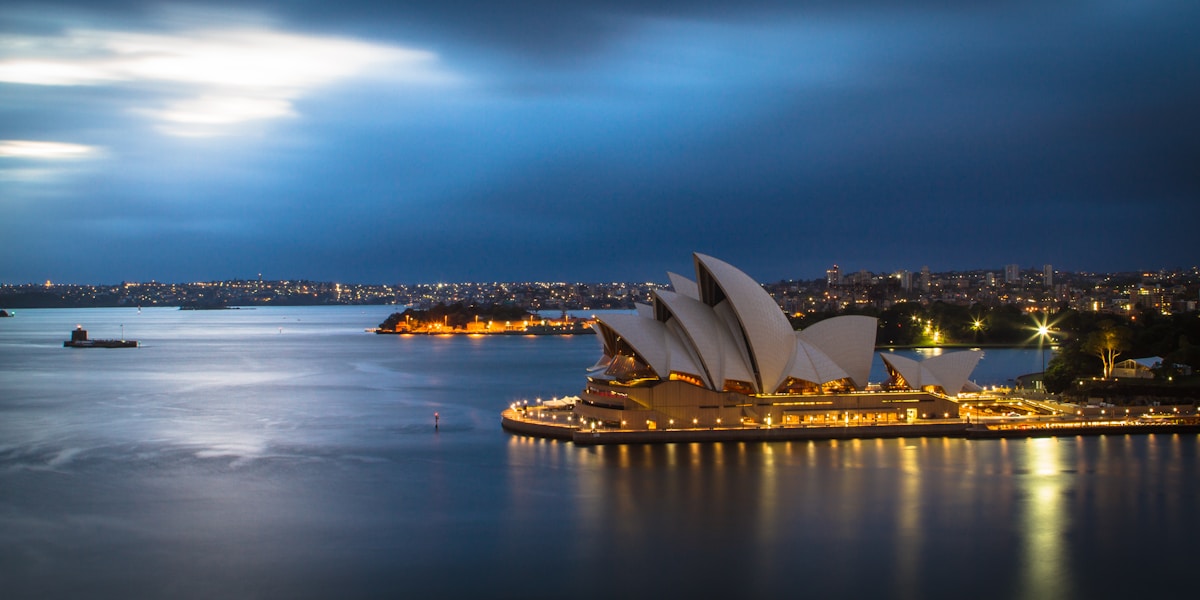
The Sydney Opera House, perched on Bennelong Point in Sydney Harbour, is one of the most iconic buildings of the 20th century. Designed by Danish architect Jørn Utzon and opened in 1973, its cluster of interlocking shell-shaped roofs has made it instantly recognizable worldwide and a symbol of both Sydney and Australia.
Designated a UNESCO World Heritage Site in 2007, the Opera House was described as "a great urban sculpture set in a remarkable waterscape" and recognized as a masterpiece of human creative genius. It hosts over 1,500 performances annually across its multiple venues, welcoming more than 10 million visitors each year.

History & Origins
- Design Competition: 1956 (233 entries from 32 countries)
- Construction: 1959–1973
- Architect: Jørn Utzon (Denmark)
- Cost: A$102 million (originally estimated at A$7 million)
In 1956, the New South Wales government held an international design competition for a performing arts center. Utzon's radical entry — featuring a series of interlocking shell-shaped vaults — was selected from 233 submissions. The design was so revolutionary that no one knew how to actually build it, and the project took 14 years longer than planned.
Utzon resigned from the project in 1966 after disputes with the government over costs and design changes. He never returned to see the completed building. In 1999, he was brought back as a design consultant, and he was awarded the Pritzker Prize — architecture's highest honor — in 2003.
Architecture & Design
- Roof Shells: Over 1 million tiles covering the sail-shaped roofs
- Performance Venues: 7 (including Concert Hall seating 2,679)
- Site Area: 1.8 hectares
- Height: 65 m at the highest shell
The roof shells are clad in over one million self-cleaning ceramic tiles manufactured in Sweden. Utzon's breakthrough was discovering that all the shells could be derived from sections of a single sphere, allowing them to be prefabricated. The tiles are designed in two shades — glossy white and matte cream — creating a subtle chevron pattern that shimmers in changing light.
The building contains seven performance venues, including the Concert Hall (2,679 seats), the Joan Sutherland Theatre (1,507 seats), and the Drama Theatre (544 seats). The interior spaces required innovative acoustic engineering, and the Concert Hall features a massive pipe organ with 10,154 pipes — the largest mechanical organ in the world.
Cultural Significance
The Sydney Opera House is far more than a performance venue — it is Australia's most recognized building and a symbol of national identity. It sits on land of deep significance to Aboriginal Australians; Bennelong Point is named for Woollarawarre Bennelong, an Aboriginal man who played a crucial role in early colonial relations.
The building hosts over 1,500 performances each year across genres from opera and ballet to contemporary music and comedy. Vivid Sydney, an annual festival of light, transforms the sails into a spectacular canvas for projected art installations that draw millions of spectators.
Key Facts
- The Sydney Opera House was inscribed as a UNESCO World Heritage Site in 2007.
- Over 10 million people visit the site annually, with 1,500+ performances per year.
- The roof is covered in over 1 million self-cleaning ceramic tiles.
- Construction took 16 years and cost 14 times the original estimate.
- The Concert Hall organ has 10,154 pipes and took 10 years to build.
Fun Facts
- Utzon's competition entry was reportedly rescued from the reject pile by late-arriving judge Eero Saarinen, the famous Finnish-American architect.
- The ceramic roof tiles are designed to be self-cleaning — rainwater washes away dirt and salt spray.
- Queen Elizabeth II officially opened the Opera House on October 20, 1973.
- The building consumes the same amount of electricity as a town of 25,000 people.
Final Thoughts
The Sydney Opera House stands as one of the defining architectural achievements of the 20th century — a building that seemed impossible to build and nearly destroyed the career of the genius who designed it. Today, its luminous shells on the edge of Sydney Harbour embody the power of visionary design and serve as a living cultural landmark that belongs to the world.