

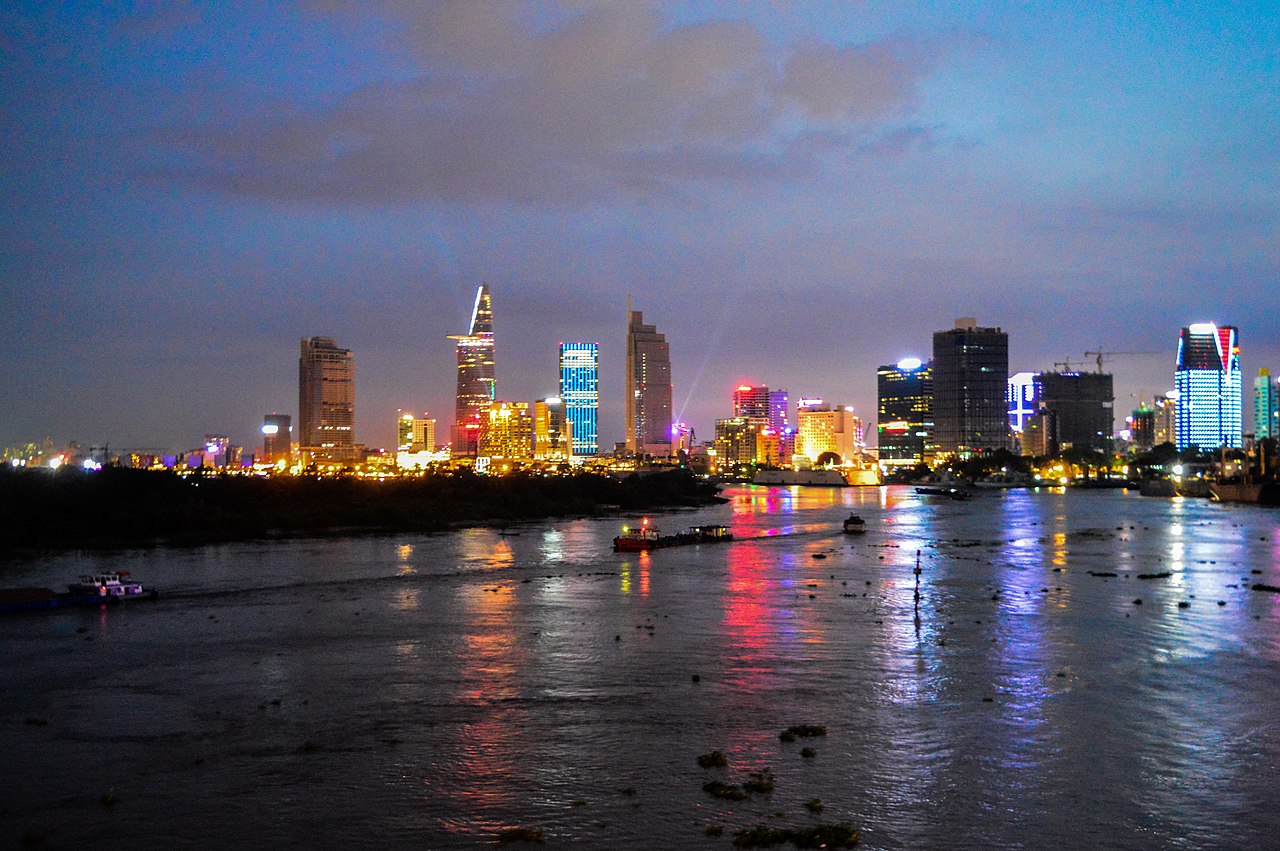
The tallest building in Ho Chi Minh City is Landmark 81, at 461.2 metres with 81 floors, completed in 2018. It stands on the west bank of the Saigon River in Binh Thanh district, is by a wide margin the tallest building in Vietnam, and was the tallest in Southeast Asia for five years until Merdeka 118 opened in Kuala Lumpur in 2023. It was also built, unusually for a supertall tower anywhere, almost entirely by a domestic contractor.
Eighty-One Floors, and the Name
The building's name is simply its floor count, which is unusual — most towers are named for their owner, their address or their developer's ambitions. Landmark 81 is named for the number 81, and the number was chosen for the height rather than the other way round.
The design, by Atkins, is a cluster of bundled tubes of different heights, tapering as they rise, which the architects described as drawing on bamboo — a stand of stalks bound together, a common symbol of strength through unity in Vietnamese culture.
The result reads as a single tapering shaft from a distance and as a bundle of vertical elements up close. The crown holds a spire and a lighting array that makes it the dominant object on the city's skyline at night from several kilometres away.
Vingroup and Vinhomes Central Park
The tower is the centrepiece of Vinhomes Central Park, a residential development by Vingroup, Vietnam's largest private conglomerate. The site was previously Tan Cang, the old Saigon port area, and the development covers around 44 hectares along the riverfront.
Vingroup was founded by Pham Nhat Vuong, who made his initial fortune selling instant noodles in Ukraine in the 1990s and returned to Vietnam to build a property, retail, healthcare and later automotive group. Landmark 81 is the group's signature project and its most visible statement.
Construction was carried out by Coteccons, a Vietnamese contractor, rather than by a foreign firm. That was widely reported in Vietnam as a matter of national significance, and it is genuinely unusual — most supertall buildings outside China and the Gulf are built by a small set of international contractors.
Built Fast
Ground was broken in 2014 and the tower topped out in 2018, a construction period of roughly four years for a 461-metre building. That is quick by any standard.
The foundation is a mat of around 9,000 cubic metres of concrete over 419 bored piles, and the concrete pour for the mat ran continuously for over three days. The site sits on soft Mekong delta alluvium, so the piles go down around 70 to 80 metres.
The structural system is a reinforced concrete core with outriggers connecting to perimeter megacolumns, the standard arrangement for towers in this height range. Wind governs the design; Vietnam is not seismically active in the way Taiwan or Japan are.
What Is Inside
The lower floors hold a shopping centre, a cinema and an ice rink. Above that are around 1,000 apartments across the middle of the tower, a Vinpearl Luxury hotel occupying floors 47 to 76, and offices.
The observation deck, Landmark 81 SkyView, occupies floors 79 to 81 at around 382 metres and includes an outdoor terrace. The Blank Lounge on the 75th and 76th floors is the highest bar in Vietnam and is usually easier to get into than the deck itself.
The building holds a Guinness record for the world's highest infinity pool in a building at the time it opened, on the 78th floor, though that kind of record changes hands frequently.
Southeast Asia's Tallest, For Five Years
When it topped out in 2018, Landmark 81 took the Southeast Asian record from the Petronas Towers in Kuala Lumpur, which had held it since 1996 at 451.9 metres. It kept it until Merdeka 118 completed in 2023 at 678.9 metres.
Merdeka 118 is now the second tallest building in the world after the Burj Khalifa, which makes the regional comparison lopsided. Landmark 81 remains comfortably ahead of everything else in the region: Jakarta's Autograph Tower at 382.9 metres, Bangkok's Mahanakhon at 314 metres, Singapore's Guoco Tower at 283.7 metres.
Vietnam's second tallest building is Lotte Center Hanoi at 272 metres, and the country's third is Keangnam Hanoi Landmark Tower at 336 metres — which held the national record from 2011 until Landmark 81 took it.
The Height Is Not the Point
Landmark 81 was not built because Ho Chi Minh City needed 461 metres of floor space in one place. The office market is concentrated in District 1, the apartment market is spread across the metropolitan area, and neither required a supertall tower.
What it produced was a marker. Vinhomes Central Park's apartments sold at a substantial premium over comparable stock elsewhere in Binh Thanh, and the tower gave the entire development an address that needed no further explanation. Developers call this a halo asset and it is the standard justification for supertall residential projects worldwide.
Vietnam's government has also treated it as a national symbol. State media covered the topping out extensively, and the fact that the design was foreign but the construction domestic was the detail most often emphasised.
The Records It Holds and the Ones It Does Not
Landmark 81 is the tallest building in Vietnam, the tallest in Southeast Asia excluding Malaysia, and was among the world's twenty tallest when it opened. It has since slipped out of the top twenty as Chinese and Gulf towers have completed.
It is not Vietnam's tallest structure. That is a broadcast mast rather than a building, and the distinction is the same one that separates Sydney Tower from Crown Sydney and the CN Tower from Toronto's skyscrapers — habitable floors are what the building rankings count.
Its 81 floors also do not map onto 81 usable levels. Like most supertall towers it contains mechanical floors, refuge floors and a crown that holds no occupiable space, so the highest floor anyone works or sleeps on is well below the top of the structure.
Saigon's Skyline Before Landmark 81
Ho Chi Minh City had essentially no tall buildings until the 2000s. The Saigon Trade Center, completed in 1997 at 145 metres, was the first, and the Bitexco Financial Tower at 262 metres in 2010 was the first that changed the skyline.
Bitexco, designed by Carlos Zapata, is the one with the helipad protruding from the 52nd floor like a diving board, and its Saigon Skydeck was the city's main viewpoint until Landmark 81 opened. Its shape is meant to evoke a lotus bud.
The city's tall buildings cluster in District 1 around Nguyen Hue and Le Loi, and increasingly along the river in Binh Thanh and across the water in Thu Thiem, a large planned development on reclaimed marshland in District 2 that has been under construction for two decades.
The Ground Underneath Is Sinking
Ho Chi Minh City is subsiding, in places by several centimetres a year, driven mainly by groundwater extraction from the delta aquifers and by the weight of construction on soft alluvium. Studies have measured cumulative subsidence of tens of centimetres in parts of the city since the 1990s.
Combined with sea level rise and the city's average elevation of only a couple of metres, this makes flooding a chronic and worsening problem. Parts of District 7 and Binh Thanh flood on high tides regardless of rainfall.
Tall buildings themselves are not the main cause — they sit on deep piles that reach competent strata — but they concentrate load and their construction lowers the water table locally. Vietnam has restricted groundwater extraction in the city in response.
What Is Planned
Several taller Vietnamese projects have been announced. Empire City Tower in Thu Thiem is designed at 333 metres and has been slow to progress; the Saigon Peninsula and Thu Thiem plans include towers above 400 metres that have not started.
Vingroup announced plans in 2024 and 2025 for towers in Hanoi and in the Can Gio development south of Ho Chi Minh City that would exceed Landmark 81, including a proposal reported at over 100 storeys. None has broken ground on a foundation for a supertall.
Vietnam's construction sector went through a serious credit contraction from 2022, and several large developers have restructured. The pipeline of announced supertall towers is considerably longer than the pipeline of funded ones.
Visiting
Landmark 81 is about five kilometres from District 1 and is not on the metro line that opened in 2024, though Tan Cang station on Line 1 is close. Most visitors take a taxi or ride-hail.
SkyView tickets are timed and the deck is busiest at sunset. The view runs across District 1, down the river towards the port, and on clear days out towards the delta.
The cheapest way to see the tower rather than see from it is from the far bank of the Saigon River at Thu Thiem, or from the Landmark 81 bridge over the canal, where the whole shaft is visible from base to spire. For neighbouring comparisons, see the tallest building in Singapore and the countries where Vietnamese is spoken.