
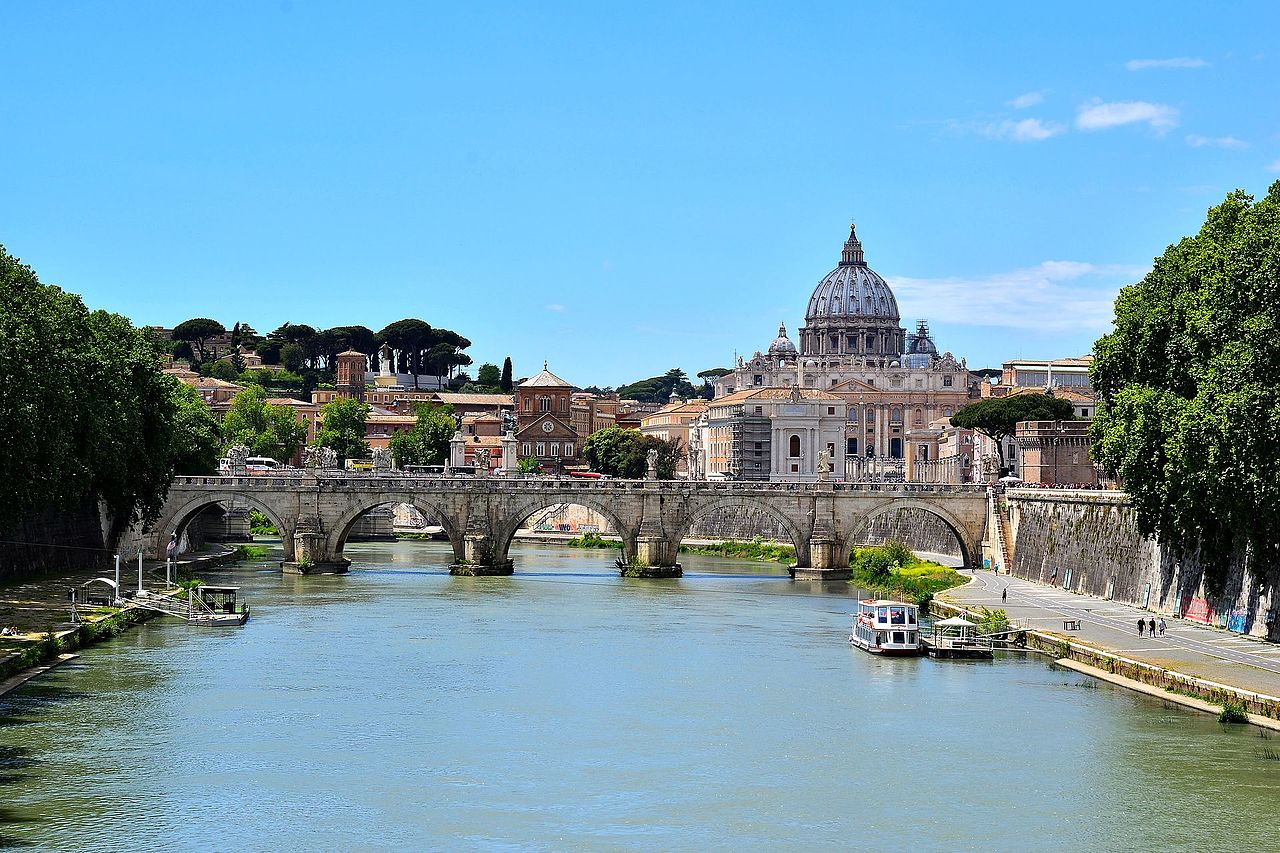
The Tiber (Tevere in Italian) is the third-longest river in Italy at approximately 405 kilometers, flowing from the Apennine Mountains of Emilia-Romagna through Umbria and Lazio to the Tyrrhenian Sea. Though modest in size, the Tiber's historical significance is immense: Rome, one of the most influential cities in human history, was founded on its banks.
Introduction
According to Roman legend, Romulus and Remus were cast into the Tiber as infants and saved by a she-wolf. The river served as Rome's water supply, sewer, trade route, and defensive barrier. Vatican City, the spiritual center of Roman Catholicism, sits on the Tiber's western bank, making this river sacred to over a billion Christians.

Source to Sea
- Length: ~405 km
- Source: Mount Fumaiolo, Emilia-Romagna, Apennine Mountains (~1,268 m elevation)
- Mouth: Tyrrhenian Sea, at Ostia/Fiumicino, near Rome
The Tiber begins as a spring on Mount Fumaiolo in the Apennines and flows south through the fertile valleys of Umbria, past Perugia, before turning south and then southwest toward Rome. The river enters Rome from the north, loops through the historic center in a series of famous bends, and exits southwest toward the sea.
The Tiber reaches the Tyrrhenian Sea at Ostia, which was ancient Rome's port city. The river's sediment deposition has pushed the coastline roughly 3 kilometers seaward since Roman times, so ancient Ostia now lies inland. Fiumicino, Rome's modern international airport, takes its name from the Tiber's northern mouth channel (Fiumicino means "little river").
Geography & Course
- Basin Area: ~17,375 km²
- Through Rome: ~27 km of river flows through the city
- Major Tributaries: Nera, Aniene, Chiascio, Paglia
The Tiber Basin covers a relatively small area of central Italy, primarily in Umbria and Lazio. The river's largest tributary is the Nera, which joins from the east and carries water from the Marmore Falls, a 165-meter waterfall created by the Romans in 271 BCE to drain a swamp — one of the oldest engineering works still in use.
The Tiber through Rome is spanned by over 20 bridges, many of historical importance. The Ponte Sant'Angelo, originally built by Emperor Hadrian in 134 CE, leads to the Castel Sant'Angelo. The Ponte Fabricio, built in 62 BCE, is the oldest bridge in Rome still in its original state. Tiber Island (Isola Tiberina), in the center of the river, has been associated with healing since ancient times.
Climate & Hydrology
- Average Discharge: ~230 m³/s
- Flood History: Major floods recorded since 414 BCE; worst in 1557, 1598, 1870
- Flood Control: High embankment walls built after 1870 flood
The Tiber has a Mediterranean flow regime with peak flows in winter from rainfall and low flows in summer. The river has a long history of catastrophic flooding in Rome, with records dating back to 414 BCE. The flood of December 1870, shortly after Rome became the capital of unified Italy, caused extensive damage and prompted the construction of the high stone embankment walls that now line the river through the city.
These embankments, called muraglioni, were built between 1876 and 1910. While they protect Rome from flooding, they also cut the city off from its river, creating a vertical barrier that makes the Tiber largely inaccessible and invisible from street level. Various proposals to reconnect Rome with its river, including waterfront parks and floating restaurants, have met with mixed success.
Ecology & Wildlife
- Water Quality: Poor through Rome; improving with treatment investment
- Fish: Several species present despite pollution
- Invasive Species: Tilapia and red swamp crayfish now common
The Tiber's ecology through Rome has been degraded by centuries of urban pollution. Wastewater treatment has improved significantly since the 1990s, but the river still receives combined sewer overflows during heavy rain. Water quality improves significantly upstream of Rome, where the river flows through the relatively pristine landscapes of Umbria.
Invasive species have altered the Tiber's ecology. Tilapia, introduced from tropical Africa, now thrive in the warm waters near power plant outflows. Red swamp crayfish, originally from the southeastern United States, have colonized the river and its tributaries. Native species including brown trout survive in the upper reaches but have been largely displaced from the urban section.
Human Geography & History
- Rome Founded: Traditionally 753 BCE on the Tiber's Palatine Hill
- Vatican City: Located on the Tiber's western bank
- Bridges: Over 20 historic bridges cross the Tiber in Rome
The Tiber is inseparable from the story of Rome. According to tradition, Romulus founded the city on the Palatine Hill above the Tiber in 753 BCE. The river provided water, served as a sewer (the Cloaca Maxima, built in the 6th century BCE, still drains into the Tiber), facilitated trade through the port of Ostia, and formed a defensive boundary on Rome's western side.
Vatican City, the world's smallest sovereign state and the spiritual center of the Roman Catholic Church, sits on the Tiber's western bank. St. Peter's Basilica, the Sistine Chapel, and the Vatican Museums are all within steps of the river. The Tiber thus connects two of the most important institutions in Western history: the Roman Empire and the Catholic Church.
Key Facts
- The Tiber flows ~405 km through central Italy and the heart of Rome.
- Rome was traditionally founded on the Tiber's banks in 753 BCE.
- Vatican City, the spiritual center of Roman Catholicism, sits on the Tiber's western bank.
- The Ponte Fabricio (62 BCE) is the oldest bridge in Rome still in its original state.
- High embankment walls built after the 1870 flood protect Rome but cut the city off from the river.
Fun Facts
- According to legend, Romulus and Remus were cast into the Tiber as infants and saved by a she-wolf.
- The Cloaca Maxima, Rome's ancient sewer that drains into the Tiber, has been in continuous use for over 2,500 years.
- Fiumicino airport's name comes from the Tiber's northern mouth channel ("little river").
- Ancient Ostia, Rome's port, is now 3 km from the sea due to centuries of Tiber sediment deposition.
Final Thoughts
The Tiber is small among the world's rivers but enormous in its historical impact. This modest Italian waterway gave birth to Rome, witnessed the rise and fall of the greatest empire of the ancient world, and today flows past the seat of the world's largest Christian church. The Tiber is a reminder that a river's importance is measured not in cubic meters but in the civilizations it nurtures.
Test Your Knowledge!
Think you know the world's rivers? Test your knowledge!
Play Geography Games →