
Introduction
Timbuktu, located on the southern edge of the Sahara Desert in present-day Mali, was one of the most important intellectual and commercial centers in the medieval world. Founded around 1100 CE as a seasonal camp for Tuareg nomads, it grew into a wealthy trading city and a renowned seat of Islamic scholarship that rivaled the great centers of learning in Cairo, Baghdad, and Cordoba.
Designated a UNESCO World Heritage Site in 1988, Timbuktu is famous for its three great mosques, Djinguereber, Sankore, and Sidi Yahia, and for its vast collections of ancient manuscripts. At its peak in the 15th and 16th centuries, the city's university attracted scholars from across the Islamic world, and its libraries held hundreds of thousands of handwritten manuscripts on subjects ranging from astronomy to law.

Geography & Geology
- Location: Northern Mali, edge of Sahara Desert
- River: Near the Niger River's great bend
- Elevation: ~264 m above sea level
- Climate: Hot desert (BWh)
Timbuktu sits at the intersection of the Sahara Desert and the Niger River's great northward bend, a strategic location that made it a natural meeting point for Saharan caravan routes and the river-based trade networks of West Africa. The city is about 15 kilometers from the Niger River, connected by a series of canals that flood during the rainy season.
The surrounding landscape is semi-arid to arid, with the Sahara encroaching from the north. Desertification has been an ongoing challenge, with sand dunes advancing toward the city. The climate is extremely hot and dry, with temperatures regularly exceeding 40 degrees Celsius and annual rainfall averaging only about 200 millimeters.
UNESCO Inscription
- Year Inscribed: 1988
- Criteria: Cultural (ii, iv, v)
- Danger Listed: 1990-2005, 2012-present
- Key Structures: Three great mosques
Timbuktu was inscribed as a UNESCO World Heritage Site in 1988, recognized for its role as an intellectual and spiritual capital and an important center for the dissemination of Islam in Africa. The site has been on the List of World Heritage in Danger twice: from 1990 to 2005 due to sand encroachment, and again since 2012 due to armed conflict.
In 2012, Islamist militant groups occupying Timbuktu deliberately destroyed several historic mausoleums and damaged the ancient mosques, prompting international outrage and intervention. A restoration program led by UNESCO and the Malian government has since rebuilt most of the damaged structures using traditional construction techniques.
Ecology & Environment
- Desertification: Major ongoing threat
- Sand Encroachment: Dunes advancing toward city
- Niger River: Seasonal flooding provides water
- Temperature: Regularly exceeds 40 degrees Celsius
The advance of the Sahara Desert poses an existential threat to Timbuktu. Sand dunes have encroached on the city's outskirts, burying outlying structures and threatening the historic center. Local and international efforts to combat desertification include planting trees and building sand barriers, but the challenge remains immense.
The Niger River's seasonal flooding cycle is critical to the region's ecology and economy. During the flood season from August to November, water channels reach Timbuktu, providing water for agriculture and transportation. The fish-rich waters of the Niger also support local livelihoods. Climate change threatens to make both droughts and floods more extreme.
Cultural Heritage
- University of Sankore: One of the world's first universities
- Manuscripts: 300,000-700,000 surviving
- Golden Age: 15th-16th centuries
- Trade Goods: Gold, salt, books, enslaved people
The University of Sankore, centered around the Sankore Mosque, was one of the foremost centers of learning in the medieval world. At its peak in the 15th and 16th centuries, it attracted as many as 25,000 students from across Africa, the Middle East, and Europe. The curriculum included astronomy, mathematics, medicine, law, philosophy, and Quranic studies.
Timbuktu's greatest treasure is its manuscripts. An estimated 300,000 to 700,000 handwritten manuscripts survive, some dating to the 13th century, covering subjects from theology and jurisprudence to astronomy, chemistry, and botany. Many are held in private family libraries that have been passed down through generations. The Ahmed Baba Institute houses over 30,000 manuscripts available for scholarly study.
Visitor Experience
- Access: Flights from Bamako or overland
- Security: Ongoing conflict limits tourism
- Key Sites: Three mosques, Ahmed Baba Institute
- Cultural Heritage: Tuareg and Songhai traditions
Timbuktu has long captured the Western imagination as a byword for the most remote and exotic place on Earth. The phrase "from here to Timbuktu" entered English to describe the farthest possible destination. In reality, Timbuktu is a living city with a rich cultural life, though ongoing security concerns in northern Mali have severely limited tourism since 2012.
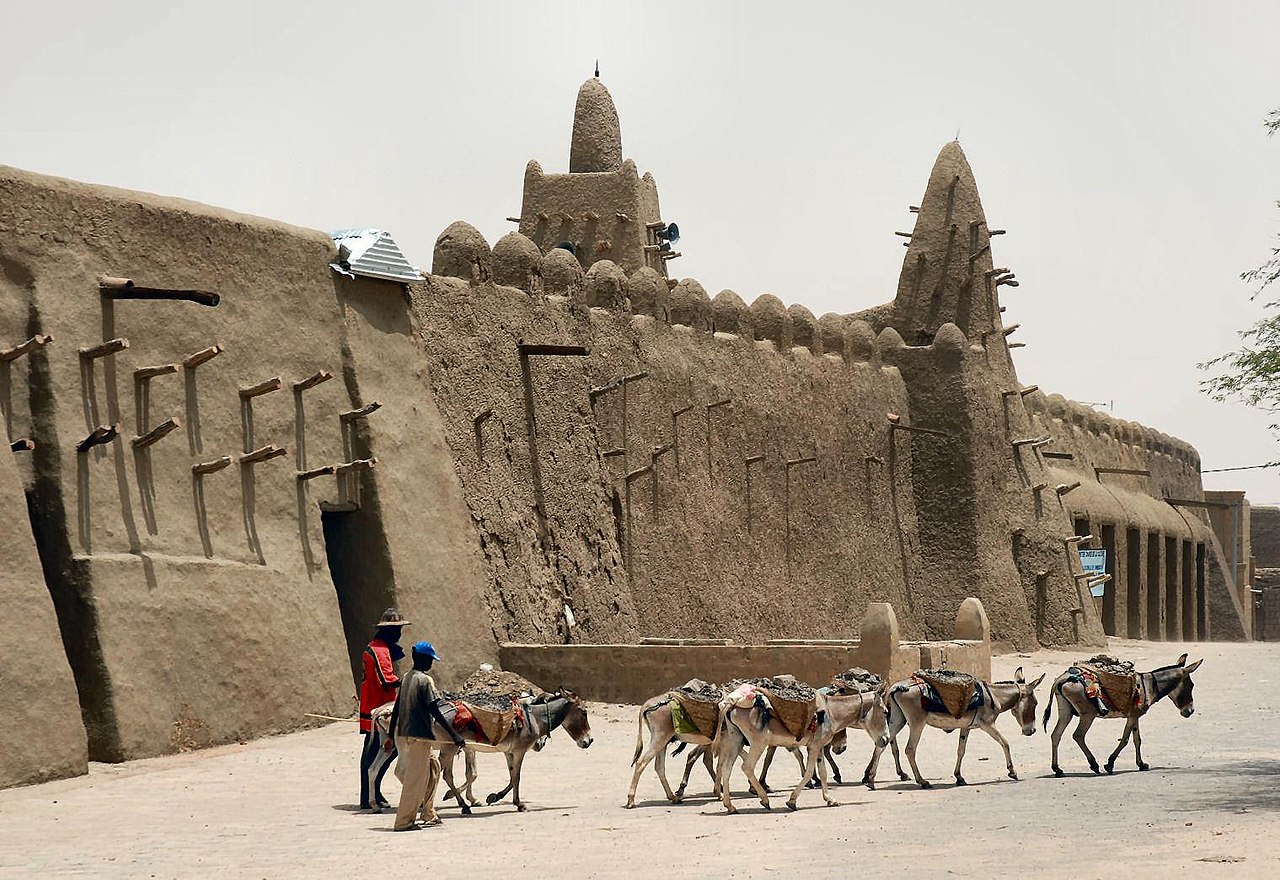
For those who can visit, the three great mosques of Timbuktu are the principal attractions. The Djinguereber Mosque, built in 1327 by the Andalusian architect Abu Ishaq es-Saheli on the orders of Mansa Musa, is a masterpiece of Sudano-Sahelian mud-brick architecture. The mosque's mud walls and distinctive protruding wooden beams (toron) require annual re-plastering, a community tradition that has continued for nearly 700 years.
Key Facts
- Timbuktu was one of the wealthiest cities in the medieval world, built on the trans-Saharan gold and salt trade.
- The University of Sankore attracted up to 25,000 students and was one of the world's first universities.
- An estimated 300,000 to 700,000 ancient manuscripts survive in private libraries and institutions.
- The city has been on the UNESCO List of World Heritage in Danger since 2012 due to armed conflict.
- Mansa Musa of the Mali Empire reportedly spent so much gold in Cairo en route to Mecca that he crashed the city's gold market for a decade.
Fun Facts
- The phrase "from here to Timbuktu" entered English as a metaphor for the most remote place imaginable.
- Mansa Musa's pilgrimage to Mecca in 1324, passing through Timbuktu, is considered the most lavish journey in human history.
- Books were the most valuable trade commodity in Timbuktu, worth more than gold by weight.
- The Djinguereber Mosque's mud walls are replastered every year in a community festival called the crepissage.
Final Thoughts
Timbuktu is a city that challenges assumptions. Far from being the "end of the earth" of Western imagination, it was for centuries a cosmopolitan center of wealth, learning, and cultural exchange at the crossroads of Africa's greatest trade routes. Its surviving manuscripts represent one of the most important collections of pre-modern African intellectual heritage, and its mosques stand as monuments to a golden age of Sahelian civilization.
