
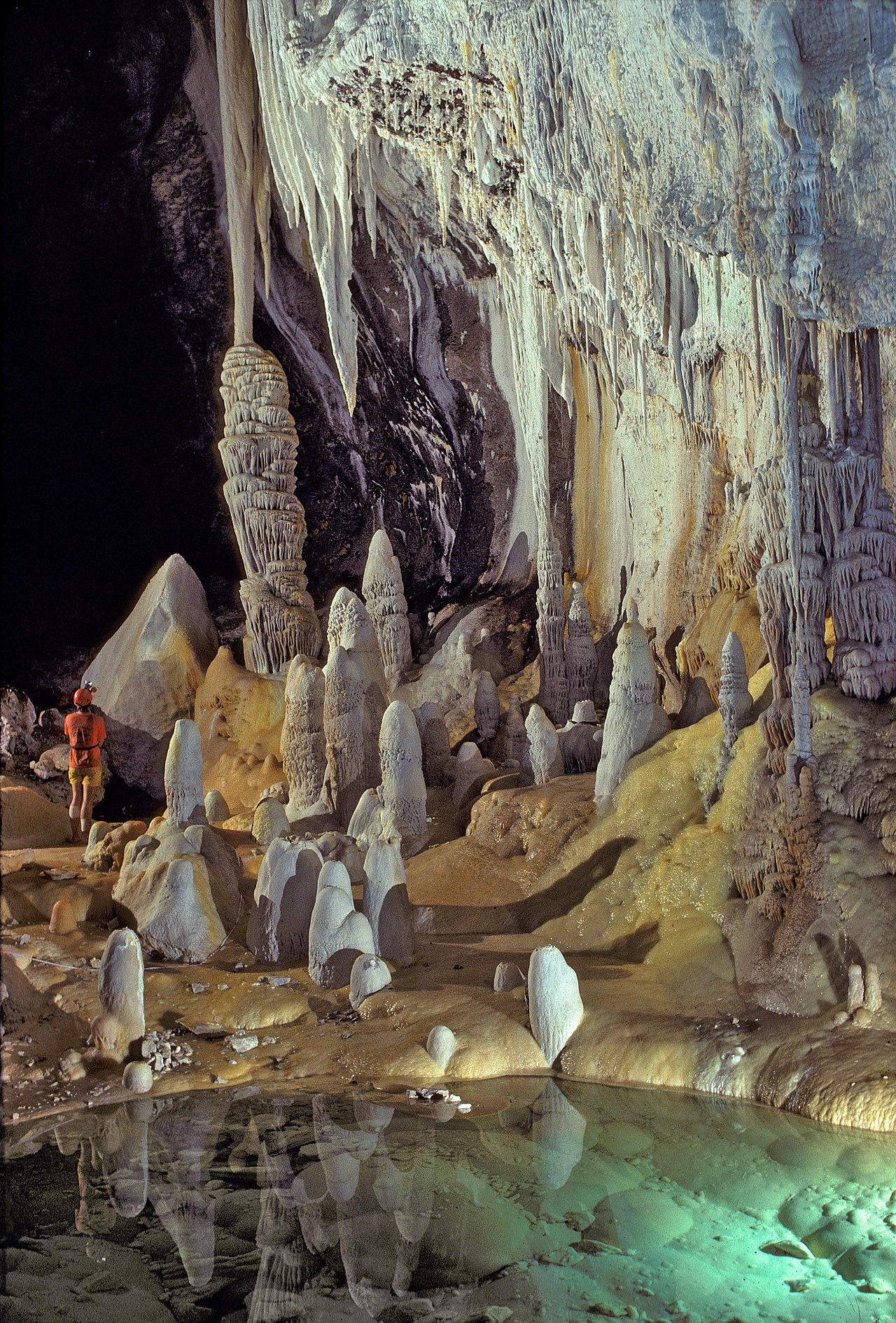
Veryovkina Cave in the Arabika Massif of Georgia holds the world record as the deepest known cave, reaching an astonishing 2,212 meters below the surface. Only a handful of elite cavers have ever reached its bottom, a journey that takes multiple days of technical rope work through flooded passages and vertical shafts.
Introduction
The world's deepest caves are concentrated in just a few regions with the right geological conditions: thick limestone formations, tectonic uplift, and millions of years of water erosion. The Caucasus Mountains of Georgia, the Pyrenees, and the Alps dominate this list, though deep caves have been found on every continent except Antarctica.

1. Veryovkina Cave, Georgia — 2,212 m
- Depth: 2,212 m
- Location: Arabika Massif, Abkhazia, Georgia
- Discovered: 1968; depth record set 2018
Veryovkina Cave became the first cave confirmed to exceed 2,200 meters depth in March 2018, when a Russian-Ukrainian team reached its terminal sump at -2,212 meters. The cave features enormous vertical shafts, including one drop of 194 meters, and several sections of underwater passage that require cave diving equipment.
Reaching the bottom of Veryovkina takes approximately five days, with teams establishing underground camps at various depths. The cave is located in a politically sensitive area of Abkhazia, adding logistical complexity to expeditions. Temperatures at the bottom hover around 7 degrees Celsius year-round.
2. Krubera Cave, Georgia — 2,197 m
- Depth: 2,197 m
- Location: Arabika Massif, Abkhazia, Georgia
- Record Held: Deepest cave 2001–2018
Krubera Cave, also known as Voronya Cave, held the world depth record for 17 years before Veryovkina surpassed it. Located just 15 kilometers from Veryovkina in the same limestone massif, Krubera was the first cave to break the 2,000-meter barrier in 2004, when Ukrainian caver Alexander Klimchouk's team reached -2,080 meters.
The cave's deepest point was established by diver Gennadiy Samokhin in 2012, who dove through a terminal sump to reach -2,197 meters. The cave has multiple branches and is still being explored, with some passages potentially connecting to Veryovkina — which would create a mega-cave system.
3. Sarma Cave, Georgia — 1,830 m
- Depth: 1,830 m
- Location: Arabika Massif, Abkhazia, Georgia
- Notable: Third deepest cave; same massif as top two
Sarma Cave is the third entry from the Arabika Massif in the top 10, underscoring this region's dominance in extreme depth caving. The cave was explored progressively by Russian teams throughout the 2000s and 2010s, with the current depth of 1,830 meters confirmed in 2017.
The cave features challenging conditions including tight squeezes, extensive wet passages, and long vertical drops. Like its neighbors, Sarma develops in Upper Jurassic and Lower Cretaceous limestone, with water flowing through the system eventually emerging as springs at the Black Sea coast.
4. Lamprechtsofen, Austria — 1,735 m
- Depth: 1,735 m
- Location: Leoganger Steinberge, Salzburg, Austria
- Notable: Deepest cave outside the Caucasus
Lamprechtsofen is the deepest cave in the Alps and the deepest outside the Caucasus region. Located in the Leoganger Steinberge mountains of Salzburg, it held the world depth record from 1998 to 2001. The cave system has been explored through multiple entrances at different elevations, giving it its exceptional vertical range.
The cave was first entered in the 19th century, but its true depth was only revealed through decades of systematic exploration connecting upper and lower entrances. The system includes over 50 kilometers of surveyed passage and an underground river that emerges dramatically from the mountain's base.
5. Gouffre Mirolda, France — 1,733 m
- Depth: 1,733 m
- Location: Haute-Savoie, French Alps
- Notable: Briefly held world record in 2003
Gouffre Mirolda in the French Alps briefly held the world depth record in 2003 at 1,733 meters before being surpassed by Krubera. The cave develops in Urgonian limestone in the Haute-Savoie department, near the Swiss border. Its entrance sits at approximately 2,350 meters elevation.
Exploration of Mirolda began in the 1970s and continued for decades, with teams gradually pushing through tight passages and water-filled sumps. The cave is notable for its challenging access: the entrance is at high altitude, accessible only during summer months, and expeditions must contend with snowmelt flooding the upper passages.
Key Facts
- The top three deepest caves are all in the same mountain massif in Georgia.
- Veryovkina Cave at 2,212 m is the only cave deeper than 2,200 meters.
- Reaching the bottom of the world's deepest cave takes approximately five days.
- Most of the world's deepest caves develop in Jurassic and Cretaceous limestone.
- Cave diving is required to reach the deepest points in many of these systems.
Fun Facts
- The pressure at the bottom of Veryovkina Cave is no different from the surface — unlike deep ocean dives, caves are filled with air at atmospheric pressure.
- Cavers exploring the deepest systems carry all supplies for five or more days underground, including sleeping bags and stoves.
- The Arabika Massif in Georgia contains the three deepest caves on Earth within a 15-kilometer radius.
- Some of these deep caves contain unique species of invertebrates found nowhere else on the planet.
Final Thoughts
The race to find the deepest cave on Earth is far from over. New passages are discovered every year, and some geologists believe caves exceeding 2,500 meters depth may exist in the Caucasus and Central Asian ranges. Each expedition pushes the boundaries of human endurance and speleological knowledge.
Test Your Knowledge!
Think you know your geography facts? Try our interactive quiz!
Play Geography Games →