
China exports more than any other country, shipping about $3.18 trillion of goods in 2023, ahead of the United States at about $2.05 trillion and Germany at about $1.69 trillion, according to World Bank balance-of-payments data. The Netherlands, Japan, France, Italy, South Korea, the United Kingdom and Mexico complete the top ten. The table below gives the full ranking for 2023; the sections after it explain what put each country there.
| Rank | Country | Goods exports, 2023 (US$ billion) | Top goods export |
|---|---|---|---|
| 1 | China | 3,179 | Broadcasting equipment |
| 2 | United States | 2,045 | Petroleum |
| 3 | Germany | 1,694 | Cars |
| 4 | Netherlands | 732 | Petroleum |
| 5 | Japan | 714 | Cars |
| 6 | France | 680 | Packaged medicines |
| 7 | Italy | 646 | Packaged medicines |
| 8 | South Korea | 645 | Integrated circuits |
| 9 | United Kingdom | 629 | Gold |
| 10 | Mexico | 594 | Cars |
Two notes on how the table is built. First, it counts goods only: physical products such as cars, chips, crude oil and grain that cross a border. Services such as banking, software licences, tourism and shipping are excluded, and adding them narrows the gap between China and the United States sharply, because American exports lean far more on services. Second, it ranks sovereign states with a 2023 figure. Belgium’s most recent number in the same World Bank series is for 2022, at about $615 billion, and Hong Kong, a territory of China, recorded about $575 billion in 2023; both would otherwise sit around tenth place. Just behind Mexico come Canada ($569 billion) and Singapore ($546 billion).
The ranking is not simply a list of the biggest economies, although size matters. It rewards countries that combine large industrial bases with deep-water ports, a place inside a free-trade bloc, and a small number of products the rest of the world cannot easily make itself. Those causes are taken one by one below.
It also helps to see the scale of the whole. The World Bank puts total world goods exports at about $24.3 trillion for 2022–23, so China alone accounts for roughly 13% of everything the world ships, and the top three together for more than a quarter. The next seven are bunched tightly: only about $140 billion separates the Netherlands in fourth place from Mexico in tenth, so a strong year for one economy or a weak currency in another is enough to reshuffle them. The choice of source matters too. UN customs data for 2023 put the United Kingdom at only about $520 billion, which moves it out of the top ten and lets India, at about $582 billion, in.
China’s factory scale since joining the WTO in 2001
China’s lead rests on sheer manufacturing capacity. After it joined the World Trade Organization in 2001, lower tariffs abroad and foreign investment at home turned the country into what was widely called the “world’s factory”. By 2010 it had become the world’s largest exporter, and it has held that position since. Its top goods export is broadcasting equipment, the category that includes mobile phones, but the range runs from furniture and clothing to solar panels and steel. The latest shift is in vehicles: China shipped 3.11 million cars abroad in 2022, second only to Japan, and overtook Japan in 2023 to become the world’s largest exporter of cars.
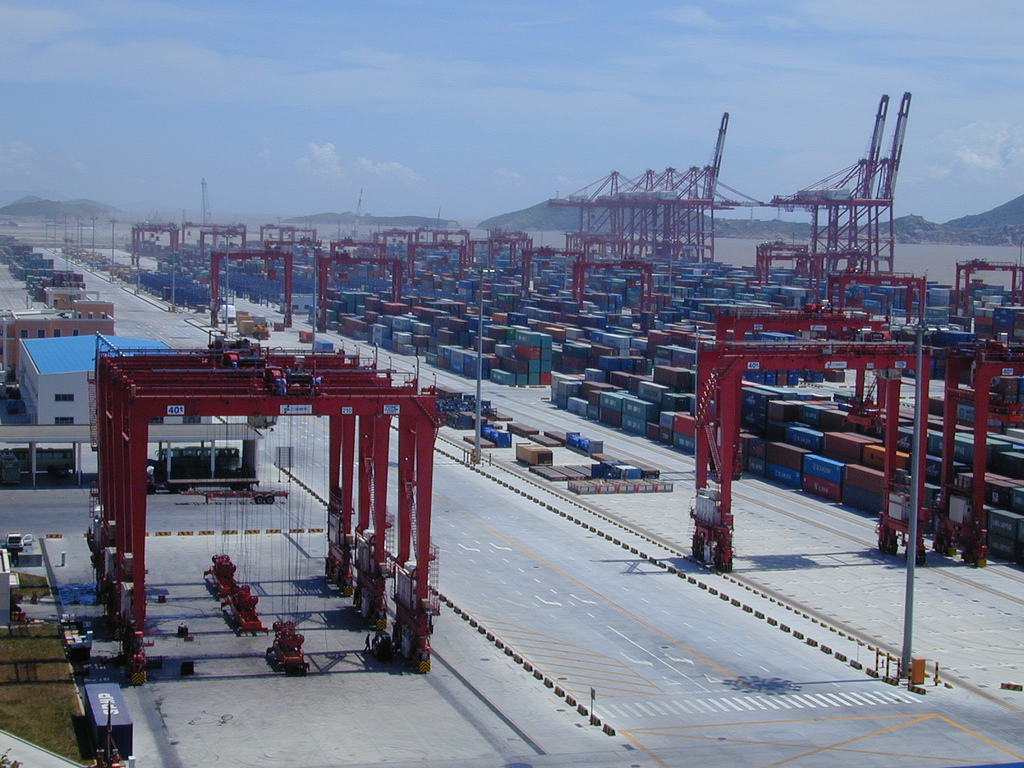
Geography helped. China’s coast faces the busiest shipping lanes on Earth, and the Port of Shanghai overtook Singapore in 2010 to become the world’s busiest container port. Because the Huangpu River mouth was too shallow for the largest container ships, Shanghai built Yangshan, an offshore deep-water port on reclaimed land among the Zhoushan islands, joined to the mainland by the 32.5 km Donghai Bridge.
North America’s shared market: the United States and Mexico
The United States is the world’s second-largest exporter and its largest importer. It is also the largest producer of petroleum and natural gas, which is why refined and crude petroleum is its top goods export rather than aircraft or machinery. America’s factories account for about a fifth of global manufacturing output, and the country is also the world’s largest producer of blood products, another sizeable export. Its biggest trading partners are Mexico, Canada, China, Japan and Germany, in that order.
Canada, the third partner in that bloc, only just misses the top ten, with about $569 billion of goods exports in 2023. Its top export is petroleum, and its largest customer is the United States, which shows how much of North America’s trade is the continent trading with itself.
Mexico’s place at No. 10 is a product of that border. In 1965 the Border Industrialization Program let factories in northern Mexico, the maquiladoras, import machinery and components duty-free to assemble goods for the US market. The North American Free Trade Agreement, signed in 1992, widened the arrangement to the whole country, and its successor, the United States–Mexico–Canada Agreement, took effect in 2020. From 1993 to 2002 its trade with the United States rose by 183% and its trade with Canada by 165%. As of 2019, about 80% of Mexico’s exports went to the United States and Canada. Its top export, like Germany’s and Japan’s, is cars, most of them built for buyers north of the Rio Grande.
Rotterdam and re-exports: how the Netherlands outranks Japan
A country of about 18 million people ranking fourth needs explaining, and the explanation is the Rhine delta. The Port of Rotterdam is the largest seaport in Europe and the largest outside Asia; from 1962 until 2004 it was the busiest port in the world by tonnage. Crude oil, containers and bulk cargo arrive from across the world, and much of it is refined, repackaged or simply transferred and shipped on by river, rail and road to Germany and the rest of the continent. Those re-exports count as Dutch exports, which is why petroleum products head the Dutch list. In 2020 Rotterdam ranked only tenth in the world by containers handled, a sign that its tonnage comes as much from oil, ore and other bulk cargo as from boxes. This transit trade is also why the Netherlands, Singapore and the United Arab Emirates all post export totals that look outsized for their economies.

The Netherlands is not only a transit hub. It is the world’s second-largest exporter of food and agricultural products by value, thanks to intensive greenhouse farming, and it is home to ASML, the only company in the world that makes extreme ultraviolet lithography machines, the tools needed to produce the most advanced microchips. Counting imports as well as exports, the Netherlands was the fifth-largest trading nation in the world in 2025, behind only the United States, China, Germany and the United Kingdom.
Engineering for the world: Germany, Japan and South Korea
Germany, Japan and South Korea reach the top ten by a different route: high-value manufactured goods that other countries find hard to substitute. Germany’s main exports are vehicles, machinery, chemicals, electrical equipment and pharmaceuticals, and its strength lies as much in thousands of family-owned mid-sized manufacturers, the Mittelstand, as in household names. The Volkswagen plant at Wolfsburg in Lower Saxony, founded with the town in 1938, covers just under 6.5 million square metres and produced 815,000 cars in 2015; around 61,880 people worked there in mid-2023. Counting services as well as goods, Germany exported $1.66 trillion in 2024 and ran a trade surplus of $255 billion, the second-largest in the world.

Japan rebuilt its economy after the Second World War on export industries, moving from textiles to steel, shipbuilding, electronics and finally cars; Toyota is today the world’s largest carmaker, producing about 10 million vehicles a year, Honda, Nissan, Suzuki and Mazda are also Japanese, and cars are Japan’s top export. South Korea adopted an export-led strategy in the 1960s, and its companies climbed the same ladder faster. Today integrated circuits are its top goods export, led by Samsung Electronics of Suwon, the world’s largest maker of memory chips and, every year since 2006, the largest television manufacturer by revenue. With a population of about 51 million, South Korea exports almost as much as Italy, a larger country with a much older industrial base.
Medicines, luxury and gold: France, Italy and the United Kingdom
The three remaining European economies owe their places to specialisms. France’s single largest goods export is packaged medicines, but its signature industry is aerospace: Toulouse is the centre of Europe’s aircraft industry, and Airbus runs its day-to-day management from Blagnac on the city’s edge. Satellites, pharmaceuticals, shipbuilding and cars are among France’s other leading industries. Italy, the second-largest manufacturer in Europe, exports through a dense web of small and medium-sized firms grouped in industrial districts, each specialising in one product line, from machinery to food and fashion; packaged medicines again top the product list.
The United Kingdom is the oddest case. Its top goods export is gold, because London is by far the largest centre for over-the-counter trading in bullion, overseen by the Bank of England and the London Bullion Market Association, and metal moving out of London vaults counts as British exports. Britain’s real export strength lies in services such as finance, insurance and law, which this goods table leaves out; on a goods-and-services basis the UK climbs higher up the table.
Behind all ten stand the sea lanes that carry the cargo. Our guide to the world’s busiest ports shows how many of them are in China, and the ranking of countries by GDP shows how closely export power follows economic size, with the Netherlands and Mexico as the clearest exceptions. For the Americas’ other big trade bloc, where Brazil’s top export is iron ore and Argentina’s is soybeans, see our guide to Mercosur.