
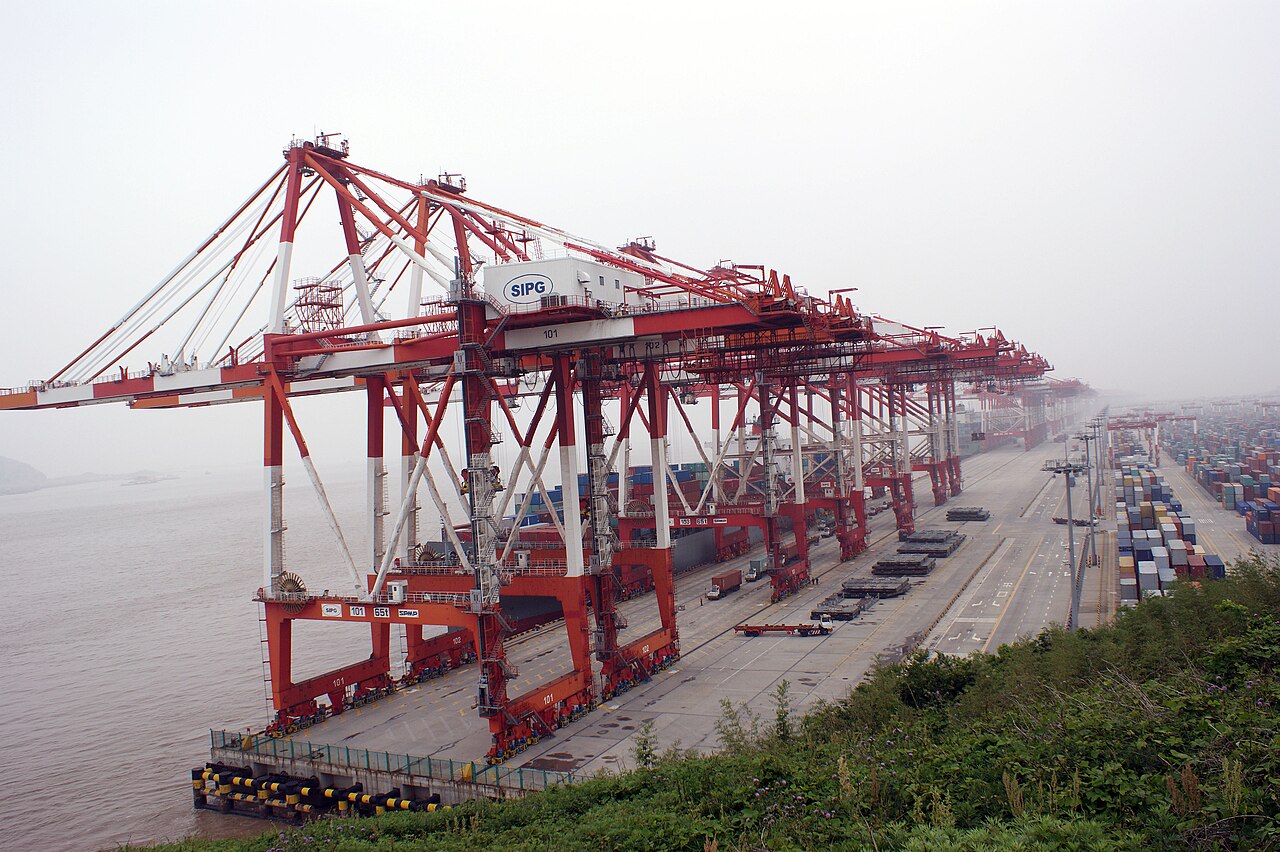
The Port of Shanghai has been the world's busiest container port since 2010, handling over 49 million TEU (twenty-foot equivalent units) annually. Its Yangshan Deep-Water Port terminal, connected to the mainland by a 32.5-kilometer bridge, is one of the most technologically advanced port facilities in the world, with automated cranes and driverless container vehicles.
Introduction
Approximately 90 percent of all internationally traded goods travel by sea at some point in their journey, making container ports the critical nodes of the global economy. The busiest ports are concentrated in Asia, which dominates global manufacturing and trade. Seven of the world's ten busiest ports are in China or Southeast Asia, reflecting the region's role as the factory of the world.

1. Port of Shanghai, China — 49+ million TEU
- Annual Volume: ~49.7 million TEU
- Location: Yangtze River Delta, China
- Key Terminal: Yangshan Deep-Water Port
- Notable: World's busiest port since 2010
Shanghai's port complex spans both the traditional Huangpu River facilities in the city center and the massive Yangshan Deep-Water Port on islands in Hangzhou Bay, connected to the mainland by the Donghai Bridge. Yangshan Phase IV, opened in 2017, is the world's largest automated container terminal, using AI-guided vehicles and robotic cranes.
The port serves as the primary gateway for goods manufactured in the Yangtze River Delta economic zone, which produces a significant fraction of China's exports. Shanghai's strategic location at the mouth of the Yangtze — China's longest river, navigable for over 2,800 kilometers — gives it access to a vast inland market.
2. Port of Singapore — 39+ million TEU
- Annual Volume: ~39.4 million TEU
- Location: Singapore
- Key Terminal: Tuas Mega Port (under development)
- Notable: World's largest transshipment hub
Singapore is the world's premier transshipment port, meaning most containers that pass through are transferred between ships rather than entering the local economy. Its location at the southern tip of the Malay Peninsula, where the Indian Ocean meets the Pacific, makes it the natural hub for trade routes connecting East Asia, South Asia, Europe, and the Middle East.
The Port of Singapore Authority is developing the Tuas Mega Port, expected to be completed by the 2040s, which will consolidate all container operations at a single location with a capacity of 65 million TEU — enough to remain the world's top transshipment hub for decades.
3. Port of Ningbo-Zhoushan, China — 35+ million TEU
- Annual Volume: ~35.3 million TEU
- Location: Zhejiang Province, China
- Notable: Largest port by cargo tonnage globally
While Shanghai handles more containers, Ningbo-Zhoushan is actually the world's busiest port by total cargo tonnage, processing over 1.2 billion tonnes annually when bulk commodities like iron ore, crude oil, and coal are included. The port stretches across the mainland city of Ningbo and the Zhoushan archipelago offshore.
The port benefits from natural deep-water channels that can accommodate the largest vessels afloat, including Ultra Large Crude Carriers (ULCCs). It serves the manufacturing powerhouse of Zhejiang Province and provides an alternative gateway to the Yangtze Delta region.
4. Port of Shenzhen, China — 30+ million TEU
- Annual Volume: ~30.2 million TEU
- Location: Guangdong Province, China
- Notable: Gateway to the Pearl River Delta manufacturing region
Shenzhen's port complex serves the Pearl River Delta, one of the most productive manufacturing regions on Earth. The city itself transformed from a fishing village to a global tech hub in just four decades, and its port grew alongside it. Major terminals include Yantian, Shekou, and Chiwan, handling goods from factories producing electronics, textiles, and consumer goods.
Shenzhen's proximity to Hong Kong creates a complementary port relationship — shippers choose between the two based on cost, speed, and routing considerations. Together, the Shenzhen-Hong Kong port cluster handles over 50 million TEU annually, rivaling Shanghai.
5. Port of Guangzhou, China — 25+ million TEU
- Annual Volume: ~25.2 million TEU
- Location: Guangdong Province, China
- Notable: One of the oldest ports in the world, dating back 2,000+ years
The Port of Guangzhou has been a center of international trade for over 2,000 years, serving as the eastern terminus of the ancient Maritime Silk Road. Today it handles over 25 million TEU annually, with the Nansha terminal complex serving as its primary deep-water container facility.
Guangzhou's port benefits from its position at the head of the Pearl River Delta, with inland waterway connections extending hundreds of kilometers into southern China. The city hosts the biannual Canton Fair, the world's oldest and largest trade fair, attracting over 25,000 exhibitors from around the globe.
Key Facts
- Seven of the world's ten busiest container ports are in Asia.
- The Port of Shanghai has been the world's busiest since 2010.
- Singapore is the world's largest transshipment hub — most containers pass through without entering the country.
- Ningbo-Zhoushan is the busiest port by total cargo tonnage at 1.2 billion tonnes per year.
- The Port of Guangzhou has been a trading hub for over 2,000 years.
Fun Facts
- If all the containers handled by Shanghai's port in one year were placed end to end, they would stretch more than halfway around the Earth.
- Singapore's Tuas Mega Port will be large enough to handle 65 million TEU — visible from space.
- The Port of Guangzhou was already an international trading center when the Roman Empire was at its height.
- About 90% of everything you buy has spent time on a container ship at some point.
Final Thoughts
The world's busiest ports are the arteries of global commerce, processing billions of tonnes of goods that sustain modern life. Their scale and efficiency are staggering, and as global trade continues to grow, these mega-ports will only become more critical to the world economy.
Test Your Knowledge!
Think you know your geography facts? Try our interactive quiz!
Play Geography Games →