
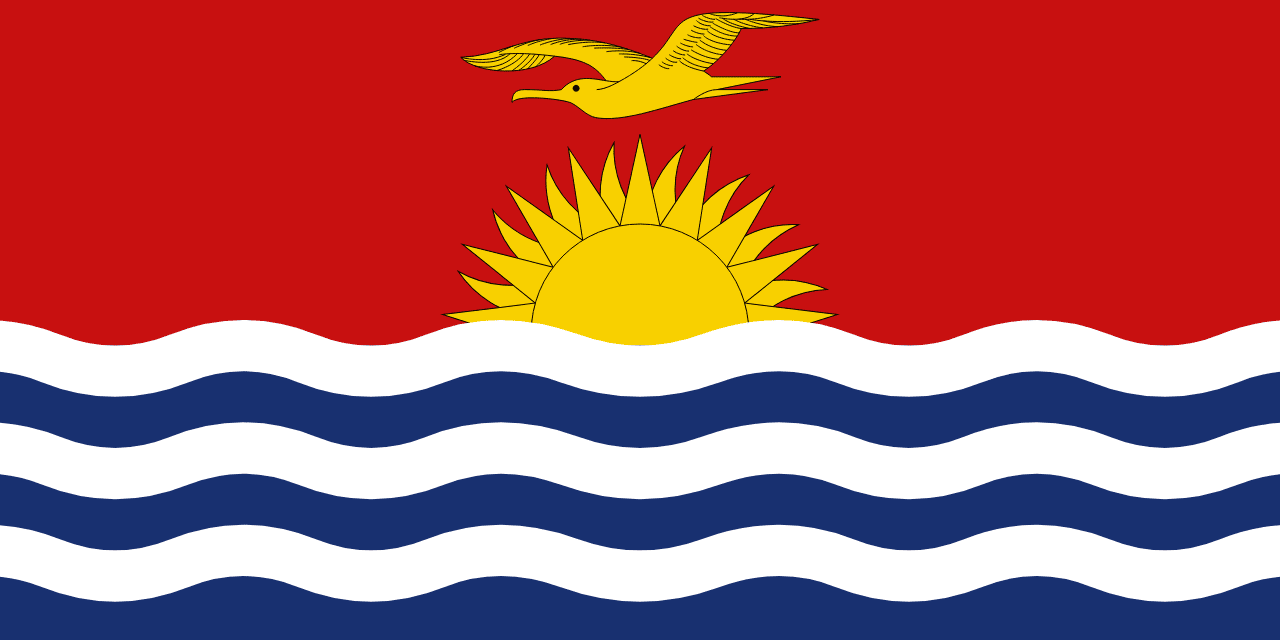
Scattered across an expanse of the Pacific larger than the continental United States, Kiribati is a nation that exists almost entirely as water with a few thin ribbons of coral in between. It is the only country on Earth to straddle all four hemispheres at once, and the first place to greet each new day. Here are ten facts that reveal why this tiny equatorial republic is one of the most extraordinary places on the planet.
1. It Straddles Every Hemisphere on Earth
Kiribati holds a geographic distinction no other country can claim: it sits in all four hemispheres simultaneously. Its 33 islands sprawl across both the equator (north and south) and the 180th meridian (east and west), spanning roughly 3.5 million square kilometers of ocean. Yet the total land area is only about 811 square kilometers, smaller than New York City. This staggering ratio of sea to land defines everything about the nation. The islands fall into three groups: the Gilbert Islands, the Phoenix Islands, and the Line Islands, separated by thousands of kilometers of open water. You can learn more in our country guide.
2. It Is the First Country to See Each New Day
Because Kiribati reaches farther east than almost anywhere else inhabited, its easternmost point, Caroline Island, is the first place on Earth to welcome the sunrise each morning. This was made dramatic in 1995, when the government shifted the international date line eastward to bring the entire country onto the same calendar day. Before that, parts of Kiribati were a full day apart from each other, an absurd situation for governing a single nation. To mark the millennium, the country renamed Caroline Island as Millennium Island, and it became one of the first inhabited spots to experience the year 2000.
3. The Name Is Pronounced "Kiribas"
Visitors are often surprised that Kiribati is pronounced "KIRR-ih-bass," not "kirry-bah-tee." The name is the local rendering of "Gilberts," after the Gilbert Islands, named for British captain Thomas Gilbert. In the Gilbertese language, the combination "ti" is pronounced like an "s." So the islands of "Kiribati" are simply "Gilberts" spoken with a Gilbertese accent. This quirk reflects how Pacific languages absorbed and reshaped European names during the colonial era while keeping their own distinct sound systems.
4. Tarawa Is One of the Most Crowded Capitals in the Pacific
The capital, South Tarawa, is a thin chain of islets linked by causeways, and it is home to roughly half of the country's entire population. Despite being little more than a sliver of coral, parts of South Tarawa have population densities rivaling those of major Asian cities, creating real pressure on freshwater, sanitation, and housing. Bairiki and Betio are its main hubs, with the government offices, the main port, and the international airport at Bonriki. The contrast between crowded South Tarawa and the sleepy, remote outer islands is one of the defining features of life in Kiribati.
5. It Was the Site of One of WWII's Bloodiest Battles
In November 1943, the islet of Betio on Tarawa Atoll became the scene of the Battle of Tarawa, one of the fiercest engagements of the Pacific War. U.S. Marines stormed heavily fortified Japanese positions across exposed reef flats, and in roughly 76 hours of combat, thousands of soldiers on both sides were killed on a piece of land barely two miles long. The battle shocked the American public with its casualties and reshaped amphibious assault tactics for the rest of the war. Today, rusting guns, bunkers, and a few wartime relics still dot Betio, quiet monuments to a brutal chapter of history.
6. The People Are the I-Kiribati, Master Navigators of the Pacific
Citizens of Kiribati are known as I-Kiribati, a Micronesian people with a seafaring heritage stretching back roughly 3,000 years. Their ancestors crossed vast tracts of open ocean in outrigger canoes, navigating by stars, swells, bird flight, and cloud formations long before modern instruments existed. This deep maritime knowledge remains a point of pride. Communal life centers on the maneaba, a large open meeting house where decisions are made, disputes are settled, and ceremonies unfold according to long-established protocols that give every family a recognized place and voice.
7. The Gilbertese Language Thrives Alongside English
Kiribati has two official languages: English and Gilbertese, also called te taetae ni Kiribati. While English is used in government and formal education, Gilbertese is the everyday language of homes, markets, and the maneaba, spoken by virtually the entire population. It is a Micronesian language with a relatively small set of sounds and a rich tradition of oral poetry, chant, and storytelling. The survival and strength of Gilbertese, even as English spreads, reflects how tightly language is woven into I-Kiribati identity and community life.
8. Climate Change Threatens Its Very Existence
Most of Kiribati's land sits only a couple of meters above sea level, making it one of the nations most vulnerable to rising oceans. Saltwater intrusion already contaminates freshwater supplies, and king tides regularly flood villages. In a remarkable act of foresight, the government purchased around 20 square kilometers of land in Fiji as a potential refuge and food-security measure. Leaders have framed the country's plight as a warning to the world, and "migration with dignity" has become a national policy aimed at preparing citizens for an uncertain future. Few places make the stakes of climate change so starkly visible.
9. The Phoenix Islands Hold a Vast Marine Sanctuary
Kiribati is home to the Phoenix Islands Protected Area (PIPA), one of the largest and deepest marine protected areas on Earth and a UNESCO World Heritage Site. Covering more than 400,000 square kilometers of ocean, it shelters pristine coral reefs, seamounts, deep-sea habitats, and an abundance of sharks, tuna, sea turtles, and seabirds. The reserve is a living laboratory for studying healthy reef systems largely untouched by human activity. For a nation whose wealth lies overwhelmingly in the sea, protecting such a sanctuary is both an environmental and an economic statement.
10. The Economy Runs on Fish, Coconuts, and a Sovereign Trust Fund
With so little arable land, Kiribati's economy leans heavily on the ocean. Licensing fees from foreign fleets fishing its enormous exclusive economic zone, especially for tuna, provide a major share of government revenue. Copra, the dried coconut flesh used for oil, is the leading agricultural export. Cleverly, Kiribati also maintains the Revenue Equalisation Reserve Fund, a sovereign wealth fund established in 1956 from earlier phosphate mining on Banaba Island, which still helps cushion the national budget today. You can also explore the symbolism of the nation's flag, featuring a golden frigatebird soaring over a rising sun and ocean waves.
Frequently Asked Questions
What is the capital of Kiribati?
The capital is South Tarawa, located on Tarawa Atoll in the Gilbert Islands. It is a chain of islets connected by causeways and home to roughly half of the country's population, hosting the government, main port, and international airport.
What is Kiribati famous for?
Kiribati is famous for being the first country to see each new day, for straddling all four hemispheres, for the WWII Battle of Tarawa, and for its vulnerability to rising seas. It is also known for the vast Phoenix Islands Protected Area and its rich I-Kiribati seafaring culture.
Why is Kiribati pronounced "Kiribas"?
The name comes from "Gilberts," the islands' colonial name. In the Gilbertese language, the letter combination "ti" is pronounced like an "s," so "Kiribati" sounds like "KIRR-ih-bass" rather than how the spelling might suggest to English speakers.
Conclusion
Kiribati may be one of the world's smallest and most remote nations, but it carries outsized significance, from its hemisphere-spanning geography and front-row seat to every sunrise to its proud navigational heritage and urgent climate frontline. These ten facts only begin to capture a country where land is scarce, ocean is everything, and resilience is a way of life. Keep exploring, and you will find that few places reward your curiosity quite like this scattered Pacific republic.
