
Libya is a country of staggering contrasts: a thin, sun-drenched Mediterranean coastline gives way almost immediately to one of the harshest deserts on Earth, where ancient Roman cities sit half-buried in sand and rock art records a vanished green Sahara. Stretching across more than 1.7 million square kilometres, it is the fourth-largest nation in Africa, yet most of its roughly 7.5 million people cling to a narrow strip near the sea. Here are ten facts that reveal just how surprising, layered, and beautiful this North African giant really is.
1. It Is Almost Entirely Desert
More than 90 percent of Libya is covered by the Sahara, making it one of the most arid countries on the planet. The landscape ranges from the vast Sand Sea of the Rebiana to the volcanic peaks of the Tibesti range along the southern border, where Bikku Bitti rises to roughly 2,267 metres as Libya's highest point. Rainfall is so scarce across much of the interior that some areas can go years without measurable precipitation. To survive, Libya depends heavily on fossil groundwater pumped from deep beneath the desert. Despite this aridity, the terrain is far from monotonous: dramatic escarpments, salt flats, oases fringed with date palms, and wind-sculpted dunes give the country a stark, cinematic grandeur.
2. The Sahara Was Once Green
Tucked into the remote southwestern corner of Libya is Tadrart Acacus, a UNESCO World Heritage Site famous for thousands of rock paintings and carvings dating back as far as 12,000 years. These images show elephants, giraffes, crocodiles, herds of cattle, and people swimming, hunting, and herding, vivid proof that the now-bone-dry Sahara was once a lush, well-watered savanna teeming with life. The art spans many distinct periods, charting a slow climatic shift from green grassland to the desert we know today. For archaeologists and geographers alike, the Acacus is one of the most important open-air galleries of prehistory anywhere in the world, a window into how dramatically Earth's climate can transform a single landscape.
3. Tripoli Wears Many Empires at Once
The capital, Tripoli, is a port city whose very name comes from the Greek Tripolis, meaning "three cities." Founded by the Phoenicians around the 7th century BCE, it later passed through Roman, Byzantine, Arab, Spanish, Ottoman, and Italian hands. That layered history is written into its streets: the walled old town, or medina, hides Ottoman-era mosques, Roman ruins like the Arch of Marcus Aurelius, whitewashed courtyards, and bustling souks. As Libya's largest city and economic hub, Tripoli blends ancient stonework with modern seafront boulevards. Sitting on the Mediterranean, it has always faced outward, a trading crossroads linking sub-Saharan Africa to southern Europe. You can learn more in our country guide.
4. It Holds Africa's Largest Oil Reserves
Beneath Libya's sands lies extraordinary wealth: the country has the largest proven crude oil reserves in Africa and ranks among the top ten globally. Oil was first discovered in commercial quantities in the late 1950s, and petroleum quickly came to dominate the economy, accounting for the overwhelming majority of government revenue and export earnings. Libyan crude is prized for being "light" and "sweet," meaning low in sulphur and relatively easy to refine, which makes it especially valuable to European buyers just across the Mediterranean. This resource has shaped modern Libyan history profoundly, funding ambitious infrastructure projects while also making the nation's fortunes vulnerable to the swings of global oil prices and political turmoil.
5. A Man-Made River Runs Beneath the Sand
One of Libya's most astonishing engineering feats is the Great Man-Made River, often called the world's largest irrigation project. Rather than a river in the natural sense, it is a colossal network of pipelines and tunnels, thousands of kilometres long, that transports ancient freshwater from massive aquifers deep under the Sahara to the coastal cities where most Libyans live. The water itself is "fossil water," rainfall that seeped underground tens of thousands of years ago when the region was wet. The scale is hard to overstate: the project moves enormous volumes of water daily and represents one of the most ambitious responses any nation has mounted to chronic water scarcity in a desert environment.
6. Leptis Magna Is a Roman City Frozen in Time
On the coast east of Tripoli stand the ruins of Leptis Magna, widely regarded as one of the best-preserved Roman cities in the entire Mediterranean world. Birthplace of the emperor Septimius Severus, who lavished imperial wealth upon his hometown, the city boasts a magnificent triumphal arch, a vast basilica, sprawling baths, a theatre, and a forum, much of it buried and protected by sand for centuries until excavation revealed its splendour. Together with nearby Sabratha and Cyrene, Leptis Magna shows that Libya was once a thriving heartland of classical civilisation, not a periphery. These sites are UNESCO World Heritage treasures, though they remain little visited today.
7. Arabic Reigns, but Berber Endures
Arabic is the official language and the mother tongue of most Libyans, with the local Libyan dialect peppered with Italian and Turkish loanwords inherited from centuries of foreign rule. Yet Libya is not linguistically uniform. In pockets of the west and the deep south, communities of Amazigh (Berber) people speak Tamazight languages that predate the Arab conquest by millennia, and the nomadic Tuareg and the Toubou of the southern desert maintain their own distinct tongues and identities. Italian and English are also understood in business and education. This linguistic patchwork mirrors the way Libya has long sat at the meeting point of Mediterranean, Arab, and African worlds, blending influences while preserving deep-rooted local heritage.
8. The Cuisine Carries an Italian Accent
Libyan food is a flavourful fusion of Arab, Berber, and Mediterranean traditions, with a distinctive Italian streak left over from the colonial era. Pasta is genuinely popular here, and a spicy dish sometimes called makaruna imbakbka blends Italian noodles with North African spices and tomato. The unofficial national dish is bazin, a dense, dome-shaped unleavened bread made from barley flour, eaten with a rich tomato and lamb sauce. Other staples include sharba, a hearty spiced lamb soup especially loved during Ramadan, and asida, a sweet porridge often drizzled with date syrup. Strong, sweet tea and aromatic coffee accompany meals, and dates, harvested from desert oases, are everywhere.
9. The Coastline Is Surprisingly Beautiful
Libya has the longest Mediterranean coastline of any African country, stretching nearly 1,800 kilometres. Far from the desert cliché, this shore features turquoise bays, sandy beaches, and rocky coves that rival better-known Mediterranean destinations. Coastal wetlands and lagoons provide vital stopover habitat for migratory birds travelling between Europe and Africa, while the offshore waters support fish, sea turtles, and Mediterranean marine life. Inland, the desert hides its own wildlife, including Barbary sheep, fennec and desert foxes, gazelles, and resilient reptiles adapted to extreme heat. The contrast between glittering coast and endless dunes, sometimes only a short drive apart, is one of Libya's most striking natural signatures.
10. A Young Nation With Ancient Roots
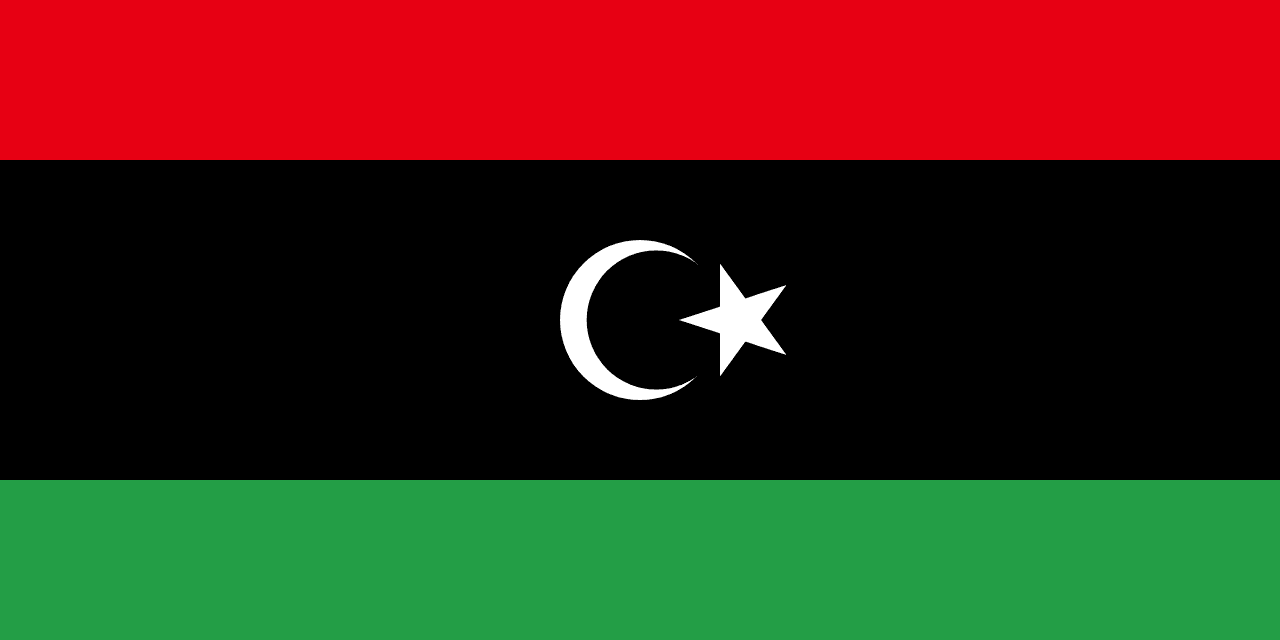
Although humans have lived here for tens of thousands of years, the modern state of Libya is remarkably young. The name "Libya" was used by the ancient Greeks for much of North Africa, but the unified country only emerged after the Italian colonial period ended, gaining independence in 1951 as the Kingdom of Libya. A 1969 coup brought Muammar Gaddafi to power, and he ruled for over four decades until 2011. Libya's striking solid green flag under Gaddafi was unique in the world as the only national flag with a single colour and no design; today the country has returned to its earlier red, black, and green tricolour. Explore the symbolism in our piece on the Libyan flag.
Frequently Asked Questions
What is the capital of Libya?
The capital of Libya is Tripoli, a Mediterranean port city and the country's largest urban centre. Founded by the Phoenicians and shaped by Roman, Ottoman, and Italian rule, it serves as Libya's political and economic heart, blending an ancient walled medina with a modern seafront.
What is Libya famous for?
Libya is best known for the Sahara Desert covering most of its territory, its enormous oil reserves, the world-class Roman ruins of Leptis Magna, and the prehistoric rock art of Tadrart Acacus. It also holds Africa's longest Mediterranean coastline and built the colossal Great Man-Made River.
Did Libya really once have a completely plain green flag?
Yes. From 1977 to 2011, under Gaddafi, Libya flew an entirely plain green flag with no emblem or markings, the only such single-colour national flag in the world. Green symbolised the country's political ideology of the time. After 2011, Libya readopted its original red, black, and green tricolour with a white star and crescent.
Conclusion
From a Sahara that once ran green with rivers and giraffes to Roman cities preserved beneath the sand, from a plain green flag to the longest coastline in Africa, Libya constantly defies easy assumptions. It is a land where deep history and dramatic geography meet, rewarding anyone curious enough to look past the headlines. These ten facts only begin to map a country whose oases, ruins, and shores still hold countless stories waiting to be explored.