
Squeezed into a sun-baked corner of the central Mediterranean, Malta is one of the smallest yet most densely storied nations on Earth. This archipelago of honey-coloured limestone has been fought over by Phoenicians, Romans, Arabs, crusading knights, Napoleon and the British Empire, leaving behind a layered identity unlike anywhere else in Europe. Here are ten genuinely fascinating facts that reveal why Malta punches so far above its tiny weight.
1. A Whole Country Smaller Than Many Cities
Malta covers just about 316 square kilometres, making it one of the smallest sovereign states in the world and the tiniest member of the European Union by area. The nation is actually an archipelago, with the three inhabited islands being Malta itself, the greener and quieter Gozo, and the tiny Comino, famous for its dazzling turquoise Blue Lagoon. Despite its minuscule footprint, the country lies at a strategic crossroads roughly 80 kilometres south of Sicily and around 290 kilometres north of the African coast. That central position has shaped its destiny for thousands of years. To dig deeper into its landscapes and regions, see our Malta country guide.
2. Home to the World's Oldest Free-Standing Temples
Long before Stonehenge or the Egyptian pyramids rose, Neolithic Maltese were stacking colossal stone slabs into temples. The megalithic temples of Ġgantija on Gozo date to around 3600 BC, making them among the oldest free-standing structures known anywhere on the planet. Malta has several such UNESCO-listed temple complexes, including Ħaġar Qim and Mnajdra. Equally astonishing is the Ħal Saflieni Hypogeum, a subterranean burial complex carved out of solid rock across three levels, where the bones of an estimated 7,000 people were once interred. These sites suggest a sophisticated prehistoric society thriving here more than five millennia ago.
3. Valletta: A Capital Built by Knights
The capital, Valletta, was founded in 1566 by the Knights of St John after their dramatic victory in the Great Siege of 1565, when a small garrison repelled a massive Ottoman invasion. Named after Grand Master Jean Parisot de Valette, the city is a planned Baroque masterpiece laid out on a grid, fortified with enormous bastions, and crammed with palaces, churches and auberges. The entire city is a UNESCO World Heritage Site. At only about 0.8 square kilometres, Valletta is also one of the smallest capital cities in Europe, yet it served as the 2018 European Capital of Culture and remains the country's political and ceremonial heart.
4. Two Official Languages, One Unique Tongue
Malta has two official languages: Maltese and English. Maltese is the only Semitic language written in the Latin alphabet and the only one that is an official EU language. It descends from the Arabic spoken in the medieval period, then absorbed huge amounts of Italian, Sicilian, French and English vocabulary, producing a hybrid that sounds unlike anything else in Europe. Most Maltese are comfortably bilingual or trilingual, with Italian also widely understood thanks to decades of Italian television. This linguistic blend mirrors the country's crossroads history and is a point of deep national pride.
5. One of the Most Densely Populated Nations on Earth
With a population of roughly 549,000 packed into those 316 square kilometres, Malta has one of the highest population densities of any country in the world. The vast majority of residents live on the main island, clustered around the harbour conurbation that includes Valletta, Sliema, Birkirkara and the so-called Three Cities. Towns blur into one another so seamlessly that it can be hard to tell where one ends and the next begins. In recent years the population has grown rapidly, driven largely by foreign workers drawn to the country's booming services economy.
6. A Devoutly Catholic Country with 359 Churches
Roman Catholicism is woven into daily Maltese life, and the islands are dotted with an extraordinary number of churches, chapels and shrines, said to number around 359. According to tradition, the Apostle Paul was shipwrecked on Malta around AD 60, an event recorded in the Book of Acts that locals credit with bringing Christianity to the islands. Every town and village celebrates its patron saint with a festa, featuring brass bands, elaborate street decorations, marching processions and spectacular fireworks. The rivalry between villages to stage the grandest display has made Malta one of the world's great producers of pyrotechnics.
7. A Cuisine Forged at a Culinary Crossroads
Maltese food reflects centuries of Mediterranean and North African influence. The national dish is fenek, or rabbit, traditionally slow-cooked in wine and garlic and enjoyed at communal feasts. Street food revolves around the pastizz, a flaky savoury pastry filled with ricotta or mushy peas, sold cheaply at corner shops. Other staples include ftira (a ring-shaped sourdough sandwich now protected by UNESCO heritage status), hearty aljotta fish soup, and kapunata, the local take on ratatouille. Wash it down with Kinnie, a uniquely Maltese soft drink made from bitter oranges and aromatic herbs that locals adore.
8. A Hollywood Backlot in the Mediterranean
Malta's golden fortifications, ancient streets and crystalline waters have made it a magnet for filmmakers. The islands have doubled as ancient Rome, medieval Europe and fantasy kingdoms in productions including Gladiator, Troy, Munich and the opening season of Game of Thrones, where Mdina and the surrounding landscapes stood in for King's Landing. The 1980 musical Popeye was filmed in a purpose-built village at Anchor Bay, which still survives today as the popular Popeye Village tourist attraction. This thriving film industry brings significant revenue and global attention to the small nation.
9. The Silent City of Mdina
Before Valletta existed, the fortified hilltop town of Mdina served as Malta's capital for much of its history. Founded by the Phoenicians and later expanded by the Arabs and the nobility, this walled medieval city sits inland on a commanding ridge. Today only a few hundred people live within its walls, and cars are largely banned, earning it the evocative nickname "the Silent City." Wandering its narrow, winding lanes past Baroque palazzos and the imposing St Paul's Cathedral feels like stepping back centuries. Its timeless atmosphere is exactly why filmmakers and visitors find it so captivating.
10. A Flag Decorated with a British Bravery Award
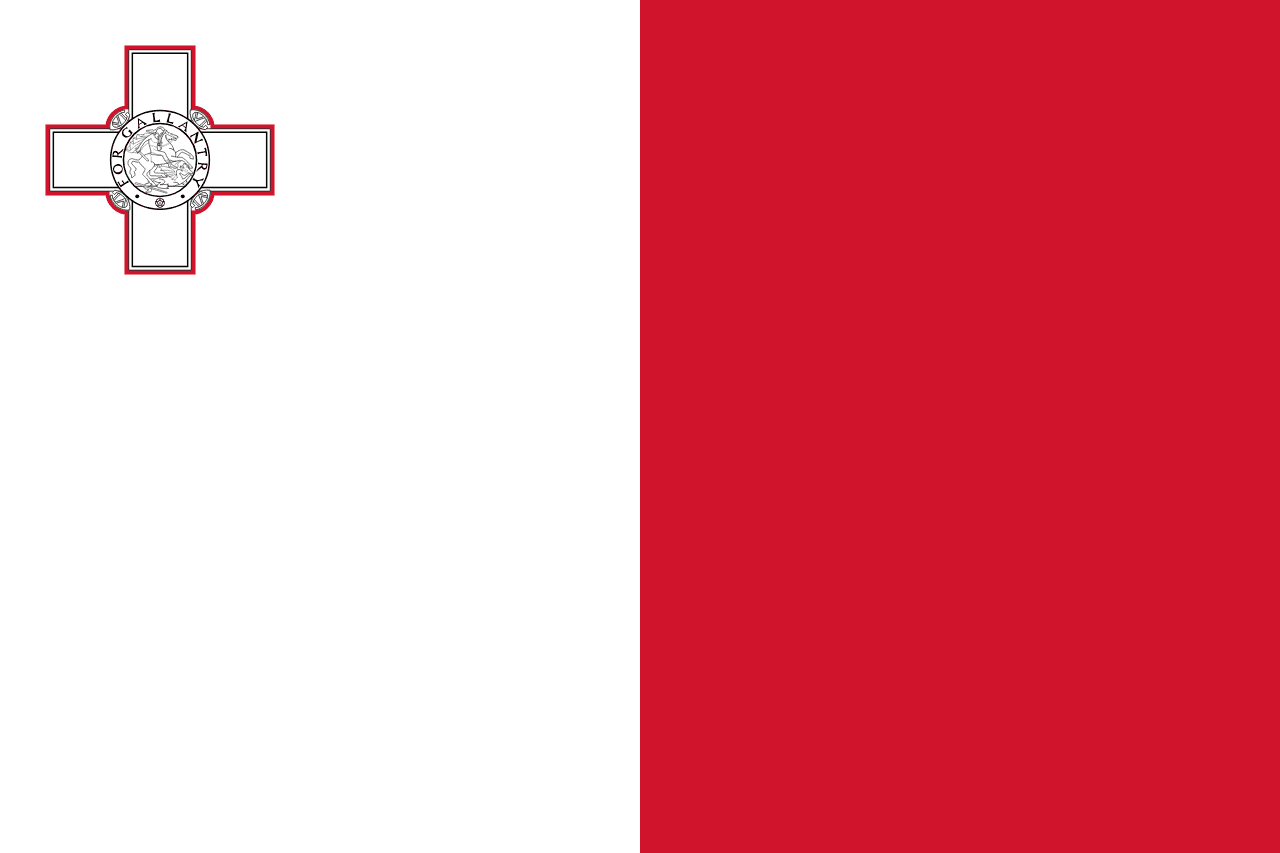
Malta's flag tells a remarkable wartime story. In the upper hoist corner sits a representation of the George Cross, Britain's highest civilian award for gallantry. King George VI awarded it to the entire population of Malta in 1942 to honour their extraordinary courage during relentless Axis bombing in World War II, when the island endured one of the most intense aerial sieges in history. Malta later joined the small club of nations to collectively hold such an honour. You can read more about its design and symbolism in our piece on the Malta flag.
Frequently Asked Questions
What is the capital of Malta?
The capital of Malta is Valletta, a fortified Baroque city founded by the Knights of St John in 1566. Though it is one of the smallest national capitals in Europe at under one square kilometre, the entire city is a UNESCO World Heritage Site packed with palaces, churches and dramatic harbour views.
What is Malta famous for?
Malta is famous for its ancient megalithic temples that predate the pyramids, its crystal-clear Mediterranean waters and the Blue Lagoon, its honey-coloured limestone architecture, and its role as a strategic island fortress through history. It is also renowned as a film location and a popular sun-and-diving holiday destination.
Why does Malta have a cross on its flag?
The flag features the George Cross because King George VI awarded the medal to the whole Maltese population in 1942, recognising their bravery while enduring devastating bombardment during World War II. It is one of the rare instances of an entire nation receiving a gallantry decoration.
Conclusion
For a country you could drive across in under an hour, Malta is staggeringly rich, layering 7,000 years of prehistory, faith, warfare and culture onto a few sun-drenched islands. From the world's oldest temples to a flag bearing a medal for collective courage, every corner tells a story. These ten facts barely scratch the surface, so let your curiosity carry you further into this remarkable Mediterranean gem.