
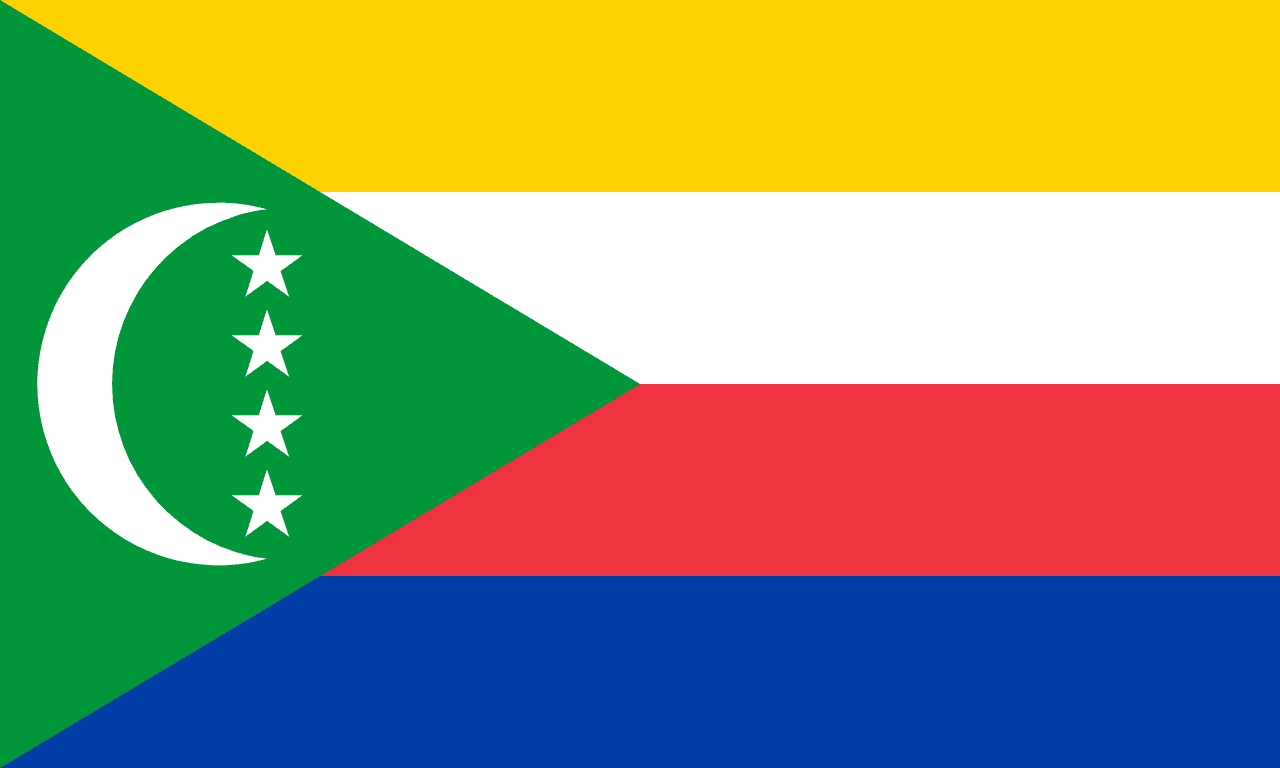
Scattered across the warm channel between Madagascar and the East African coast, the Comoros is a nation of volcanic islands, vanilla orchards, and a coastline perfumed by ylang-ylang blossoms. It is one of the smallest and least-visited countries in Africa, yet it holds one of the most astonishing scientific stories on the planet. From "living fossils" hiding in its deep waters to a perfume trade that scents the world's most famous fragrances, these ten facts reveal why this archipelago punches far above its weight.
1. It Is an Archipelago of Volcanic Islands
The Comoros sits in the northern Mozambique Channel, between Mozambique and Madagascar, made up of three main islands: Grande Comore (Ngazidja), Anjouan (Nzwani), and Mohéli (Mwali). The whole nation is volcanic in origin, born from eruptions that pushed these peaks out of the Indian Ocean. The total land area is only around 2,235 square kilometres, roughly the size of a small metropolitan region, making it one of Africa's tiniest countries by area. Despite this modest footprint, the terrain is dramatically varied, with rugged mountains, lush rainforest, black-sand beaches, and fertile valleys. You can learn more in our country guide.
2. Home to One of the World's Most Active Volcanoes
Towering over Grande Comore is Mount Karthala, an active shield volcano rising to about 2,361 metres, the highest point in the country. Karthala possesses one of the largest active volcanic craters on Earth and has erupted numerous times in recorded history, including significant eruptions in 2005 and 2006 that blanketed the capital in ash. Hiking to its summit is one of the great adventures of the Indian Ocean, offering hikers a glimpse into a vast, smoking caldera. The volcano's slopes are also crucial to local life, their fertile soils nurturing the spices and crops that sustain island agriculture.
3. Moroni — A Capital of Whitewashed Mosques
Moroni, the capital, sits on the western coast of Grande Comore in the shadow of Karthala. Its name is often translated as "in the heart of the fire," a nod to the looming volcano. The old town, known as the Medina, is a maze of narrow alleys, carved wooden doors, and coral-stone buildings reflecting centuries of Swahili and Arab influence. The waterfront is dominated by the elegant Old Friday Mosque (Ancienne Mosquée du Vendredi), built in 1427, whose white minaret and arcades are among the most photographed sights in the country. Despite being a national capital, Moroni retains the intimate, unhurried rhythm of a small port town.
4. A Crossroads of African, Arab, and French Cultures
With a population of roughly 900,000, the Comorian people are a rich blend of Bantu African, Arab, Malagasy, and Persian ancestry, the legacy of centuries as a trading hub on the maritime spice and slave routes. This melting-pot heritage shapes everything from architecture to social customs. The grand marriage, or anda, is a famously elaborate and expensive wedding ceremony that can take years to save for and confers lifelong social status on the groom. Society is heavily Islamic, with Sunni Islam practised by the vast majority and woven deeply into daily life, festivals, and community structure.
5. Three Official Languages Reflect Its Layered History
The Comoros recognises three official languages: Comorian (Shikomori), Arabic, and French. Shikomori is a Bantu language closely related to Swahili and is the everyday mother tongue of most islanders, with distinct dialects on each island. Arabic carries deep religious significance and is taught in Quranic schools, while French remains the language of administration, higher education, and much official business, a holdover from the colonial era. This trilingual reality means a single conversation, prayer, and government document might each unfold in a different tongue, capturing the nation's African, Islamic, and European threads all at once.
6. The Coelacanth — A "Living Fossil" Lives Here
Perhaps the most extraordinary fact about the Comoros is biological. The coelacanth, a deep-water fish once thought to have vanished alongside the dinosaurs around 65 million years ago, was famously rediscovered alive in the western Indian Ocean in 1938. Comorian waters became one of the few places on Earth where this prehistoric creature is regularly found, lurking in the volcanic underwater caves off the islands. Local fishermen had occasionally caught the strange, lobe-finned fish for generations without realising its significance to science. The coelacanth has since become a national emblem, a stunning reminder that some of evolution's oldest secrets still swim in these depths.
7. The Perfume Capital of the World
The Comoros is one of the planet's leading producers of ylang-ylang, a fragrant yellow flower distilled into an essential oil prized by the global perfume industry. The island of Mohéli and parts of Anjouan are carpeted with ylang-ylang plantations, and the heady scent drifts across entire villages during harvest. Comorian ylang-ylang oil has long been a key ingredient in legendary fragrances, including classic French perfumes. Alongside it, the country is a major exporter of vanilla and cloves. Together these three "green gold" crops dominate the economy, meaning this small archipelago helps scent and flavour products sold in luxury boutiques worldwide.
8. Independence in 1975 — and an Island That Said No
The Comoros gained independence from France in 1975. However, the fourth island of the archipelago, Mayotte, voted to remain a French territory and is today an overseas department of France, a dispute the Comorian government has never accepted, still claiming the island as its own. The young nation's early decades were turbulent, marked by a remarkable number of coups and coup attempts, several involving foreign mercenaries, which earned it a reputation for political instability. In recent decades the country has worked toward greater stability through a rotating presidency designed to share power among its islands. The story is captured on the nation's flag.
9. A Cuisine Built on Spice, Sea, and Coconut
Comorian food reflects the islands' tropical bounty and Swahili-Arab roots. A signature dish is langouste à la vanille, lobster cooked in a creamy vanilla sauce that showcases the local spice trade. Everyday meals lean on mataba, a stew of pounded cassava leaves cooked with coconut milk and meat or fish, served alongside rice. Spiced rice dishes like pilao, grilled fish, and breadfruit are staples, while cardamom-scented coffee and fresh tropical fruit round out the table. Meals are deeply communal, and hospitality is a cornerstone of island culture, with guests honoured by generous spreads of fragrant, slow-cooked food.
10. A Refuge for Rare and Giant Wildlife
For its size, the Comoros shelters remarkable biodiversity. The islands are home to the Livingstone's fruit bat, one of the largest bats in the world, with a wingspan that can approach 1.4 metres, found only here and gravely endangered. The surrounding reefs and waters host green sea turtles, with Mohéli Marine Park serving as an important nesting site, plus dolphins, humpback whales on migration, and dugongs. On land, endemic birds and the unique flora of the volcanic forests add to the islands' natural richness. This concentration of species found nowhere else makes the Comoros a quietly significant hotspot for conservation in the Indian Ocean.
Frequently Asked Questions
What is the capital of the Comoros?
The capital is Moroni, located on the west coast of Grande Comore, the largest island. Sitting beneath the Mount Karthala volcano, it is the nation's political, commercial, and cultural centre and is known for its historic medina and the 15th-century Old Friday Mosque on the harbour.
What is the Comoros famous for?
The Comoros is famous for being a leading producer of ylang-ylang perfume oil, vanilla, and cloves, earning it the nickname "the Perfume Islands." It is equally renowned among scientists as one of the few places where the coelacanth, a prehistoric "living fossil" fish, is found.
Is the coelacanth really found in the Comoros?
Yes. After being thought extinct for around 65 million years, the coelacanth was rediscovered alive in the western Indian Ocean, and Comorian waters became one of the most reliable places to find it. The deep volcanic caves around the islands provide the dark, cool habitat this ancient fish prefers.
Conclusion
The Comoros may be small and often overlooked, but it is a nation of outsized wonders: smoking volcanoes, perfume-scented hillsides, a trilingual culture spanning three continents, and a prehistoric fish that rewrote the textbooks. From the white minarets of Moroni to the endangered giant bats of its forests, this Indian Ocean archipelago rewards anyone curious enough to look closer. Few countries pack so much natural drama and cultural depth into so little space.
